
10x Banking's £40m Arrived After A Convertible Note Matured
10x Banking raised £40 million after a £25 million convertible note matured, leaving the old note, a 15% warrant and founder control terms unresolved.
On this page
Conduct your own private market research
Add dossaro to Claude or ChatGPT and run source-backed register research from your own workspace.
 Add to Claude
 Add to ChatGPT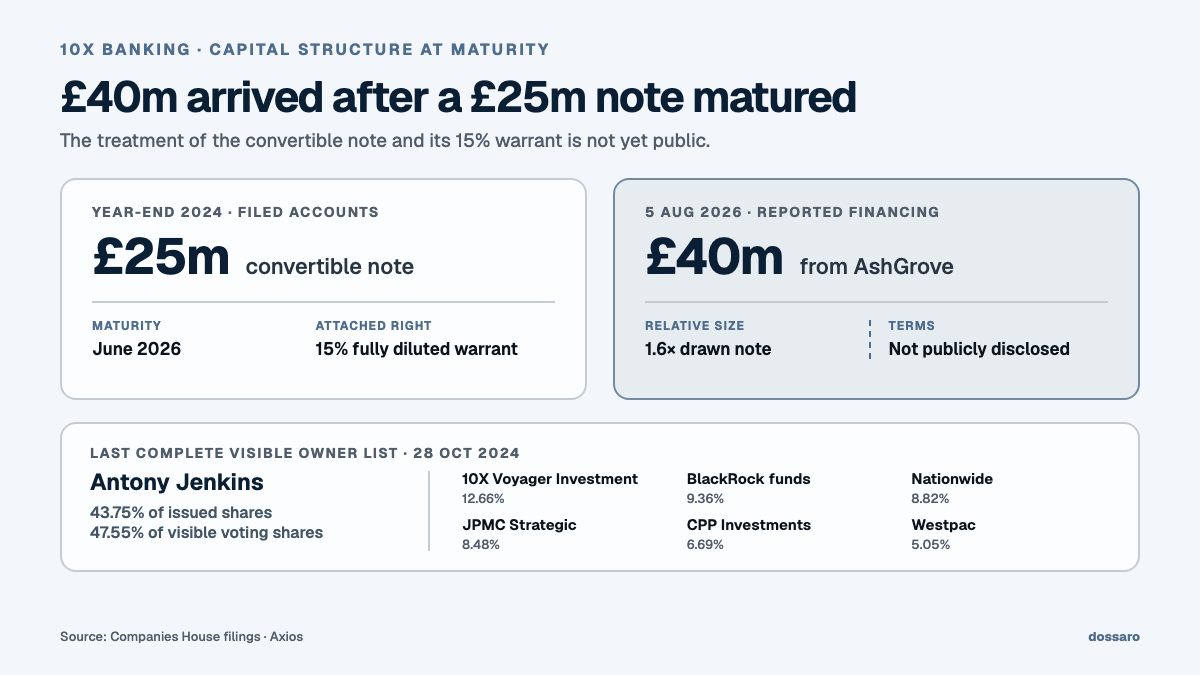
10x Banking's new £40 million arrived directly after a £25 million convertible loan note reached its June 2026 maturity with conversion rights and an accompanying warrant for 15% of fully diluted capital.
Axios reported on 5 August that private-credit manager AshGrove Capital supplied the financing. The amount is 1.6 times the note drawn at the end of 2024 and almost nine times 10x's latest reported cash balance.
That makes the transaction more than a generic growth round. It lands at the point where an existing funding instrument could affect debt repayment, dilution and control across a cap table led by founder Antony Jenkins and institutions including BlackRock funds, Nationwide, J.P. Morgan, CPP Investments and Westpac.
The public record does not yet show whether AshGrove repaid, refinanced, extended or replaced the old note. It also does not reveal what happened to the 15% warrant. The source-backed finding is narrower: the new capital is large enough to cover the drawn note, and it arrived immediately after the maturity and control questions became current.
For private-market readers, the next financing documents matter as much as the £40 million headline. They will determine whether AshGrove funded expansion, resolved the old maturity, changed the priority stack or did several of those jobs at once.
The New Money Met A £25m Maturity
10x's group accounts for the year ended 31 December 2024 recorded £25 million drawn under a fixed-rate unsecured convertible loan note. That included another £10 million drawn during the year.
The note was due to mature in June 2026. It carried conversion rights, while an accompanying warrant entitled its holder to acquire 15% of the company's fully diluted capital. Continued shareholder funding beyond the maturity had not been executed when the accounts were approved.
| Financing measure | Amount or date | Decision-relevant reading |
|---|---|---|
| Drawn convertible loan note | £25.00m | Existing funding due in June 2026 |
| AshGrove financing reported by Axios | £40.00m | 1.6 times the drawn note |
| Latest reported cash | £4.492m | New financing equals 8.9 times cash |
| Convertible maturity | June 2026 | Reached before the 5 August financing report |
| Accompanying warrant | 15% fully diluted | Potential dilution and control consequence |
The ratio does not prove that £25 million of AshGrove's money went to the old lender. It shows why the maturity cannot be separated from the economic reading of the new transaction. A £40 million facility could absorb the old balance and still leave £15 million before fees, interest or other uses. It could also be structured for a different purpose entirely.
The accounts had already identified this as a real funding dependency. Management said the group required continued shareholder support and noted that alternative refinancing offers existed. The auditor highlighted a material uncertainty that could cast significant doubt on going concern.
This is a historical warning, not a present-tense distress claim. The company subsequently reported a sharp operating improvement. The unresolved issue is how that improvement and the old instrument met at maturity.
The Convertible Economics Had Already Hit The Income Statement
The 2024 numbers show why the note was not just a distant legal footnote. 10x generated £25.593 million of revenue and an operating loss of £23.718 million, then reported a £52.311 million net loss.
Interest expense rose from £1.516 million to £32.279 million. The accounts attributed much of the increase to remeasurement of the conversion and warrant economics attached to the financing.
| Group financial measure | 2024 result | Translation |
|---|---|---|
| Revenue | £25.593m | Operating scale before the later 2025 improvement |
| Operating loss | £23.718m | Almost 93% of revenue |
| Net loss | £52.311m | More than twice annual revenue |
| Interest expense | £32.279m | Up £30.763m from 2023 |
| Cash | £4.492m | About one ninth of the new financing |
| Net liabilities | £49.303m | Negative group equity at year-end |
The £32.279 million expense was not simply cash interest paid to a lender during the year. Remeasuring embedded conversion and warrant rights can create a large accounting charge as the expected value of those rights changes. The distinction matters because it separates cash burn from the economic cost assigned to potential equity participation.
Even so, the year-end position left little room for ambiguity about the funding requirement. Cash was £4.492 million against a £25 million drawn note and £49.303 million of net liabilities. A refinancing or fresh-capital event before or around maturity was commercially important even if operating performance improved afterward.
The sequence resembles the financing dependency in Naked Energy's state-led round, where later capital changed the immediate runway question without erasing the contractual position that existed before it arrived. In 10x's case, the extra layer is control: the note carried conversion rights and the warrant referenced a substantial fully diluted stake.
The Warrant Put Founder Control In The Frame
10x's last fully enumerated shareholder statement, dated 28 October 2024, listed 19,426,468 issued shares. Antony Jenkins held 8,500,001 ordinary shares, equal to 43.75% of the issued total.
One class was explicitly non-voting: JPMC Strategic Investments held 1,551,084 Series D2 shares without votes on company resolutions. Removing those shares from the visible voting denominator puts Jenkins at approximately 47.55% of the shares carrying votes in that dated register state.
That is not a claim that Jenkins currently controls 47.55%, nor is it a fully diluted percentage. It is the last complete public voting snapshot. The 15% fully diluted warrant matters because a holder that close to half of visible voting shares can be highly sensitive to conversion, new issuance and the voting status of any resulting equity.
The filing does not disclose enough to model the outcome. The warrant exercise price, exact holder economics, adjustment mechanics and treatment at the June 2026 maturity remain outside the reviewed public record. No responsible current cap table can simply add or subtract 15 percentage points.
The Last Complete Owner List Names Every Holder
The same October 2024 statement provides a rare complete list rather than a partial significant-control disclosure. The table below aggregates eight separately named BlackRock fund vehicles for readability but preserves every other legal holder as filed.
| Holder or legal-fund group | Shares | Issued-share position | Visible class mix |
|---|---|---|---|
| Antony Jenkins | 8,500,001 | 43.75% | Ordinary |
| 10X Voyager Investment Company Limited | 2,460,294 | 12.66% | Series A and B1 |
| Eight BlackRock-branded legal fund holders | 1,818,205 | 9.36% | Series D1 |
| Nationwide Building Society | 1,713,477 | 8.82% | Series B1 and C1 |
| JPMC Strategic Investments 1 Corporation | 1,646,577 | 8.48% | Series D1 and non-voting D2 |
| CPP Investment Board PMI-2 Inc | 1,298,701 | 6.69% | Series C1 |
| Westpac Banking Corporation | 980,418 | 5.05% | Series B1 and C1 |
| 10X Voyager Partners Company Limited | 523,191 | 2.69% | Series C1 |
| Oliver Wyman Limited | 460,604 | 2.37% | Series A and B1 |
| Michael Lockett | 25,000 | 0.13% | Series A |
| Total | 19,426,468 | 100.00% | Last complete visible state |
The ownership map matters for two reasons. First, Jenkins was by far the largest holder, but the institutional bloc around him was broad and economically senior through multiple preferred classes. Second, the filed rights put Series D ahead of Series C, Series B, Series A and ordinary shares in the visible return-of-capital waterfall.
The list is a pre-financing state. It cannot identify AshGrove's current position or show whether the old note holder became a shareholder. It does, however, name the investors exposed to whatever happened at the 2026 maturity.
The underlying documents can be found through the UK Companies House research source. The useful distinction here is between a dated issued-share list, a voting denominator and a fully diluted outcome. They are three different ownership measures.
Stronger Operations Support A Benign Reading
10x's own June 2026 operating update says the business reached positive earnings before interest, tax, depreciation and amortisation in the fourth quarter of 2025. It also reported annual recurring revenue growth above 30% in the 12 months to May 2026 and more than ten million accounts running on its platform.
Those claims materially change the counterposition. AshGrove may be backing a software company whose unit economics and recurring revenue strengthened enough to support a conventional private-credit facility. The old note may already have been repaid or converted on acceptable terms.
AshGrove describes its general toolkit as including annual-recurring-revenue financing, growth debt and non-dilutive capital. That makes a growth-led interpretation plausible. It does not establish the terms of this transaction.
The strongest conclusion therefore holds both states at once. 10x entered 2026 with much better operating momentum, but the fresh financing still arrived at the end of a documented instrument that could reshape debt and control. Improvement in the business does not answer what happened to the capital structure.
The Next Documents Decide Whether This Was Refinancing
Four public records would resolve the central uncertainty.
| Next document | Question it should answer |
|---|---|
| Note repayment, conversion or amendment record | Whether the £25m balance was repaid, extended or converted |
| Warrant cancellation, exercise or repricing document | Whether the 15% fully diluted right still exists |
| AshGrove facility or registered charge | Instrument type, security, maturity and creditor position |
| Next full shareholder statement | Whether ownership or voting control changed after October 2024 |
Until those documents appear, calling the £40 million pure growth capital would be as premature as calling it a rescue. The financing is large, the company says operations improved, and the historical maturity was real.
The defensible investment reading is that AshGrove entered at a capital-structure hinge. Its £40 million arrived after a £25 million convertible note matured with a 15% fully diluted warrant attached. The next filings will show whether that hinge opened toward ordinary growth debt, a refinancing, an ownership change or some combination of all three.
Continue reading
Related Research
Naked Energy's £8.875m Round Followed A Funding Warning
Great British Energy invested £7.5 million after Naked Energy disclosed unfinished funding, while a 2x Series B preference protected incumbent capital.
Modo Energy Put Its Brands Behind $17m Of Venture Debt
Modo Energy called CIBC's $17m package growth funding. UK charges show fixed and floating security over its business and two core trademarks.
Humanoid's $152m Round Recapitalises A Business With £50.5m Of Founder Loans
Humanoid raised $152m after ending 2025 with £43.5m of net liabilities and £50.5m in founder loans, while its founder appeared to retain 53% of ordinary shares.
Mindgard’s $30m Round Followed A Founder Threshold Drop And A US Subsidiary Pledge
Mindgard raised a $30m Series A after its founder fell below the UK PSC threshold and First Citizens took security over its entire US subsidiary.