
Naked Energy's £8.875m Round Followed A Funding Warning
Great British Energy invested £7.5 million after Naked Energy disclosed unfinished funding, while a 2x Series B preference protected incumbent capital.
On this page
Conduct your own private market research
Add dossaro to Claude or ChatGPT and run source-backed register research from your own workspace.
 Add to Claude
 Add to ChatGPT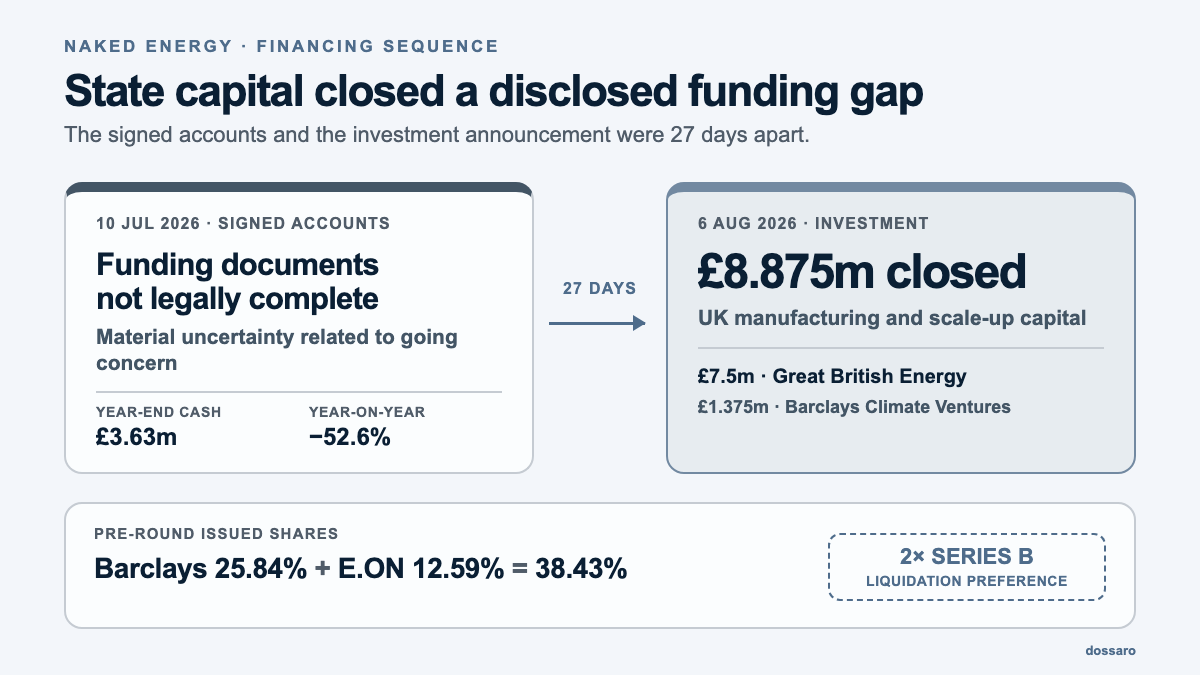
Great British Energy's £7.5 million investment in Naked Energy arrived 27 days after the solar-thermal company signed accounts saying its continued operation depended on additional funding that was not yet legally complete.
The 6 August round totals £8.875 million. Barclays Climate Ventures, already a shareholder, is supplying the remaining £1.375 million. The money is intended to establish a UK manufacturing facility for Naked Energy's Virtu technology and create up to 40 direct and about 100 indirect jobs.
That manufacturing plan is real. So is the financing dependency beneath it. Naked Energy's cash had fallen by more than half during its latest financial year, while net assets declined by £3.38 million. Its auditor highlighted a material uncertainty related to going concern because the company still needed fresh capital.
The new investment therefore does two jobs at once. It funds a factory-led expansion and removes a disclosed near-term financing cliff. In doing so, it preserves a pre-round cap table where Barclays and E.ON together held 38.43% of issued shares and where a 2024 Series B class carried a two-times liquidation preference.
For private-market readers, the unresolved question is not whether public capital can support industrial scale-up. It is what price, ownership and downside protection Great British Energy received for absorbing the next stage of manufacturing and runway risk. Those terms have not yet reached the public register.
The Accounts Made The Funding Dependency Explicit
Naked Energy's latest accounts cover the year ended 30 September 2025 and were signed on 10 July 2026. The company filed them three days later. They show a business still investing ahead of a durable financial base.
| Financial measure | 2024 | 2025 | Change |
|---|---|---|---|
| Cash | £7.66m | £3.63m | Down £4.03m, or 52.6% |
| Net assets | £9.86m | £6.48m | Down £3.38m, or 34.3% |
| Accumulated loss reserve | Prior-year base | Worsened by about £3.38m | Larger cumulative deficit |
The cash decline matters more than the static year-end balance. Naked Energy used £4.03 million of cash across the year, leaving less than half the prior amount. Net assets fell by roughly one third.
Management's going-concern assessment said continued operation depended on securing additional funding. The auditor drew attention to the same dependency and the resulting material uncertainty. At the date the accounts were approved, the necessary funding documentation was not legally complete.
This language does not mean Naked Energy was insolvent or about to stop trading. A going-concern material uncertainty is a warning about the assumptions required for continued operation, not a prediction of failure. Here, the decision-changing assumption was specific: additional capital had to close.
Twenty-seven days later, it did.
Great British Energy Supplies Most Of The New Money
Great British Energy's announcement puts the total investment at £8.875 million. Great British Energy contributes £7.5 million through its Energy Engineered in the UK programme, while Barclays Climate Ventures participates as an existing shareholder.
Naked Energy's own release confirms the same amount and purpose. The factory location remained undecided at announcement, but the stated goal is to reduce production costs, expand UK capacity and support exports.
| New-round participant | Announced amount | Share of total round | Position described publicly |
|---|---|---|---|
| Great British Energy | £7.500m | 84.51% | Lead investor through Energy Engineered in the UK |
| Barclays Climate Ventures | £1.375m | 15.49% | Existing shareholder participating again |
| Total | £8.875m | 100.00% | UK manufacturing and scale-up capital |
The split makes the risk transfer unusually clear. Publicly owned Great British Energy supplies more than five-sixths of the announced capital. Barclays extends its earlier exposure but is not carrying most of this round.
Great British Energy describes the transaction as its first major solar investment. Its governance framework gives it an industrial and clean-energy mandate, while its announcement says it is putting public money behind British businesses at critical points in their growth.
Naked Energy fits that policy description almost literally. The critical point was visible in the accounts before the investment was announced.
The Existing Capital Already Had Downside Protection
The new money does not enter an empty cap table. Naked Energy's 2024 financing created a large Series B preferred class with one vote per share and a two-times non-participating liquidation preference ahead of the company's other share classes on an exit or winding-up.
The principal allotment issued 355,776 Series B shares across three price blocks. The filings imply about £17.15 million of gross cash consideration.
| 2024 Series B price block | Shares | Price per share | Economic role |
|---|---|---|---|
| Block 1 | 179,094 | £54.72 | Series B preferred capital |
| Block 2 | 105,936 | £43.78 | Series B preferred capital |
| Block 3 | 70,746 | £38.30 | Series B preferred capital |
| Total | 355,776 | Mixed | About £17.15m documented cash |
At two times the documented consideration, the class-level preference amount is roughly £34.3 million. That is not a guaranteed return and it does not outrank creditors. It applies only in the events and under the mechanics set out in the filed rights, and only to the extent value is available. It nevertheless gives the preferred class a materially different downside position from ordinary shares.
The August 2025 confirmation statement then shows how concentrated the pre-round issued-share base had become.
| Pre-round holder | Shares | Share of 725,851 total |
|---|---|---|
| Sustainable Impact Capital Limited, Barclays' investment vehicle | 187,579 | 25.84% |
| E.ON Energy Infrastructure Solutions GmbH | 91,374 | 12.59% |
| Barclays and E.ON combined | 278,953 | 38.43% |
| Founder Christophe Williams | 49,302 | 6.79% |
These figures are an issued-share snapshot, not a fully diluted cap table and not the ownership position after the August 2026 investment. They establish that two strategic investors together held almost two-fifths of the company before Great British Energy entered.
The ownership table and the preference filing answer different questions. One identifies the largest visible pre-round holders; the other identifies the class-level ordering of proceeds. They should not be collapsed into a claim that every share held by a named investor carries identical rights. Together, however, they show why new capital preserves more than a technology platform. It preserves substantial incumbent positions inside a company with an established preference layer.
Public Capital Is Taking The Next Manufacturing Risk
Naked Energy says its Virtu collectors generate renewable heat and, in the hybrid version, electricity from the same rooftop footprint. Great British Energy points to installations at the British Library and the All England Lawn Tennis Club as evidence that the technology is already operating at prominent sites.
The investment case is that domestic manufacturing can lower costs, expand supply and turn those installations into a repeatable industrial product. If that works, Great British Energy can participate in the upside while advancing a public policy goal. The planned jobs and export capacity are economic outputs, not decorative language around the cheque.
But factory scale-up changes the risk profile. Building a manufacturing base requires capital before it produces stable volume, margin and cash generation. Naked Energy's accounts show that its existing resources were already declining while the next financing remained unfinished.
That is why the round resembles Moa Technology's preference-backed financing dependency, even though the businesses and investors differ. In both cases, the funding announcement became more informative when read alongside accounts that said the plan depended on completing the round.
The Companies House evidence also illustrates the value of treating a UK filing history as a sequence rather than a profile. A practical Companies House research workflow links the accounts, allotments, shareholder state and class rights without treating any one document as a complete cap table.
The Public Investor's Terms Remain The Missing Fact
The official announcements do not identify Great British Energy's share class, subscription price, percentage ownership, board rights or liquidation priority. They also do not say whether Barclays invested its £1.375 million on identical terms.
That absence prevents several tempting conclusions. The investment should not be called a grant, because both parties describe it as an investment. It should not be called a bailout, because the capital also funds a defined manufacturing expansion and the company had operating projects. And it cannot yet be said that Great British Energy accepted worse terms than the 2024 Series B investors.
The fair countercase is strong. Great British Energy was created to provide patient capital where industrial projects require more time and risk tolerance than conventional investors may offer. A publicly owned investor can rationally accept technology and manufacturing risk in exchange for both financial upside and domestic capacity.
The public-interest test is therefore contractual as well as strategic. If Great British Energy receives a meaningful equity position and appropriate downside rights, taxpayers participate directly in the value they help preserve. If its instrument is junior or unusually weak, the round would transfer more benefit to existing shareholders and preference holders. The current evidence does not decide between those outcomes.
The Next Allotment Will Put A Price On The Intervention
Three filings will determine the final economic reading.
| Next document | What it should reveal |
|---|---|
| Return of allotment | New shares, class, price and paid consideration |
| Updated articles or shareholder resolutions | Preference, governance and consent rights |
| Confirmation statement | Great British Energy's stake and the post-round ownership map |
Those documents will also show whether Barclays extended its position on the same terms and how much dilution the earlier holders accepted.
For now, the sequence is clear enough to change the headline. Naked Energy did not simply raise £8.875 million to build a factory. It closed a financing gap that its signed accounts had identified 27 days earlier. Great British Energy supplied 84.5% of the new money, preserving a company where Barclays and E.ON already held 38.43% of issued shares and where a 2x preference shaped downside allocation.
The round solves the immediate funding dependency. The next filings will show what the public received for solving it.
Continue reading
Related Research
Moa Technology's £22.2m Round Put £44.4m First In Line
Moa Technology's £22.2m Series C created 46.4% of its issued shares and a roughly £44.4m first claim after accounts warned the round was essential.
PaperShell's €40m EU Grant Leaves A €43m Financing Test
PaperShell's signed 2025 annual report links an €83m factory and €40m EU grant to a planned IPO, while private capital must still fund roughly half.
QUICKBLOCK's £940k Funding Was Also A Recapitalisation
QUICKBLOCK raised £940,000 after reporting £534,213 of net liabilities. Filings map £638,571 to equity, leaving about £301,429 as implied grants.
Seqens's Lender-to-Owner Reset Exposes a €930m Acquisition Debt Stack
Seqens says senior lenders will become shareholders, while filings show Sirona BidCo carried €930m of term debt, €29k cash and a €62m dividend.