
Cytix's $7m Series A Reset Its Registered Control
Cytix's $7m Series A ended both founders' significant-control status, added Northern Gritstone to the board and followed a £1m convertible bridge.
On this page
Conduct your own private market research
Add dossaro to Claude or ChatGPT and run source-backed register research from your own workspace.
 Add to Claude
 Add to ChatGPT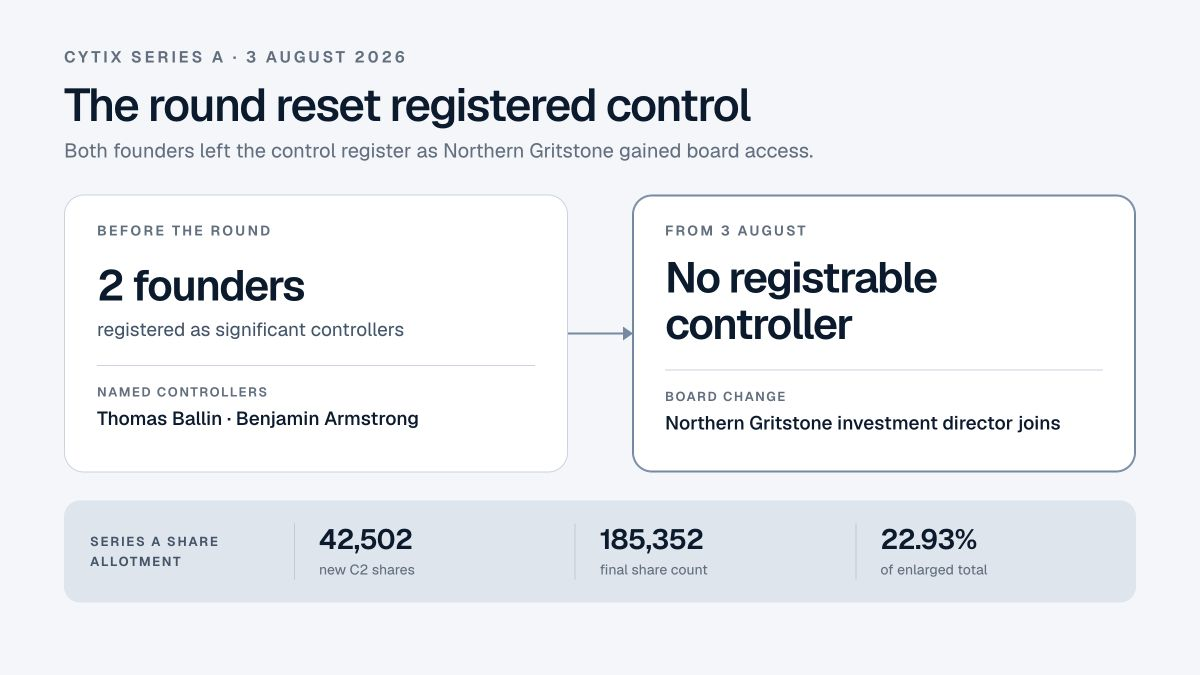
Cytix's $7 million Series A reset who appeared to control the cybersecurity company. On 3 August 2026, both founders ceased to be registered as persons with significant control, Cytix reported that it had no registrable controller, and Northern Gritstone investment director Gareth Llewellyn joined the board.
The same date anchors the round's first visible share allotment. Cytix issued 42,502 new C2 shares across 3 and 4 August, a block equal to 22.93% of the enlarged share count. The forms report £5.02 million of paid consideration.
Tech.eu reported on 12 August that Northern Gritstone led the financing, with existing investors Auriga Cyber Ventures and NPIF II – PXN Equity Finance participating. The investment is intended to expand Cytix's software-change risk platform among enterprise and regulated customers.
The register adds a second transaction story. New capital diluted the existing base enough to end both founders' significant-control status, while the lead investor gained formal board access. That is a registered-control shift, not proof that the founders lost operational control.
One Date Joined The Shares, Control And Board Changes
The Companies House filing history puts the round's legal events into a tight sequence.
| Effective date | Filed event | Commercial meaning |
|---|---|---|
| 3 Aug 2026 | 38,534 C2 shares allotted | First and largest visible Series A block |
| 3 Aug 2026 | Thomas Ballin and Benjamin Armstrong ceased as persons with significant control | Neither founder remained individually registrable as a controller |
| 3 Aug 2026 | Cytix reported no registrable person or relevant legal entity | Registered control moved from two founders to no single disclosed controller |
| 3 Aug 2026 | Gareth Llewellyn and Jeremy Gidlow appointed as directors | Lead investor and existing-investor interests gained board access |
| 4 Aug 2026 | 3,968 more C2 shares allotted | Enlarged the total new C2 block to 42,502 shares |
Northern Gritstone's team page identifies Llewellyn as an investment director. Gidlow was already among the shareholders who signed Cytix's May convertible-note resolutions. The two appointments therefore connect the post-round board to both the new lead and the existing financing group.
The founders did not leave the company. Ballin and Armstrong remained directors in the filings reviewed for this article, and the control forms do not disclose their exact post-round holdings. Their cessation means they no longer met a UK registration condition, such as holding more than 25% of shares or voting rights or exercising another form of registrable control.
That distinction matters. A person-with-significant-control filing is a legal threshold, not a complete governance map. Shareholder agreements, reserved matters, board composition and class consent rights can all preserve influence below the threshold.
New Shares Made Up 22.93% Of The Enlarged Count
The two share forms show how much new paper entered the company. Cytix had 185,352 shares after the allotments. Subtracting 42,502 new C2 shares leaves a pre-round count of 142,850.
| Series A allotment evidence | Shares | Price per share | Reported consideration |
|---|---|---|---|
| C2 allotment on 3 Aug | 10,758 | £94.48 | £1,016,415.84 |
| C2 allotments at £126.01 | 31,744 | £126.01 | £4,000,061.44 |
| Total new C2 shares | 42,502 | £5,016,477.28 | |
| New shares as share of final total | 22.93% |
The £5.02 million is the consideration reported on the share forms. It is not the same as the $7 million financing headline, and the difference cannot be assigned from the public record. Currency, transaction timing and the treatment of Cytix's earlier convertible notes can all affect the comparison.
The final allotment form also changes the class mix in a way the form does not explain. Ordinary shares fall by 5,290 while C2 shares rise by 9,258, even though only 3,968 new shares were issued that day. The total still reconciles, which implies that 5,290 existing ordinary shares moved into C2. The filing does not identify the holders or the supporting instrument.
This missing class document prevents a complete allocation. The public forms establish the size and price of the issued block, but not which investor received each share or whether part of the allotment converted earlier notes.
The Series A Followed A £1m Convertible Bridge
Cytix entered the round after a sharp reduction in its year-end cash position. Its unaudited accounts for 2025 show cash falling from £987,197 to £311,147 and net assets falling from £1.05 million to £314,302. Accumulated losses increased by £734,249 as average headcount grew from seven to eleven.
The going-concern section says Cytix secured £1 million through convertible loan notes in March 2026. Written resolutions signed in May then authorised a £1 million unsecured convertible-note instrument and the issue of shares on conversion.
This sequence makes the Series A the second financing step visible in five months. The bridge supplied capital after the year-end cash decline. The equity round then introduced a large C2 block, changed the registered-control state and added investor-linked directors.
It would be wrong to add the £1 million note amount mechanically to the £5.02 million of reported share consideration. The notes may have converted into some of the C2 shares. Without a conversion schedule, doing so could double-count the same capital.
The balance-sheet context also does not establish distress. Management said the bridge supported its expectation that Cytix had adequate resources to continue operating, and the company went on to close a larger institutional round. The commercial point is narrower: the Series A followed a bridge-financed period rather than arriving on an untouched balance sheet.
Northern Gritstone Gained Access Without Becoming The Controller
The post-round structure separates board access from registered control. Northern Gritstone led the round and its investment director joined the board, but Cytix did not register Northern Gritstone or any other investor as a person or legal entity with significant control.
That can be a deliberate institutional balance. A lead investor gets information, oversight and a vote in the boardroom without holding a publicly disclosed controlling stake. Founders remain involved, while ownership disperses across new and existing investors.
Risk Ledger's recent financing produced a related but more measurable result: Axiom became its largest individual shareholder and gained board access. Cytix's filings reveal the board and control change but stop short of a shareholder list, so the precise ranking remains unknown.
For employees and option holders, the important question is not only the 22.93% new-share block. It is what rights C2 carries. Voting rights, liquidation preferences, conversion terms and consent matters determine whether dilution affects only percentage ownership or also changes economic priority and decision power.
The Next Documents Must Explain The C2 Rights
The financing announcement describes what Cytix plans to build. The register shows what changed inside the company. Neither source completes the post-round cap table.
The next decision-changing document is the C2 rights instrument or updated articles. It should explain the class's voting, liquidation and consent terms. A subscription agreement or note-conversion schedule would show how the £1 million bridge interacted with the share allotments. A shareholder list would identify the new ownership percentages and the holders behind the unexplained 5,290-share reclassification.
Until those documents appear, the defensible finding is already substantial. Cytix's $7 million Series A did more than fund product expansion. It moved the company from two registered founder controllers to no registrable controller on the same date that Northern Gritstone's investment director entered the boardroom.
Continue reading
Related Research
Risk Ledger's £24m Round Put Axiom Ahead Of Its Founder
UK filings show Axiom became Risk Ledger's largest individual shareholder as £18.5m of cash allotments trailed the announced £24m Series B headline.
Lightning Reach's Sale Replaced Founder Control And Flattened Its Share Stack
UK filings show Lightning Reach's founder lost control on 1 July as a buyer took at least 75% of rights and converted 256,163 shares into one ordinary class.
10x Banking's £40m Arrived After A Convertible Note Matured
10x Banking raised £40 million after a £25 million convertible note matured, leaving the old note, a 15% warrant and founder control terms unresolved.
Cambridge Aerospace's $300m Series C Includes A $37m Old-Holder Block
Cambridge Aerospace moved 158,087 founder and early-holder shares into Series C, a block carrying about $37.2m at the filed class reference price.