
Cambridge Aerospace's $300m Series C Includes A $37m Old-Holder Block
Cambridge Aerospace moved 158,087 founder and early-holder shares into Series C, a block carrying about $37.2m at the filed class reference price.
On this page
Conduct your own private market research
Add dossaro to Claude or ChatGPT and run source-backed register research from your own workspace.
 Add to Claude
 Add to ChatGPT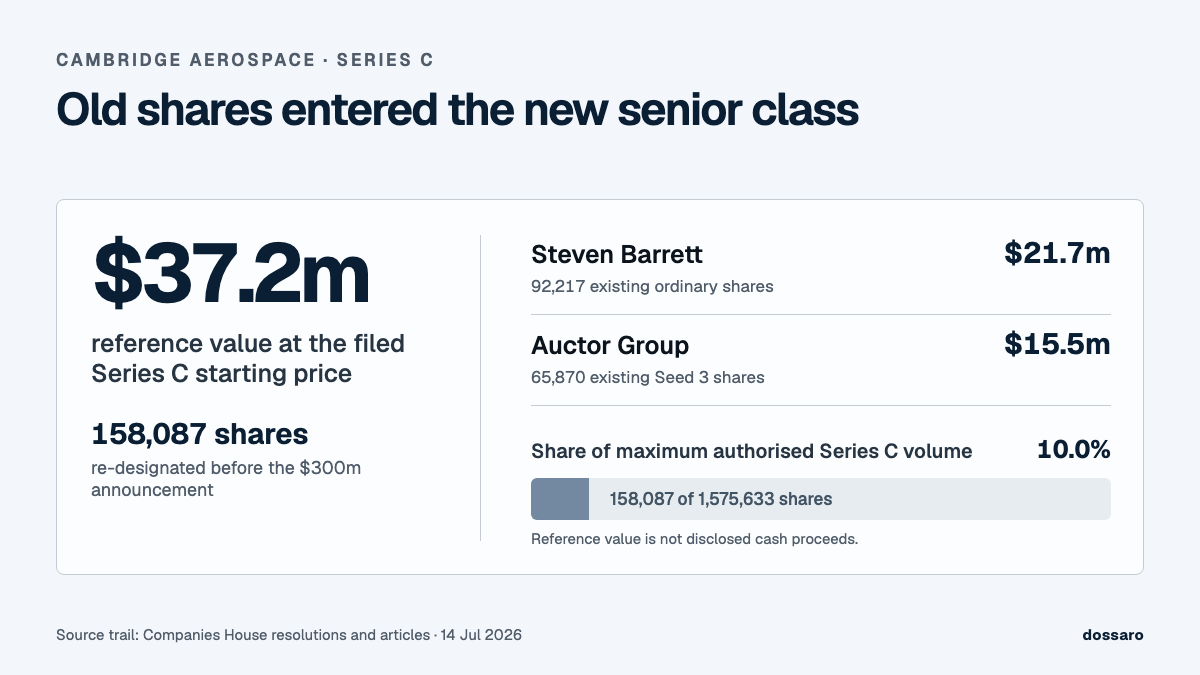
Cambridge Aerospace moved 158,087 existing founder and early-holder shares into its new Series C class before announcing a $300 million financing. At the class's filed starting price, that old-holder block carries about $37.2 million of reference value.
Can You Buy Cambridge Aerospace Shares?
Cambridge Aerospace is a privately held company. Its shares do not trade on a public stock exchange, so there is no public ticker or continuously quoted public share price. The $235.30751 figure in the filing is the Series C class's starting price, not a live market quote.
A private secondary transaction may still be possible if an existing holder is willing to sell, an eligible buyer is available and the company's transfer rules permit it. Public filings do not establish that shares are currently offered for sale, however, and a broker's private-market indication is not the same as an exchange price. The evidence below explains the filed share classes and financing structure; it should not be read as an offer or investment recommendation.
The 14 July shareholder resolution names both pieces. Founder Steven Barrett's 92,217 ordinary shares were re-designated as Series C. Auctor Group Pte Ltd's 65,870 Seed 3 shares received the same one-for-one treatment.
Six days after Companies House published the resolution and new articles, Axios reported a $300 million Series C led by DFJ Growth at a $3.4 billion post-money valuation. Lux Capital, Accel, Lakestar, Never Lift, Ora Global and Elad Gil were named as additional investors.
The filings do not turn $37.2 million into a disclosed cash payout. They establish something narrower and economically important: old shares entered the same new senior class used for the financing. The final allocation will determine whether the re-designation produced secondary liquidity, preserved a senior position for existing holders, or combined both effects.
| Old-holder block | Shares moved into Series C | Reference value at $235.30751 |
|---|---|---|
| Steven Barrett | 92,217 | $21.70m |
| Auctor Group Pte Ltd | 65,870 | $15.50m |
| Total | 158,087 | $37.20m |
The Resolution Put Existing Holders Inside The New Class
Cambridge Aerospace's latest pre-Series-C allotment return recorded 9,989,979 shares across ordinary, Seed and Series A and B classes. The July resolution then authorised up to 1,575,633 Series C shares or rights and created the new class before the public funding report.
The 158,087 re-designated shares equal 10.03 percent of that maximum authorised Series C volume. That is too large to dismiss as a rounding adjustment. It places a measurable old-holder component inside the legal architecture of the round.
The maximum authorisation itself should not be confused with shares actually issued. At $235.30751 each, all 1,575,633 authorised shares would carry about $370.8 million of reference value, above the reported financing amount. The gap reinforces why the resolution is a ceiling and transaction framework rather than a closing statement. Rights can be reserved without being exercised, and re-designated shares can sit beside newly allotted shares without adding cash to the company.
The distinction matters because primary and secondary capital do different jobs. New shares sold by the company add cash to fund engineering, production and working capital. Existing shares sold by holders transfer cash to those holders instead. A rollover into the new class may deliver no immediate liquidity, but it can change downside protection and governance.
The filing does not provide a closing sources-and-uses schedule. Subtracting $37.2 million from the $300 million headline would therefore be false precision. The reported financing amount and the calculated class reference value are different types of number until a post-closing allotment return and transfer schedule reconcile them.
This resembles the split visible in 9fin's employee secondary, where resolutions separated new company shares from an authorised old-share sale. Cambridge Aerospace's filing is less complete on the final transfer, but it similarly prevents the funding headline from being read as one uniform pool of company cash.
Series C Added Downside And Governance Protection
The new articles set the Series C starting price at $235.30751 per share. They give the class a one-times liquidation preference, meaning Series C holders sit ahead of ordinary equity for the amount defined by the preference mechanics before remaining proceeds are distributed under the wider waterfall.
Series C also receives weighted-average anti-dilution protection. If the company later issues shares below the protected price under the relevant conditions, the conversion economics can adjust to reduce dilution for the preferred holders.
Consent rights add a governance layer. The articles reserve specified actions for investor approval and preserve director appointment rights for Accel, Lakestar and Lux. The exact effect depends on the final Series C allocation, but the rights show why a one-for-one class change can matter even when the underlying share count does not.
Auctor's block makes the change particularly visible. Its 65,870 shares came from Seed 3, whose stated starting price was $3.00. That former class carried about $197,610 of starting-price reference value. At the Series C starting price, the same share count corresponds to about $15.50 million.
That comparison is not a 78-fold realised gain. Starting prices can interact with different rights, conversion terms and transaction steps. It does show that Auctor's shares moved from an early class into the round's new senior class at a dramatically different filed reference point.
The Round Benchmark Also Appears In The Exit Rules
Cambridge Aerospace's articles use the same two headline numbers in their definition of a qualified initial public offering. The threshold requires at least $300 million of primary proceeds and a minimum implied pre-IPO valuation of $3.4 billion.
That wording does not predict a listing. It embeds the financing benchmark into the conditions for a future exit that can trigger class treatment under the articles. Investors are therefore not only buying exposure to the company's current contracts and products. They are entering a class whose protections and exit mechanics use the round's valuation framework.
The commercial backdrop is unusually strong for a young defence company. The UK government said in April that Cambridge Aerospace would supply interceptor missiles and launchers to the UK military and Gulf partners. Government procurement can reduce demand risk and help finance industrial scale-up.
It does not answer the transaction question. Public contracts explain why new investors may accept a $3.4 billion post-money valuation. They do not show how the $300 million was split between company funding, holder liquidity and class rollover.
Two Closing Paths Lead To Different Economics
One plausible path is a pre-closing secondary transfer. Barrett and Auctor could have converted their old shares into Series C so incoming investors could buy stock with the same class protections as the primary issue. Under that path, the re-designation is transaction plumbing for old-holder liquidity.
Another path is that some or all of the re-designated shares remained with their existing holders. That would leave Barrett and Auctor with a position in the protected class rather than the ordinary or Seed 3 economics they held before.
Both paths put old-holder interests inside the financing. They differ on who received cash and who held the senior shares after closing. The July resolution proves the preparation; it does not prove the final destination.
For growth investors, that distinction changes more than a headline ratio. Primary capital increases the company's resources and dilutes the existing base. Secondary consideration transfers ownership without adding operating cash. A retained preferred position leaves existing holders invested but improves their place in the capital stack. Each path can be commercially rational, yet each produces a different answer to how much runway the round bought and how much value it delivered to earlier shareholders.
The first post-closing SH01 should show how many new Series C shares were allotted and at what price. The Companies House filing workflow can then track that allotment alongside a later confirmation statement or shareholder list, which may show whether the 158,087-share block stayed with Barrett and Auctor or moved to buyers. Subscription and sale schedules would provide the final split between cash for the company and consideration for existing holders.
Until those documents arrive, the defensible conclusion is precise. Cambridge Aerospace's $300 million Series C was built to include more than new shares. Its pre-announcement filings moved an old-holder block carrying about $37.2 million of Series C reference value into the round's senior class, leaving the final cash and ownership outcome as the next disclosure test.
Continue reading
Related Research
9fin Authorised 139,527 Shares for Its Employee Secondary
9fin authorised 139,527 existing shares for its employee secondary, implying £7.45m at the Series C price before conversion into preferred stock.
Inforcer Doubled Its Implied Valuation As Old Shares Entered Series C
Inforcer's filed Series C nearly doubled its implied value in nine months, while one-third of the preferred class came from existing ordinary shares.
Volta's $300m Raise Had A 30.5x Nominal Share-Price Ladder
Volta's $300m raise hid a 30.5x nominal price ladder from $58 Seed shares to $1,769.91 Series A stock, plus preferred rights and $2m of debt set-off.
CuspAI's Founders Held 32.61% Before The $450m Series B
CuspAI's founders held 32.61% before its $450m Series B, while UK sovereign capital entered a company whose post-round ownership is not yet public.