
SoftBank's $200m Gravis Round Created A 12.63% Series A Class
Gravis's $200m SoftBank round created a Series A class equal to 12.63% of nominal shares and added two board members, not a takeover.
On this page
Conduct your own private market research
Add dossaro to Claude or ChatGPT and run source-backed register research from your own workspace.
 Add to Claude
 Add to ChatGPT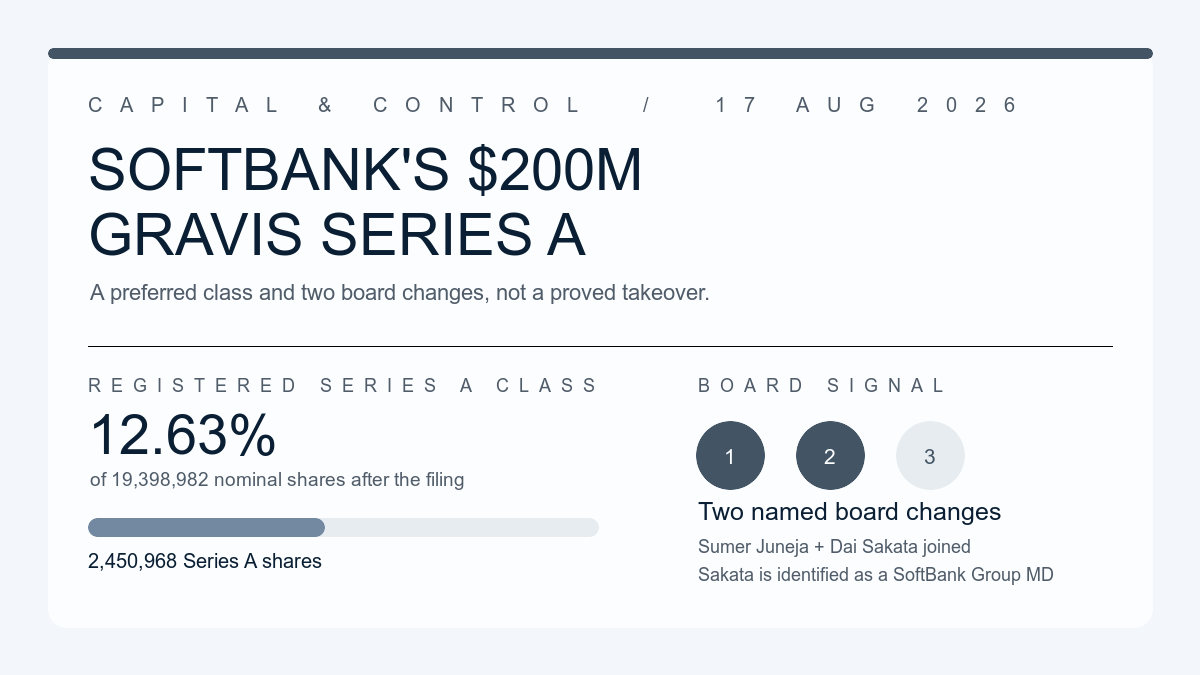
SoftBank's $200 million investment in Gravis Robotics was a very large preferred financing, but the Swiss register does not read like a takeover. A filing published ten days before the announcement created 2,450,968 Series A shares, equal to 12.63% of Gravis's 19,398,982 nominal shares after the change. The same filing put two new directors on the board, including SoftBank managing director Dai Sakata.
That combination makes the round commercially legible. SoftBank received a dedicated preferred class and visible governance access. Earlier shareholders were diluted or reclassified, yet the public record does not disclose who owns each class, the fully diluted percentage, the price per share or any control rights beyond the board appointments. The strongest defensible reading is a large minority financing with influence, not a registered majority acquisition.
The $200m headline meets a dated Swiss capital filing
Gravis's 17 August announcement says SoftBank is investing $200 million in the Zurich construction-robotics company. Gravis describes the round as the largest Series A in construction robotics and says the money will scale its retrofit autonomy system across global jobsites. The company was spun out of ETH Zurich in 2022 and sells the Gravis Rack, a hardware and software kit that adds autonomous control to mixed fleets of excavators and other heavy equipment.
Construction Dive's independent report confirms the amount, the Series A label and SoftBank as the investor. It describes the product as a way to turn existing heavy machinery into autonomous robots, rather than a new fleet tied to one equipment manufacturer. Sifted reported a $1 billion post-money valuation, but Gravis's own release did not disclose a valuation. The valuation is therefore attributed market coverage, not a filed number.
The legal timing is unusually useful. The Swiss Official Gazette filing dated 7 August 2026, based on a 5 August articles amendment, records the new Series A class and the board changes. The public financing announcement followed on 17 August. Since the company identifies SoftBank as the sole Series A investor, the filing and announcement line up closely, while the filing still stops short of naming a shareholder.
A 2.45 million-share class is not the same as a 12.63% economic stake
The 2026 publication reports CHF193,989.82 of fully paid share capital, divided into four registered classes. It lists 9,766,453 ordinary shares, 2,008,698 Pre-Seed preferred shares, 5,172,863 Seed preferred shares and 2,450,968 Series A preferred shares, each with a CHF0.01 nominal value. The arithmetic is straightforward:
| Registered state | Shares or seats | What the filing establishes |
|---|---|---|
| Series A preferred shares | 2,450,968 | 12.6345% of 19,398,982 post-change nominal shares |
| Total shares after 5 August change | 19,398,982 | The denominator for the nominal-share comparison |
| Net increase from 6 June 2025 state | 1,936,306 | 11.0883% growth from 17,462,676 shares |
| Series A board representation | 2 of 3 incoming changes | Sumer Juneja and Dai Sakata joined; Benjamin Eisert left |
The 12.63% figure is a class proportion, not proof of SoftBank's fully diluted ownership. Preferred shares can carry liquidation preferences, conversion terms and other rights that are not visible in a simple nominal count. Conditional capital and option arrangements can also change the economic denominator. The Swiss public ownership surface does not identify the holder of each class, so the filing cannot establish SoftBank's exact economic percentage.
The distinction matters because a large round can sound like a control event when the legal evidence shows something else. The filing proves that a new class was created and that it represented about one eighth of nominal shares. It does not prove that SoftBank owns one eighth of the company on an as-converted basis, that it holds a majority of votes or that it can appoint a majority of the board.
Earlier classes moved while the new class appeared
The denominator did not simply expand by the number of Series A shares. The 2025 state, published after a 30 May capital increase, contained 17,462,676 shares: 9,913,470 ordinary, 2,111,530 Pre-Seed preferred and 5,437,676 Seed preferred. The 2026 filing shows those earlier classes at 9,766,453, 2,008,698 and 5,172,863 respectively. Together, they fell by 514,662 shares while 2,450,968 Series A shares appeared.
The net result is a 1,936,306-share increase, or 11.09% relative to the 2025 total. That is why dividing the new Series A class by the old total would overstate the nominal issuance effect. The public filing describes both an ordinary capital increase and an increase from conditional capital, and it rewrites the class counts. It does not provide the holder-level steps needed to say which earlier investors were exchanged, converted or otherwise reclassified.
Gravis's previous financing gives the capital history context. In November 2025's company release, Gravis described a $23 million round led by IQ Capital and Zacua Ventures, with Pear VC, Imad, Sunna Ventures, Armada Investment and Holcim also participating. The June 2025 Swiss filing is the legal record immediately before that public financing history was followed by the new Series A class. The earlier investors are visible in the announcement, but their post-round positions are not visible in the free shareholder register.
Two new directors made the governance signal visible
The 7 August filing records Sumer Juneja and Dai Sakata as new members of the board. Benjamin Eisert left, and Burak Çizmeci's signing authority ended. Gravis's announcement identifies Sakata as a managing director at SoftBank Group. The timing gives SoftBank a named presence in the company's formal governance immediately after the capital change.
That is meaningful influence, but it is not the same as control. A two-person change in a filing can alter the board's composition, yet the public record does not show a majority of all seats, a shareholders' agreement, veto rights or reserved matters. It also does not show whether the two new directors were appointed under an investor right, a founder agreement or a broader governance reset. The safest description is that the round coincided with two new board appointments, one of them a SoftBank executive, not that SoftBank controls Gravis.
The human and commercial stakes sit in the rollout. Gravis says its retrofit system is designed for the mixed fleets contractors already own, and the company cites a labor shortage and infrastructure expansion as the market problem. SoftBank gets exposure to a physical-AI platform that can scale through existing equipment. Gravis gets a much larger capital base for hiring, hardware deployment and international operations. Earlier investors and founders face dilution or reclassification, but the public register cannot calculate whose percentage moved by how much.
This is the same evidence principle visible in OLIX's Series B: a financing headline becomes useful only when the share denominator and the rights attached to the classes are kept separate. It also echoes q.beyond's GITG acquisition, where the formal governance layer clarified the buyer's influence without revealing every economic term.
The valuation and the control question remain open
Sifted's $1 billion post-money figure would make the $200 million financing look like a 20% post-money stake on a simple headline basis. That is not a filing-based calculation. Gravis did not include a valuation in its announcement, and the Swiss publication does not disclose the issue price, conversion mechanics or shareholder register. The article therefore does not convert the reported valuation into a cap-table percentage.
The next decision-changing documents are specific. A post-round shareholder register or a subscription agreement would identify SoftBank's legal holding and the positions of earlier investors. The amended articles or a shareholders' agreement would show liquidation preferences, conversion, board nomination rights and any vetoes. A subsequent confirmation or capital filing could clarify whether the 514,662-share reduction reflects reclassification, conversion or another capital operation.
Until those records appear, the public evidence supports a narrow but consequential conclusion. SoftBank's $200 million Gravis round created a Series A preferred class equal to 12.63% of nominal shares and arrived with two new board members. It gave the investor a dedicated legal layer and visible governance access, while leaving the exact economic ownership and ultimate control structure outside the Swiss public register.
Continue reading
Related Research
OLIX's $312m Round Diluted The Founder Stake Behind The £946m Headline
OLIX's $312m Series B diluted James Dacombe from 38.6% to about 34.1%, while 110,203 growth shares make part of the stake hurdle-dependent.
q.beyond Bought 51% of GITG. Its Top Executives Took Two Supervisory Seats
q.beyond bought 51% of GITG and left its operating board intact, but a next-day filing put its top executives in two of three supervisory seats.
Sudolabs' Buyer Vehicle Took 100% Of The Operating Company
Sudolabs' buyer vehicle took 100% of its Slovak operating company, while its former 35/35/30 parent was renamed and the founders stayed managers.
Nscale's $3bn AI Debt Sits on a New Holding-Company Security Stack
Nscale's $3bn AI-data-centre facilities follow a holding-company roll-up, a $3.695bn premium reset and GLAS charges over parent and Arkon equity.