
Sudolabs' Buyer Vehicle Took 100% Of The Operating Company
Sudolabs' buyer vehicle took 100% of its Slovak operating company, while its former 35/35/30 parent was renamed and the founders stayed managers.
On this page
Conduct your own private market research
Add dossaro to Claude or ChatGPT and run source-backed register research from your own workspace.
 Add to Claude
 Add to ChatGPT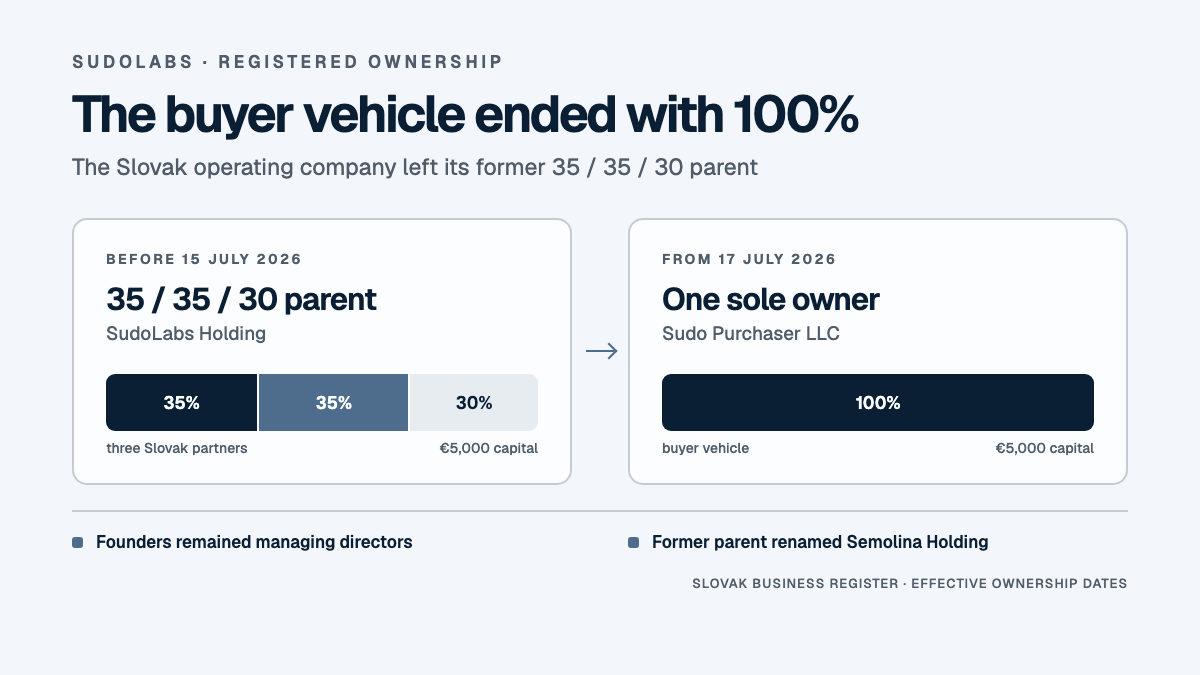
Sudolabs' Slovak operating company is now wholly owned by Sudo Purchaser LLC. The Delaware buyer vehicle has held all €5,000 of Sudo Labs s. r. o.'s registered capital since 17 July 2026, the Slovak Business Register shows.
That is the clearest legal outcome behind a deal publicly described as Eldridge acquiring a “significant ownership stake.” EU-Startups reported on 10 August that Todd Boehly's investment firm was the buyer, that terms were undisclosed and that the Slovak team would continue running day-to-day operations.
The register does not disclose who ultimately owns Sudo Purchaser LLC, so it cannot independently prove Eldridge's exact position above the Delaware vehicle. It does establish the narrower and commercially important point: this was not a new investor joining the old Slovak ownership structure at operating-company level. The entire local operating asset moved into a buyer vehicle.
The founders, Jozef Petro and Pavol Madár, remained managing directors. That continuity separates two questions often blurred in acquisition announcements. Who runs a company can stay the same even when who owns the operating company changes completely.
The Closing Moved From Two Buyers To One
The full Sudo Labs register extract records the transaction as a short sequence of dated ownership states.
Until 14 July, SudoLabs Holding s. r. o. held the full €5,000 registered capital. On 15 July, Sudo Purchaser LLC and Sudo US Topco LP each appeared with €2,500. On 16 July, the topco disappeared and Sudo Holdco 1 LLC briefly held the second €2,500. From 17 July, Sudo Purchaser LLC alone held the full amount.
| Effective state | Registered partner or partners | Share of €5,000 capital |
|---|---|---|
| Through 14 July 2026 | SudoLabs Holding s. r. o. | 100% |
| 15 July | Sudo Purchaser LLC and Sudo US Topco LP | 50% each |
| 16 July | Sudo Purchaser LLC and Sudo Holdco 1 LLC | 50% each |
| From 17 July | Sudo Purchaser LLC | 100% |
The intermediate entities matter because they show a structured closing rather than a simple allotment to a new minority investor. They do not reveal separate economic interests or consideration. Their one-day appearances may reflect transaction mechanics that only the acquisition documents can explain.
The registered-capital figures are also not a valuation. Five thousand euros is the company's nominal capital, not the price Eldridge or any acquisition entity paid. The transaction terms remain undisclosed.
That distinction is essential when screening an acquisition target: nominal capital, transaction consideration and registered ownership answer different questions.
The Operating Company Left A 35/35/30 Slovak Parent
Before closing, Sudo Labs had spent nearly five years under SudoLabs Holding. The holding-company extract shows that the parent had been divided since March 2023 among three Slovak companies.
Superuser s. r. o. and PM SPV s. r. o. each held €1,750 of the parent's €5,000 nominal capital, equal to 35% each. Sudolabs Partners s. r. o. held €1,500, or 30%.
| Position | Before the transaction | After the transaction |
|---|---|---|
| Sudo Labs operating company | 100% owned by the 35/35/30 Slovak parent | 100% owned by Sudo Purchaser LLC |
| Former parent | Named SudoLabs Holding | Renamed Semolina Holding on 25 July |
| Founder-linked partner name | Sudolabs Partners | Renamed Semolina Partners on 6 August |
| Operating management | Petro and Madár were managing directors | Petro and Madár remained managing directors |
This is the economic break the public “stake” wording leaves unstated. The old 35/35/30 structure did not remain as the direct owner with Eldridge or another investor added beside it. The operating company left that parent entirely.
The former parent's rename sharpened the separation ten days later. SudoLabs Holding became Semolina Holding on 25 July. One of its partners, Sudolabs Partners, became Semolina Partners on 6 August. A name change does not prove how sale proceeds were allocated or why the entities remain active. It does make clear that the former ownership vehicle no longer carries the operating brand.
Management Continuity Does Not Resolve Founder Economics
Petro and Madár staying as managing directors is consistent with the announcement that the existing team would continue day-to-day operations. It can protect customer relationships, product delivery and institutional knowledge after a transaction.
It does not show that the founders retained the same ownership or control. A managing director acts through a corporate role. A registered partner owns the local company. After 17 July, those positions sat with different people and entities.
The distinction resembles the parent-versus-operating-company separation visible in Wordsmith's move under a Delaware parent. In each case, reading only the local company can miss where investor economics sit. Sudolabs adds a transaction dimension: the Slovak operating company itself moved from a founder-side parent into a buyer-side vehicle.
That still does not prove a complete founder exit. Petro, Madár or their vehicles could have reinvested part of their proceeds into Sudo US Topco LP or another entity above Sudo Purchaser LLC. Such rollover equity is common in private acquisitions because it lets sellers retain exposure to future growth while the buyer takes control of the acquired business.
No public document reviewed here identifies such a rollover. The safe conclusion ends at the operating-company boundary. Sudo Purchaser LLC owns 100% of Sudo Labs' registered capital; the ultimate US cap table is unresolved.
“Significant” Was Broad, Not Necessarily Wrong
The strongest counter-reading is semantic. “Significant ownership stake” does not explicitly mean minority. It can cover a controlling or complete interest, especially when an announcement avoids disclosing transaction terms.
The public report therefore need not be false. It is incomplete for readers trying to understand where control moved. “Stake” focuses on the investor's participation. The register shows the legal structure created underneath that participation.
There is also no evidence that founders or earlier holders received a poor outcome. A 100% transfer of the operating company can support a substantial payout, a rollover into the buyer's parent, earn-outs or a mix of cash and equity. Without the purchase agreement and US capitalization records, none of those outcomes can be assigned.
What can be said is that operational continuity should not be read as ownership continuity. Eldridge was publicly named as buyer. The Slovak opco ended the closing under a sole Delaware vehicle. The former direct parent was renamed and left behind. Those are separate, mutually consistent facts.
The Next Document Must Connect The Delaware Chain
The Slovak register answers the local-company question unusually well. It identifies the exact dates, each temporary partner, the final sole owner and the unchanged managing directors. It also shows the former parent's composition and post-closing names.
The remaining uncertainty sits one layer higher. A Delaware formation or ownership record could connect Sudo Purchaser LLC, Sudo Holdco 1 LLC and Sudo US Topco LP. A buyer-side capitalization document could reveal whether Eldridge owns the top entity alone or alongside founder rollover. The transaction agreement could establish consideration, signing entities and conditions.
Until one of those records appears, the article should not assign purchase proceeds, ultimate percentages or motives. The operating-company result is sufficient on its own: a deal announced as a significant stake transferred 100% of Sudolabs' Slovak operating company into Sudo Purchaser LLC while the founders remained its managers.
Continue reading
Related Research
Wordsmith's $114m Funding Sits Above A £1 UK Subsidiary
Wordsmith AI has announced $114 million of funding above a one-share UK subsidiary, while Ross McNairn's latest register state preserves founder control rights.
Wexler's Founders Held 54%, But £4.66m Ranked First
Legora bought a Wexler that was 54% founder-owned on its last visible share count, but £4.66m of seed preference ranked ahead of ordinary shares.
Risk Ledger's £24m Round Put Axiom Ahead Of Its Founder
UK filings show Axiom became Risk Ledger's largest individual shareholder as £18.5m of cash allotments trailed the announced £24m Series B headline.
Rail Europe's Parent Had Negative Equity Before Omio Deal
Rail Europe's parent reported negative equity and its operating company lost €6.27m before Omio's proposed acquisition, putting price and debt at the centre.