
q.beyond Bought 51% of GITG. Its Top Executives Took Two Supervisory Seats
q.beyond bought 51% of GITG and left its operating board intact, but a next-day filing put its top executives in two of three supervisory seats.
On this page
Conduct your own private market research
Add dossaro to Claude or ChatGPT and run source-backed register research from your own workspace.
 Add to Claude
 Add to ChatGPT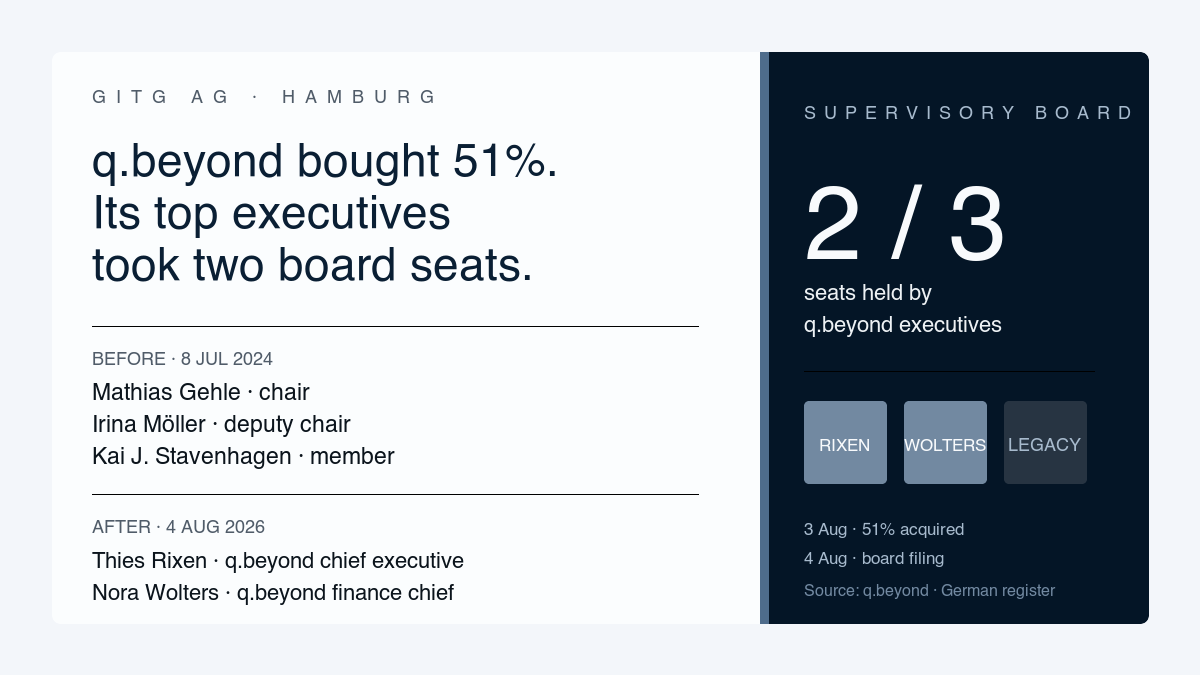
q.beyond's 51 percent purchase of GITG AG left the healthcare software company's operating management in place. The next day's German register filing made the governance consequence explicit: q.beyond Chief Executive Officer (CEO) Thies Rixen became supervisory-board chair and Chief Financial Officer (CFO) Nora Wolters took the third seat. Together, q.beyond's top two executives hold two of three supervisory positions.
That is more than a routine change of names. It gives the buyer a clear board majority while preserving one legacy seat, and it changes how the acquisition should be read by customers, employees and investors. q.beyond described the transaction as a way to secure GITG's hospital software and said the management team would remain. The filing shows the operating handover and the supervisory control shift happening at the same time.
The acquisition was framed as continuity
In its 3 August announcement, q.beyond said it had acquired 51 percent of GITG, a Hamburg-based SAP healthcare specialist founded in 2002. The purchase price was not disclosed and the transaction was financed from q.beyond's internal funds.
The strategic case is specific. GITG's GS-H replacement is designed for hospitals that still run SAP IS-H, which SAP plans to discontinue in 2030. q.beyond said more than 500 hospitals, or over 20 percent of hospitals in Germany, Austria and Switzerland, are estimated to use IS-H. The release described the acquired intellectual property as a basis for a future hospital standard and said GITG has worked on more than 500 projects with nearly 40 employees.
The same release stressed operating continuity. Prof. Dr. Wilken Möller and his management colleagues would remain after the takeover. That is commercially important in hospital software, where implementation knowledge, customer trust and a long migration window can matter as much as the code itself. A buyer can gain a platform without disrupting the people responsible for delivery.
But continuity in the operating board is not the same as continuity in governance. The filing deposited on 4 August, one day after the announcement, set out who would supervise the company after the majority investment.
A two-seat majority appeared the next day
GITG's earlier supervisory-board list, dated 8 July 2024, named Mathias Gehle as chair, Irina Möller née König as deputy chair and Kai Jürgen Stavenhagen as the third member. The new list dated 4 August 2026 names Rixen as chair, keeps Möller as deputy and adds Wolters as the third member.
| Supervisory-board role | 8 July 2024 list | 4 August 2026 list | What changed |
|---|---|---|---|
| Chair | Mathias Gehle | Thies Rixen, q.beyond CEO | Buyer executive took the chair |
| Deputy chair | Irina Möller née König | Irina Möller née König | One legacy seat remained |
| Third member | Kai Jürgen Stavenhagen | Nora Wolters, q.beyond CFO | Buyer executive took the third seat |
The arithmetic is simple: q.beyond executives occupy two of three seats, or two thirds of the supervisory board, including the chair. The remaining seat is held by the continuing deputy chair. The filing does not identify the sellers of the 49 percent that q.beyond did not acquire, and it does not disclose whether that minority has a separate governance arrangement.
The timing changes the commercial reading of the deal. q.beyond bought a majority economic interest while leaving the target's management to run the business, then placed its CEO and CFO in the board structure that oversees that management. For a company serving hospitals through a multi-year software transition, that is a visible control mechanism even while day-to-day execution remains with GITG's existing team.
The board reset is the control story
Supervisory boards in German stock corporations do not run daily operations. They appoint and monitor the management board, approve certain major decisions and provide a formal governance layer above executives. That distinction matters here. The filing identifies q.beyond's supervisory representation while Möller and his operating colleagues remain in the management team. It shows that the buyer controls the supervisory layer through two named seats.
The structure can therefore carry two messages at once. Customers are offered continuity because the people delivering GITG's hospital projects remain. The buyer's capital is protected by a board majority that can shape oversight, appointments and strategic decisions. This is a common logic for a 51 percent acquisition, but the documents make the mechanism visible rather than leaving control as an abstract consequence of the percentage.
q.beyond's own governance page identifies Rixen as Chief Executive Officer and Wolters as Chief Financial Officer. Their roles at q.beyond are not honorary labels. The buyer placed the executives responsible for group strategy and finance into the acquired company's supervisory board immediately after taking its majority stake.
That is why the percentage and the formal governance record belong together. A separate reverse-merger control shift at Redx shows the same diligence principle: transaction mechanics become commercially legible only when the legal control layer is read alongside the headline deal.
The contrast with the previous list is also more informative than the announcement's broad phrase that management would remain. Two of the three supervisory positions changed, and both incoming members came from the buyer's top management. One legacy director remained, but in the deputy-chair role rather than the chair.
Why the governance layer matters for the hospital transition
GITG's commercial opportunity depends on a deadline outside the company. SAP IS-H is due to be discontinued in 2030, creating a replacement market for hospitals that have not migrated. q.beyond wants GS-H to become a platform for that migration and says GITG's installed base and project experience provide a route into the market.
The acquisition therefore combines a time-limited technology transition with a control transition. GITG's operating team retains the customer relationships and implementation knowledge, while q.beyond's executives now have a majority on the board that oversees the company. For hospitals evaluating a migration partner, the relevant question is not only whether the product survives. It is also who can change its investment priorities, delivery model or commercial terms if the transition takes longer than planned.
That question is especially relevant because q.beyond is buying into a specialist rather than acquiring a large public company with a fully disclosed segment balance sheet. The release gives the strategic rationale and the 51 percent stake, but not the purchase price. q.beyond's half-year report says control of GITG was obtained after the reporting date and that the initial consolidation and purchase-price allocation were not yet complete. The public record therefore establishes the control event before it establishes the financial cost.
An independent Montega research note also describes the majority acquisition but notes that financial terms were not disclosed. Analyst estimates in that note are not a substitute for a reported purchase price or GITG financial statements. They can frame market expectations, but they do not identify what q.beyond paid or how the remaining 49 percent is held.
A conventional majority can still be a decisive one
The strongest alternative reading is straightforward: a buyer with 51 percent normally gets board control. Installing the chief executive and chief financial officer in two supervisory seats can be a conventional way to align oversight with the economic majority. It does not by itself show disagreement with the former directors, a dispute with the sellers or a plan to replace GITG's management.
That reading is consistent with the public announcement. q.beyond said GITG's management would remain, and the board list keeps Möller as deputy chair. The filing provides no basis for assigning motives to the changes or for treating the continuing seat as evidence of a negotiated conflict.
The commercial fact remains narrower and stronger: the majority buyer installed its CEO and CFO in two of three supervisory seats the day after announcing the deal. Operational continuity and buyer control are not competing descriptions. They are the two layers q.beyond chose to combine.
The next documents will price the control shift
The board list answers who supervises GITG. The transaction's economic exposure remains unresolved. The purchase price, the identity of the sellers, the rights attached to the remaining 49 percent and the terms of any shareholder agreement are still outside the public framing used by q.beyond.
Those details will matter when q.beyond completes its initial consolidation and publishes the purchase-price allocation. They can show how much value the group assigned to GITG's software, customer relationships and other assets, and whether the minority stake carries protections that affect future decisions. GITG's next statutory accounts can add the operating numbers behind the hospital migration opportunity.
For now, the public evidence supports a precise conclusion. q.beyond bought 51 percent of GITG with internal funds and promised continuity for the operating management. The next-day filing then put q.beyond's CEO and CFO in two of the three supervisory seats, including the chair. The transaction preserved the people who know the business while making the buyer's governance control impossible to miss.
That is the diligence question the headline leaves out: not whether GITG's management stays, but how the buyer's board majority will shape the capital, pace and risk of replacing SAP IS-H before the 2030 deadline.
Continue reading
Related Research
Vista's Quantios Deal Crosses £92m Of On-Demand Group Liabilities
Vista's Quantios deal crosses £92m of on-demand group payables and registered Jersey-share security created 69 days before the sale announcement.
Sudolabs' Buyer Vehicle Took 100% Of The Operating Company
Sudolabs' buyer vehicle took 100% of its Slovak operating company, while its former 35/35/30 parent was renamed and the founders stayed managers.
Skye's Redx 'Acquisition' Leaves Legacy Skye Holders With 5.38%
Skye's proposed Redx merger would leave legacy Skye holders with 5.38%, while Redx holders and new financiers control 94.62% and Redx leads the board.
Revier’s €6m Seed Left Legacy Holders With 57.6% While New Investors Built a 29.9% Block
Revier’s €6m seed financing left a 57.6% legacy share block in place, while KHAN II and Revier Invest held 29.9% of the latest 43,428-share register.