
Skye's Redx 'Acquisition' Leaves Legacy Skye Holders With 5.38%
Skye's proposed Redx merger would leave legacy Skye holders with 5.38%, while Redx holders and new financiers control 94.62% and Redx leads the board.
On this page
Conduct your own private market research
Add dossaro to Claude or ChatGPT and run source-backed register research from your own workspace.
 Add to Claude
 Add to ChatGPT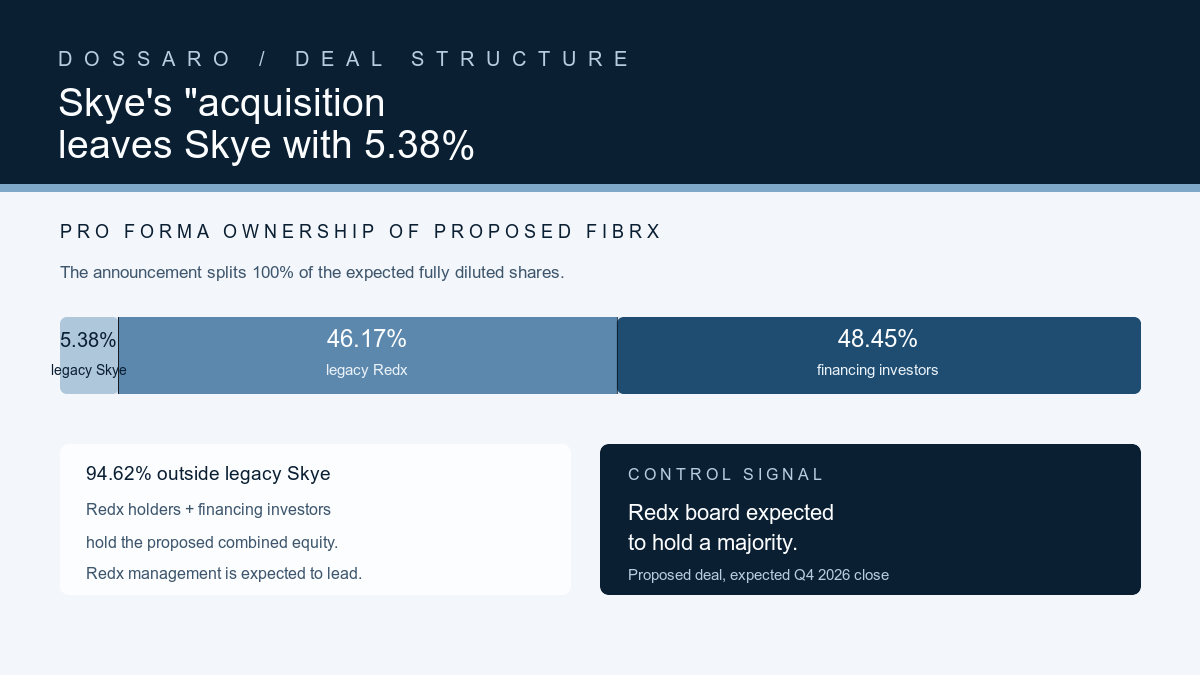
Skye Bioscience is presenting its proposed combination with Redx Pharma as an acquisition of a UK biotech. The pro forma ownership table in the parties' own announcement tells a sharper story: legacy Skye holders would receive 5.38% of the combined company, while Redx holders and the financing investors would hold the other 94.62%. Redx management would run the business and the current Redx board is expected to form a majority of the new board.
That makes the transaction economically closer to a reverse listing and financing channel than a conventional purchase by Skye. It is not closed. The companies expect completion in the fourth quarter of 2026, subject to shareholder, court, regulatory and Nasdaq conditions. But the disclosed split already shows where the negotiating leverage sits: Redx supplies the pipeline and much of the pre-transaction value, while new capital supplies the public-company funding.
| Holder group | Pro forma ownership | Legacy-value right disclosed in the announcement | What the group brings |
|---|---|---|---|
| Legacy Skye holders | 5.38% | Cash CVR for 90% of net proceeds from certain Skye legacy nimacimab and related IP over 12 months | Existing Nasdaq-listed entity and Skye assets |
| Legacy Redx holders | 46.17% | Stock-settled CVR for 100% of net proceeds from certain Redx legacy or partnered assets over 15 years | Redx pipeline, management and operating platform |
| Financing investors | 48.45% | No single allocation or recovery is specified for this block in the announcement | $125 million financing package and public-market capital |
| Total | 100% | Percentages remain subject to the Skye net-cash adjustment | The proposed Fibrx combined company |
The percentages are pro forma estimates, not a settled closing cap table. The Skye percentage is expressly subject to an adjustment for Skye's net cash. The table nevertheless answers the central commercial question earlier than the legal label does: who controls the post-deal equity and the next financing cycle?
The “Buyer” Keeps 5.38%
The joint transaction announcement says Skye will acquire all issued Redx shares through a UK Scheme of Arrangement. The combined company is to be called Fibrx Therapeutics. It also gives the reference values used to calculate the exchange: Redx is valued at $125.0 million and Skye at $14.5 million, with the Skye value subject to the net-cash mechanics and a possible floor of $2.0 million if a specified adjustment is unresolved.
Those headline values do not translate into a Skye-controlled company. The expected fully diluted share count is 934,235,920. On that basis, holders of Skye shares issued before the transaction would own 5.38% before the net-cash adjustment. Redx holders would own 46.17%, and the financing group would own 48.45%.
The economic reading is not that Skye contributes nothing. Skye contributes a listed vehicle, a cash position that can change the exchange ratio and nimacimab-related assets that receive a separate contingent value right. It is that the listed shell is being used as the route through which Redx and new investors reach a funded public company. Calling Skye the acquirer describes the legal form. The pro forma table describes the control outcome.
This distinction matters to investors assessing dilution. A Skye holder who reads only the acquisition headline could expect to own the continuing company in roughly the same economic position. The disclosed 5.38% says the legacy position is instead being heavily diluted in exchange for participation in a new platform, a cash CVR and whatever value the combined company creates after closing.
Redx Brings the Capital and the Control
The financing package is larger than the transaction exchange itself. The parties announce $125 million of aggregate financings: a $68 million PIPE from new and existing investors, a $36 million Series A for Redx led by Abingworth, a $22 million Redmile equity line and a $5 million warrant. The release identifies British Patient Capital, NEXTBio, 5AM and Redmile among the investors, while noting that British Business Bank investment does not constitute an endorsement.
The sequence is important. The financing is not a later top-up to a Skye-controlled company. It is part of the same transaction architecture that gives the financing block 48.45% of the combined equity. The announcement does not provide a final holder-by-holder allocation inside that block, so it would be wrong to turn the percentage into a precise investor ranking. It does show that almost half of the post-transaction company is being created through new and follow-on capital commitments.
Redx also supplies the operating control. The companies say Redx management will lead the combined company, with Redx's current board expected to form a majority of the Fibrx board. The headquarters will be at Alderley Park in the UK. Redx's RXC008 program is expected to reach Phase 2 topline data in the second half of 2028, and the companies say the financing is intended to fund operations through 2029.
That combination of ownership and governance is why the deal should be read as a control transfer. Redx holders receive 46.17% before any other adjustments, Redx's executives run the business and Redx directors are expected to hold the board majority. The old Skye public-company identity survives as the legal route to the market, but it does not retain the economic or governance weight it had before the announcement.
The structure has a familiar analogue in other transactions where the nominal buyer and the control buyer diverge. In Sudolabs' buyer-vehicle transaction, the legal vehicle made the ownership outcome visible. Here, the ownership table and board language do the same work even though the announcement uses acquisition terminology.
The CVRs Split Legacy Value in Opposite Directions
The contingent value rights reinforce the asymmetry between the two shareholder groups. Existing Skye holders are promised a cash-settled CVR tied to 90% of net proceeds from certain Skye legacy assets, including nimacimab and related intellectual property, over a 12-month period. The right is narrow in time and dependent on actual net proceeds. It is not a guaranteed cash payment.
Certain Redx holders receive a stock-settled CVR tied to 100% of net proceeds from certain Redx legacy or partnered assets over 15 years. This is a different risk package. It preserves exposure to long-tail asset monetisation, but the settlement is in shares of the combined company rather than cash. The public announcement does not say which individual holders qualify, how many shares each will receive or what valuation will apply when the right is settled.
The two CVRs therefore point in opposite directions. Skye's legacy holders receive a shorter cash monetisation window while accepting a small continuing stake. Eligible Redx holders retain a longer claim on asset proceeds while holding a much larger equity position in the funded company. Neither right should be valued as realised proceeds today. The underlying assets may produce no qualifying net proceeds, and the terms require further documentation.
The distinction is useful for analysing payout asymmetry. The transaction does not simply swap one set of shares for another. It separates legacy-asset optionality from the operating equity and assigns the two pools to different constituencies. The final scheme document and the definitive CVR terms will determine whether that optionality is economically meaningful.
A Private Company Arrives With a Financing History
Redx's register history explains why the proposed combination is also a financing solution. Companies House identifies Redx Pharma Limited as company 07368089. The company delisted from AIM in May 2024 and re-registered as a private company. Its 2024 accounts described limited liquidity and material uncertainty about continuing as a going concern beyond the third quarter of 2025.
The filing trail then shows a £5.0 million share issue in July 2024. Redx allotted 32,258,065 A1 ordinary shares at a £0.155 preference amount, with the accounts identifying the Redmile group as the financing party. Redmile and Sofinnova were the largest visible shareholders, and a Redmile representative became chair in January 2025. These records do not establish the final ownership of the proposed Fibrx company, but they show the financing and governance history attached to the Redx platform.
In April 2026, Redx granted an all-assets debenture to Redco II Master Fund, L.P. as security agent. The instrument includes fixed and floating security and carves out specified KRAS G12C, GI-ROCK and future specified intellectual property. The filing does not justify treating Redco II as the same entity as Redmile, and the transaction announcement does not disclose how the security interacts with the proposed CVR pool. Those are separate questions for the definitive documents.
The context changes the reading of the $125 million headline. Redx is not a clean newly formed target with no financing history. It arrives with a private-company capital structure, prior rescue financing and secured obligations. The combination can provide public access and runway, but it also carries forward the need to define which assets, rights and claims sit inside the funded company and which remain subject to legacy arrangements.
What the Scheme Still Has to Prove
The transaction is proposed, not completed. The companies still need shareholder approval, court sanction, regulatory clearances and Nasdaq-related conditions. The expected Q4 2026 closing date is a target, not a closing notice.
Before investors can underwrite the outcome, the parties need to publish the full scheme and financing documents. Those documents should settle the final share count, the Skye net-cash adjustment, the allocation within the 48.45% financing block and the exact eligibility and settlement mechanics for both CVRs. They should also make clear how Redx's secured obligations and carved-out intellectual property interact with any legacy-asset proceeds.
The most important evidence is already public, however. Skye's old holders are projected to own 5.38%, while Redx holders and financing investors would hold 94.62%. Redx management would lead the business and Redx's board would hold the expected majority. At completion, the commercial question will not be who bought whom. It will be which holders supplied the pipeline and the financing, and what the definitive scheme assigns to each.
Continue reading
Related Research
Cambridge Aerospace's $300m Series C Includes A $37m Old-Holder Block
Cambridge Aerospace moved 158,087 founder and early-holder shares into Series C, a block carrying about $37.2m at the filed class reference price.
Sudolabs' Buyer Vehicle Took 100% Of The Operating Company
Sudolabs' buyer vehicle took 100% of its Slovak operating company, while its former 35/35/30 parent was renamed and the founders stayed managers.
VIA Equity's €350m Fund VI Was Authorized Before Its Final Close
VIA Equity's €350m Fund VI was active in Sweden's register seven months before its close, while public disclosures stop short of naming LP commitments.
Deutsche Telekom Agreed to Buy Both Halves of Poland's Fiberhost Split
Deutsche Telekom agreed to buy Fiberhost's open-access network and INEA's retail business, reunited after a 2021 split under one Polish holding chain.