
Omilia's $67m Series B Sits Above A Cyprus Holding Company
Omilia raised $67m for global expansion, but the financing sits above a Cyprus parent while the visible Greek operating company reports only local accounts.
On this page
Conduct your own private market research
Add dossaro to Claude or ChatGPT and run source-backed register research from your own workspace.
 Add to Claude
 Add to ChatGPT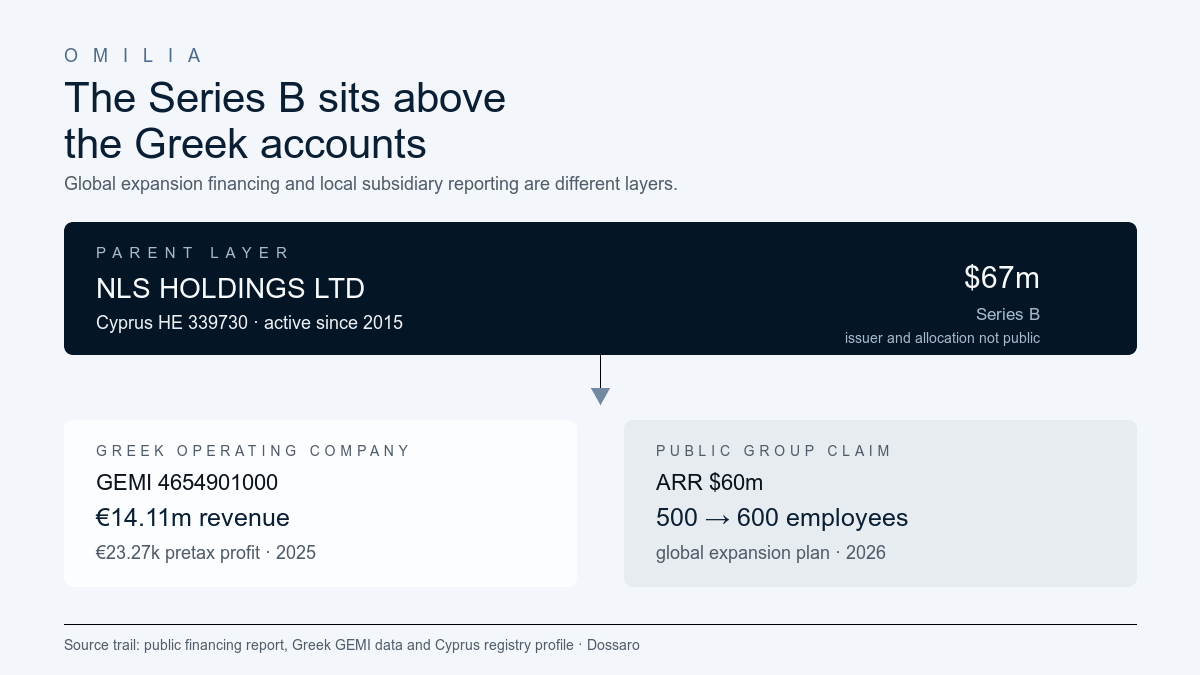
Omilia’s $67 million Series B is a financing event at the top of a cross-border group, not a cash injection that can be read from the Greek operating company’s accounts. The Greek company is a single-member subsidiary of Cyprus-registered NLS Holdings, while the latest public local figures show €14.11 million of revenue and €23,270 of pretax profit in 2025.
That distinction changes the diligence question. Omilia says annual recurring revenue has reached $60 million after growing tenfold since its $20 million 2020 round. The Greek register-derived accounts describe one operating entity inside that group, not the global business financed by the new Series B. The public record establishes where the visible subsidiary sits. It does not yet show who owns the new shares, at what price, or how the proceeds are allocated across the group.
The funding headline and the legal group are different layers
TechCrunch reported on 6 August that Omilia raised a $67 million Series B led by Expedition Growth Capital. The report says the round will fund a US office, a larger go-to-market team and further expansion, and that annual recurring revenue has risen tenfold to $60 million. The mirrored public copy of the report records the same financing amount, the 2020 $20 million round and the company’s plan to grow its workforce from about 500 to 600 people.
The financing amount is also reported as €58.1 million in European coverage, a currency presentation of the same Series B rather than a second raise. The round is the company’s second disclosed institutional financing. Expedition previously described its 2020 investment as growth capital into a business that had been profitable and bootstrapped before that round. Its account of the partnership says Oliver Thomas had been on Omilia’s board since 2020 and that the investment supported the company’s expansion after the pandemic slowdown.
The legal entity named in the Greek public record is not a $67 million financing vehicle. The Greek General Commercial Registry profile for Omilia’s operating company identifies NLS Holdings Ltd, formerly Omilia Natural Language Holdings Ltd, as its sole member. The Cyprus registry lists that parent as an active private company, registration number HE 339730, incorporated in January 2015. Its public officer list includes Omilia co-founders Dimitris Vassos, Pelias Ioannidis and Ioannis Nikolaidis, alongside Expedition executives Oliver Thomas and Mark Turner.
| Layer | Public entity and evidence | What it establishes |
|---|---|---|
| Financing headline | Omilia Series B, led by Expedition Growth Capital | $67m, also reported as €58.1m, for global expansion |
| Group parent | NLS Holdings Ltd, Cyprus HE 339730 | The cross-border holding-company layer and its visible directors |
| Operating company | Greek Omilia single-member company, GEMI 4654901000 | Local revenue, profit, capital and employment figures |
The structure matters because a financing round normally lands in a particular legal issuer. Until Omilia or the relevant registry discloses the subscription documents, the public announcement cannot by itself establish whether the new equity was issued by NLS Holdings, another group company or a financing vehicle above the operating subsidiary.
The Greek accounts are real, but they are not group accounts
The Greek operating company’s latest registry-derived figures make the boundary visible. Fundamenta, which identifies the data as coming from Greece’s GEMI open data, reports 2025 revenue of €14.11 million, up from €11.00 million, and pretax profit of €23,270, up from €12,210. It also shows roughly 266 employees, €3.52 million of equity and €1.07 million of cash for the latest period. The company profile labels the entity active and gives GEMI number 004654901000.
Those figures describe a local operating company that grew revenue by 28.2 percent while remaining close to break-even on pretax profit. They do not contradict Omilia’s claim of $60 million in global recurring revenue. They answer a narrower question: what the visible Greek subsidiary reported, and how much of the wider group’s commercial activity appears in that entity’s filed financials.
The difference is material for investors. A group that reports $60 million of recurring revenue can rationally have a Greek subsidiary with €14.11 million of local revenue if sales, intellectual property, employees or billing are distributed across other entities. But the financing analysis should not compare the $67 million round directly with the Greek company’s revenue as though the local subsidiary were the issuer or the whole business. The cap table and consolidated accounts are the missing bridge.
That issuer question also appears in Dossaro's analysis of Model ML's UK group financing, where the funded parent and the visible operating subsidiary carry different evidence. The structure is not unusual; the underwriting perimeter is what changes.
The parent’s directors show continuity, not allocation
The Cyprus company page provides a second piece of the structure. NLS Holdings is active, has been registered since 14 January 2015 and lists six directors, including the three Omilia founders and two Expedition executives. That continuity is consistent with Expedition’s public account of a long relationship with the founders. It does not establish the percentage ownership of any director, the size of Expedition’s 2020 stake or the terms of the 2026 Series B.
The distinction is especially important because the parent’s public page does not expose shareholder history or allotment records without a paid report. The Greek profile confirms the subsidiary’s single-member status, but not the economic split at the Cyprus level. The visible legal chain therefore explains control architecture better than it explains capital allocation.
That is a common international structure for a software company selling across markets. A Cyprus parent can hold shares and coordinate an international group while local entities employ staff, contract with customers or book regional revenue. The structure may simplify fundraising and expansion, but it also means a funding headline and a local filing answer different questions.
A tenfold ARR claim now sits beside a three-layer evidence problem
Omilia’s public financing narrative is unusually specific about operating ambition. The company says it serves enterprises including Capital One, Discover, Royal Bank of Canada, the UK Department for Work and Pensions and PSEG. It says the new cash will support a US office and commercial hiring, while its CEO told TechCrunch that the business is building toward a much larger revenue base.
The register evidence does not test those customer claims, and it does not need to for the ownership point. It shows that the Greek operating company is not a transparent proxy for the financed group. The Series B, the Cyprus parent and the Greek subsidiary sit on separate layers, with public sources describing each layer differently.
For venture and growth investors, the practical consequence is a document request rather than a conclusion about performance. The relevant questions are where the Series B was issued, whether the proceeds moved downstream, which entity owns the product and customer contracts, and whether the Greek operating company’s near-break-even profile reflects a deliberate group allocation or the economics of the local business. None of those questions is answered by the $67 million headline alone.
The same distinction matters for a future exit. A buyer underwriting the operating company would need to know whether it is acquiring the revenue engine, the intellectual property, the customer contracts or only a regional service entity. A buyer underwriting the Cyprus parent would need consolidated accounts, the post-round shareholder register and the rights attached to the new shares.
What the next filing should settle
The public record already establishes the central structure: Omilia’s new financing is a group-level event; NLS Holdings is the Cyprus parent named in the public chain; and the Greek operating company is a single-member subsidiary with its own filed financial profile. The evidence does not establish the new investors’ percentages, the issue price, founder dilution, the identity of the legal issuer or how the $67 million is distributed across the group.
That is not a reason to treat the round as suspect. It is the normal limit of a public announcement and a local subsidiary profile. But the limit changes the underwriting task. Omilia is presented publicly as an Athens-based AI company, while the capital event sits above a Cyprus holding company and the local accounts capture only part of the business.
The next useful documents are a Cyprus allotment or shareholder filing, the Series B subscription agreement, and consolidated group accounts. Together they would show whether the new money changed ownership at NLS Holdings, flowed into the Greek operating company or funded expansion elsewhere. Until then, Omilia’s growth story has a clear operating claim and a still-unmapped financing layer.
Continue reading
Related Research
Dwelly's $170m Round Mixed Founder Liquidity With Secured Debt
Dwelly's filings show £44.3m of new Series B cash, 19,406 founder shares sold to EQT and General Catalyst, and Trinity secured across the business.
Model ML's UK Company Owed £1.02m To Its Group Before HSBC Invested
Model ML's UK company owed £1.02m to its group and had one parent-owned £1 share before later rounds took the startup's funding above $100m.
VIA Equity's €350m Fund VI Was Authorized Before Its Final Close
VIA Equity's €350m Fund VI was active in Sweden's register seven months before its close, while public disclosures stop short of naming LP commitments.
Chemify’s £22m Grant Package Followed a £51.86m Equity Build-Up
Chemify’s £22m grant package followed £51.86m of cash-paid B/B1 allotments, a founder PSC cessation and a board swap that filings leave partly unresolved.