
Chemify’s £22m Grant Package Followed a £51.86m Equity Build-Up
Chemify’s £22m grant package followed £51.86m of cash-paid B/B1 allotments, a founder PSC cessation and a board swap that filings leave partly unresolved.
On this page
Conduct your own private market research
Add dossaro to Claude or ChatGPT and run source-backed register research from your own workspace.
 Add to Claude
 Add to ChatGPT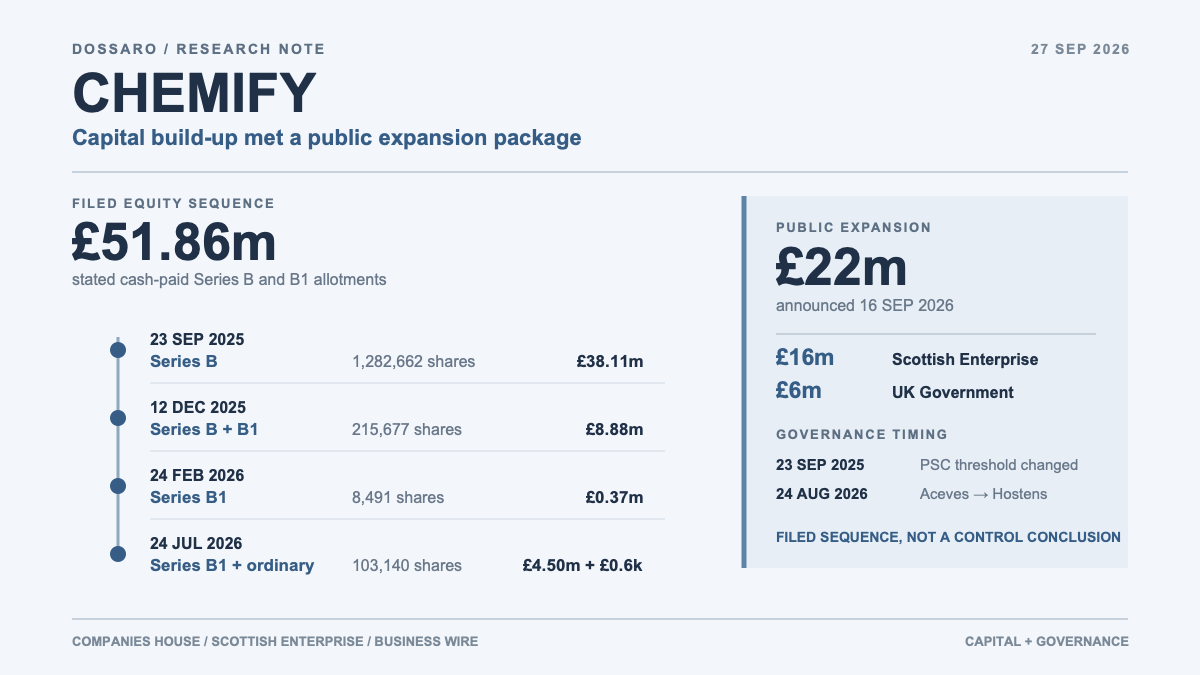
Chemify’s £22 million public funding package is also the latest chapter in a much larger private financing sequence. Companies House filings show five cash allotments of Series B and Series B1 shares between September 2025 and July 2026, with stated paid amounts totalling £51.86 million. The register also records a founder-level PSC change and an August 2026 board swap before the grant announcement.
That does not mean the grants funded the share issues, that founder Lee Cronin sold out, or that the board change caused the financing. It does mean the “chemistry hyperscaler” story is not simply a government cheque. The public package arrived after a staged equity build-up whose holders, rights and control implications are only partly visible.
The public package combines grants, expansion and a Series B extension
Scottish Enterprise says it and the UK Government are contributing £22 million to Chemify’s £89.9 million expansion project: £16 million from Scottish Enterprise and £6 million from the UK Government. Chemify is contributing the remaining £67.9 million, according to the agency’s 16 September announcement. The project is intended to expand automated chemistry operations in Glasgow, establish a new headquarters and research centre, and increase the Scottish workforce from 152 people to about 450 over three years.
Chemify’s own announcement carried by Business Wire adds a second financing fact. The company says its previously announced Series B was extended to £51.9 million, taking total funding secured to more than £110 million. Sky News reported the grant package the day before the formal release, describing a company backed by major technology investors and planning a large capacity expansion.
The grant and equity figures answer different questions. Grants are public project support and do not, on the evidence available here, identify a new shareholder. The Series B extension is an equity financing headline. Companies House shows how that equity layer was built legally, but not which investor received each allotment.
Five cash allotments built the B and B1 layer
The Companies House profile and filing history show five relevant returns of allotment. Each form says that the shares were allotted for cash and reports an amount paid per share. Multiplying the filed share counts by those stated amounts gives the following sequence.
| Allotment date | Class | Shares issued | Stated amount paid per share | Implied amount paid |
|---|---|---|---|---|
| 23 September 2025 | Series B | 1,282,662 | £29.71 | £38,107,888.02 |
| 12 December 2025 | Series B | 37,350 | £29.71 | £1,109,668.50 |
| 12 December 2025 | Series B1 | 178,327 | £43.57 | £7,769,707.39 |
| 24 February 2026 | Series B1 | 8,491 | £43.63 | £370,462.33 |
| 24 July 2026 | Series B1 | 101,901 | £44.19 | £4,503,005.19 |
| Total | Series B/B1 | 1,608,731 | £51,860,731.43 |
The September 2025 return was filed on 22 October 2025; the December returns were filed on 17 December; the February return was filed on 23 March 2026; and the July return was filed on 19 August. The forms also state that no shares in these allotments were issued other than for cash. A separate July allotment added 1,239 ordinary shares at £0.50 each, or £619.50, bringing the paid amounts across all shares in that form to £4,503,624.69. That ordinary issue is not included in the B/B1 total.
The £51.86 million arithmetic is close to Chemify’s public £51.9 million Series B extension. It is not proof that every pound in the public financing announcement maps one-for-one to these five returns. The filing dates, class labels and paid amounts establish a strong legal sequence; they do not identify subscribers, share premium agreements or any secondary component.
The July register state is a 45.2% B/B1 share block
The July SH01 states 3,558,116 shares after the allotment: 978,179 ordinary, 647,894 Series A, 323,312 Series Seed, 1,320,012 Series B and 288,719 Series B1. The 1,608,731 B and B1 shares created across the five returns therefore represent 45.21% of the latest stated issued share count.
| July 2026 class | Shares | Share of issued total |
|---|---|---|
| Ordinary | 978,179 | 27.49% |
| Series A | 647,894 | 18.21% |
| Series Seed | 323,312 | 9.09% |
| Series B | 1,320,012 | 37.10% |
| Series B1 | 288,719 | 8.11% |
| Total | 3,558,116 | 100.00% |
That percentage describes issued nominal shares, not an investor ownership table. The filings do not say whether the five allotments went to one fund, a syndicate, existing holders exercising rights, or a combination of investors. They also do not disclose the company’s valuation or the share premium paid above the tiny £0.00001 nominal value.
The prescribed particulars are more restrained than the class names might suggest. Ordinary, Series A, Series Seed, Series B and Series B1 shares are each described as carrying full voting and dividend rights. The Series B and B1 particulars say they have no present preferential right to dividends or company assets on a winding up and may be exchanged for ordinary shares. The register therefore supports a staged B/B1 financing reading, not an assumption that the B labels alone create a liquidation preference.
This distinction matters when comparing Chemify with other private financings. Basecamp’s Series C filings, for example, expressly set out a preference waterfall and a pre-emption waiver. Chemify’s public documents support a different, narrower claim: a large, cash-stated share build-up whose holder allocation and contractual rights remain outside the filed forms.
The founder-level PSC record changed before the grant announcement
Chemify’s control record also moved earlier in the sequence. A PSC07 filing received on 22 October 2025 records Professor Leroy Cronin as ceasing to be a person with significant control on 23 September 2025. A same-day PSC08 statement says the company believed there was no registrable person or registrable relevant legal entity in relation to Chemify.
The wording sets a clear boundary. It records the end of a Companies House PSC threshold, not a sale, resignation from the company, loss of influence or disappearance from the cap table. The confirmation statement filed the same day still listed Cronin with 725,470 ordinary shares and David Cleevely with 108,513 ordinary shares, alongside a broad register of Series Seed, Series A and Series B holders. Those share counts cannot by themselves explain why the PSC threshold ended, because voting arrangements and rights outside the confirmation statement are not visible here.
For the financing story, the timing is the point. The first B allotment is dated 23 September 2025, the same date as Cronin’s PSC cessation. The records do not establish whether the two events were contractually linked. They do show that the public grant package came after a formal change in the company’s recorded control position, not before it.
An August board swap preceded the public funding release
Two further filings place a board change close to the expansion announcement. A TM01 return says Dr Aiden Joseph Aceves’ directorship terminated on 24 August 2026. An AP01 return says Jonathan Hostens was appointed on the same date. The forms were filed on 31 August and 1 September, respectively. Chemify and Scottish Enterprise announced the £22 million package on 16 September, with Sky News reporting it on 15 September.
That is a sequence, not a causal claim. The filings do not explain why the directorship changed, whether Hostens represents an investor, or how the board works alongside the existing shareholder rights. They do make the grant announcement easier to diligence: a governance change occurred 23 days before the public expansion package, while the latest capital allotment was dated 24 July.
The commercial consequence is a broader risk stack, not a proven control transfer
Chemify’s public-sector support lowers the financing burden of a Glasgow expansion project and ties grant money to jobs, facilities and domestic scale-up. The private financing sequence creates a different exposure. More than 1.6 million B/B1 shares were added in cash-stated allotments, and the latest register puts those classes at 45.21% of issued shares. Existing holders would be diluted in percentage terms by new issuance, but the public record does not show which investors benefited, what rights they negotiated or whether any holder crossed a control threshold.
That boundary is commercially important. A reader can say Chemify has a grant-supported expansion and a staged, cash-stated equity build-up. A reader cannot say the grants financed the allotments, that Cronin exited, that Hostens was appointed for a particular investor, or that a named fund now controls the company. The filing trail supports a capital-and-governance sequence, not a hidden transaction narrative.
The next document that would change the picture is a post-July shareholder record or a further allotment that maps the B/B1 shares to named holders. A new PSC notice, updated articles or an investor-rights document could also clarify whether the 45.21% block carries rights that are not visible on the SH01 forms. Until then, the strongest finding is the one the headline leaves out: Chemify’s £22 million grant story sits on top of a £51.86 million legal equity build-up and a recorded change in who was treated as a registrable controller.
Continue reading
Related Research
Basecamp’s $140m Series C Put a Preference Waterfall Behind the Headline
Basecamp’s $140m Series C was filed in staged C1 and C2 allotments with a 1x preference priority, a pre-emption waiver and no public allocation by investor.
Hackuity's $19m Round Carries a 243,860-Share Ratchet
Hackuity's $19m round includes a €7m cash tranche, a bond conversion and a ratchet ceiling that could add 243,860 shares to the capital structure.
Ethris's €30m EIB Debt Followed a 2.7% Gates Equity Step
Ethris secured €30m of EIB venture debt after a 2,723-share Gates Foundation capital increase diluted existing holders by about 2.7% in the latest July list.
Ryft's £20m Series B Package Included £5m of Secondary Liquidity
Ryft's £20m Series B documents show £18.25m of new subscriptions, a £1.75m loan conversion and £4.97m of secondary liquidity for early holders.