
Ryft's £20m Series B Package Included £5m of Secondary Liquidity
Ryft's £20m Series B documents show £18.25m of new subscriptions, a £1.75m loan conversion and £4.97m of secondary liquidity for early holders.
On this page
Conduct your own private market research
Add dossaro to Claude or ChatGPT and run source-backed register research from your own workspace.
 Add to Claude
 Add to ChatGPT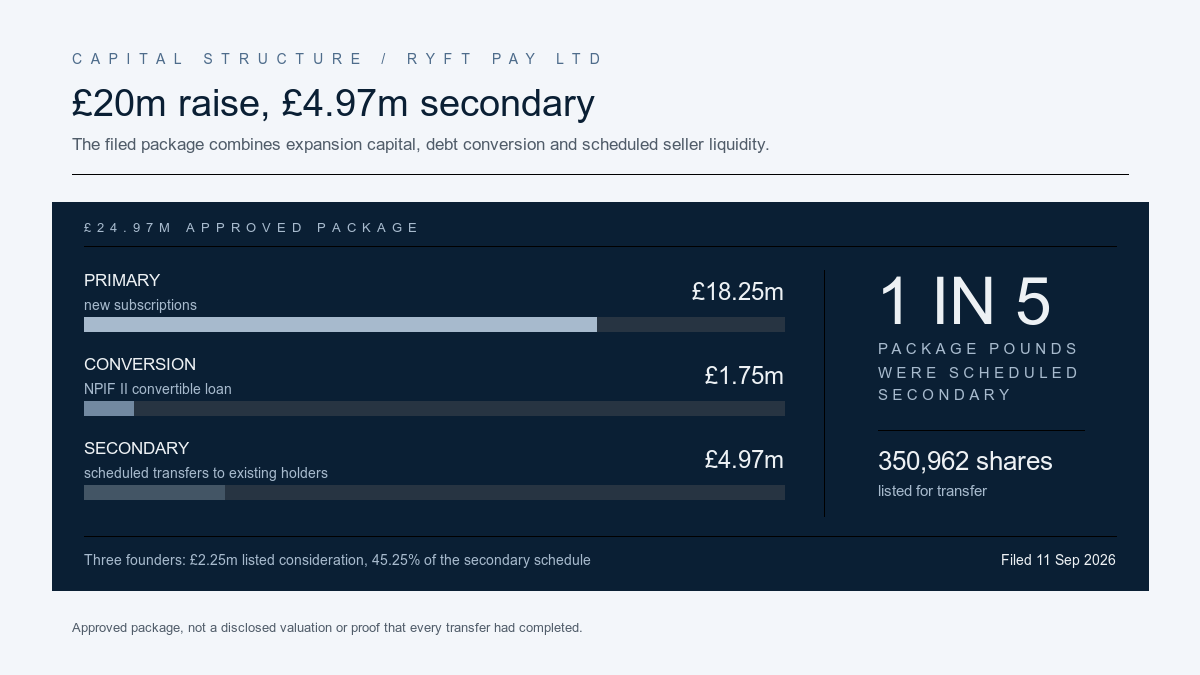
Ryft's £20 million Series B was attached to a larger signed financing package. The company's 21 August 2026 board resolutions approve £18.25 million of new subscriptions, a £1.75 million convertible-loan conversion and a £4.97 million schedule of secondary share transfers. On the filed numbers, roughly one pound in every five of the £24.97 million package was liquidity for existing holders rather than new cash for Ryft.
The three founders named in the schedule were each listed for £749,999.27 of share transfers. The same package gives Gresham House an investor-director appointment and creates a new preferred and ordinary B share structure. The resolution records an approved transaction package, not proof that every subscription and transfer had completed at the time of filing. It does, however, change the economic reading of the public round: expansion capital, debt conversion, governance and early-holder liquidity were negotiated together.
The £20m headline is the primary side
Ryft's announcement describes a £20 million Series B led by Gresham House, with Pembroke VCT and Ingenii returning and NPIF II joining through the Northern Powerhouse Investment Fund. Ryft says the money will fund European and US expansion, product development and a licence application in Malta. It also reports that processing volume tripled in the prior year and that more than 6,500 businesses use the platform.
Independent coverage by EU-Startups reports the same £20 million amount, investor group and international push. The public version is therefore clear about the operating ambition. It does not separate money paid into the company from money paid to earlier shareholders, or explain how the NPIF II capital reached the cap table.
The Companies House profile identifies Ryft Pay Ltd, company number 12128364, as an active Manchester private company incorporated in 2019. The decisive filing is a set of directors' resolutions received on 11 September 2026 and signed on 21 August. It lays out the subscriptions, loan conversion, share transfers, new articles and board changes in one package.
A £4.97m secondary schedule sits beside the raise
The resolutions approve the transfer of 350,962 existing ordinary shares at £14.1667 each. The aggregate consideration is £4,971,973.39. The listed transfers therefore equal 19.91% of the £24,971,972.15 package calculated from the filing's primary subscriptions, loan conversion and secondary schedule.
| Package component | Amount | Economic destination |
|---|---|---|
| New investor subscriptions | £18,249,998.76 | Ryft's primary financing, subject to the transaction documents |
| NPIF II convertible-loan conversion | £1,750,000 | Existing debt exchanged for new shares |
| Scheduled secondary transfers | £4,971,973.39 | Existing holders selling 350,962 shares |
| Total listed consideration | £24,971,972.15 | The approved package, not a disclosed valuation |
That split is the article's central finding. A £20 million financing headline can describe the primary subscriptions plus the converted loan while leaving a separate liquidity window outside the number. The documents do not turn the £24.97 million package into a company valuation, and the secondary price is not a public statement of Ryft's enterprise value.
Each founder was scheduled to sell £750,000
The secondary schedule names Seyed Sadra Hosseini, Alexander James Mackenzie and Richard Mark Cameron Kirby as sellers of 52,941 shares each. At the filed price, each transfer is worth £749,999.27. Together, the founders' sales total £2,249,997.81, or 45.25% of the secondary consideration.
| Seller group | Shares transferred | Listed consideration |
|---|---|---|
| Sadra Hosseini | 52,941 | £749,999.27 |
| Alexander Mackenzie | 52,941 | £749,999.27 |
| Richard Kirby | 52,941 | £749,999.27 |
| Three founders combined | 158,823 | £2,249,997.81 |
| Other named holders and nominee vehicles | 192,139 | £2,721,975.58 |
The rest of the schedule covers Lorenz Bogaert, Alister and Victoria Esam, and three nominee vehicles. The filing does not state why any seller chose to transfer shares, whether a seller retained a different class, or whether the scheduled transfers were completed. Those are separate questions from the arithmetic of the package.
Debt conversion and new share classes change the capital stack
NPIF II - Equity NW LP is listed as receiving 123,529 Preferred B Shares and 123,529 Ordinary B Shares in full satisfaction of a £1.75 million convertible loan. The other investors are scheduled to subscribe for 1,283,046 Preferred B Shares and 1,283,046 Ordinary B Shares for £18,249,998.76.
| Filing mechanic | Quantity or amount | Why it matters |
|---|---|---|
| Primary new shares | 1,283,046 Preferred B plus 1,283,046 Ordinary B | New money enters through two linked classes |
| NPIF II conversion | 123,529 Preferred B plus 123,529 Ordinary B | Debt becomes equity inside the new structure |
| Existing A shares re-designated | 1,603,852 | Earlier holders move into A-1, A-2 and A-3 classes |
| Option pool top-up | 490,265 ordinary-share options | A larger future employee pool is authorised |
The resolution also authorises new articles and the re-designation of existing A shares into A-1, A-2 and A-3 classes. That makes the round more than a cash subscription. It is a reset of the capital architecture in which the incoming investors, the converting lender, earlier holders and employees receive distinct routes through the new share and option structure.
The new articles are not treated here as a complete preference or control model. The public filing set supports the existence of the classes and the transaction mechanics, but not a final economic waterfall for each holder after a sale or liquidation.
Gresham House gained a formal board seat
The resolutions appoint Rohit Mathur as an investor director nominated by the Gresham House investors and approve the resignation of Eric Van der Kleij. Companies House filings record Mathur's appointment and Van der Kleij's termination on 21 August 2026. This is a concrete governance change attached to the financing, not an inference from Gresham House being named as lead investor.
The resolutions name Gresham House Manager rights in the transaction documents and identify Pembroke and Ingenii in the super-majority definition of the new articles. They do not disclose a final voting percentage or show which investor controls the board after all scheduled issuances and transfers. The safe conclusion is narrower: Gresham House received a documented investor-director route while the capital structure was being rebuilt.
Why the distinction matters to financing diligence
For a payments company expanding across borders, primary cash is the operating fuel. Secondary liquidity is a different economic flow. It can give founders and early holders room to realise part of a position, while new investors and a converting lender receive the securities and governance rights needed for the next phase.
That combination is not unusual, but it changes how a buyer, lender or later investor should read the round. The public announcement tells the market about Ryft's product, licence plans and growth. The filing tells the market that the same transaction also moved £4.97 million to sellers and replaced a £1.75 million loan with equity. Open Cosmos' preferred financing shows why a funding headline cannot substitute for understanding security terms. Hackuity's ratchet structure shows a related problem from the dilution side. Ryft adds a liquidity and governance layer.
The strongest ordinary business explanation is that the company needed a clean cap table before an international expansion, while the founders and earlier holders wanted partial liquidity and NPIF II needed to convert its loan. That explanation is compatible with the filing. It does not answer whether the scheduled transfers completed, what the final register of members looks like or how the new classes rank in a sale.
The next decision-changing records are a post-completion allotment or confirmation statement, a final shareholder list or a transaction document that identifies the buyers on the secondary schedule. Until those records are filed, the defensible conclusion is specific: Ryft's £20 million Series B was approved alongside £4.97 million of secondary liquidity, a £1.75 million debt conversion and a Gresham House investor-director seat.
Continue reading
Related Research
Open Cosmos' Founder Held About 41% Before Its €300m Round
Open Cosmos' €300m round sits above a register where founder Rafael Jorda held about 41% of stated capital and preferred shares ranked ahead of ordinary.
Hackuity's $19m Round Carries a 243,860-Share Ratchet
Hackuity's $19m round includes a €7m cash tranche, a bond conversion and a ratchet ceiling that could add 243,860 shares to the capital structure.
Foundever's Debt Rescue Gave Participating Lenders 40% of Equity
Foundever cut nearly $900m of debt, while S&P says participating lenders received 40% of equity and existing owners invested $225m as maturities moved to 2030 and 2031.
CloudNC’s $20m announcement sits beside a voting preferred-share filing
CloudNC announced $20m, while its latest SH01 records 44.9m voting Series B shares with priority economics, no named allottees and no direct currency match.