
Hackuity's $19m Round Carries a 243,860-Share Ratchet
Hackuity's $19m round includes a €7m cash tranche, a bond conversion and a ratchet ceiling that could add 243,860 shares to the capital structure.
On this page
Conduct your own private market research
Add dossaro to Claude or ChatGPT and run source-backed register research from your own workspace.
 Add to Claude
 Add to ChatGPT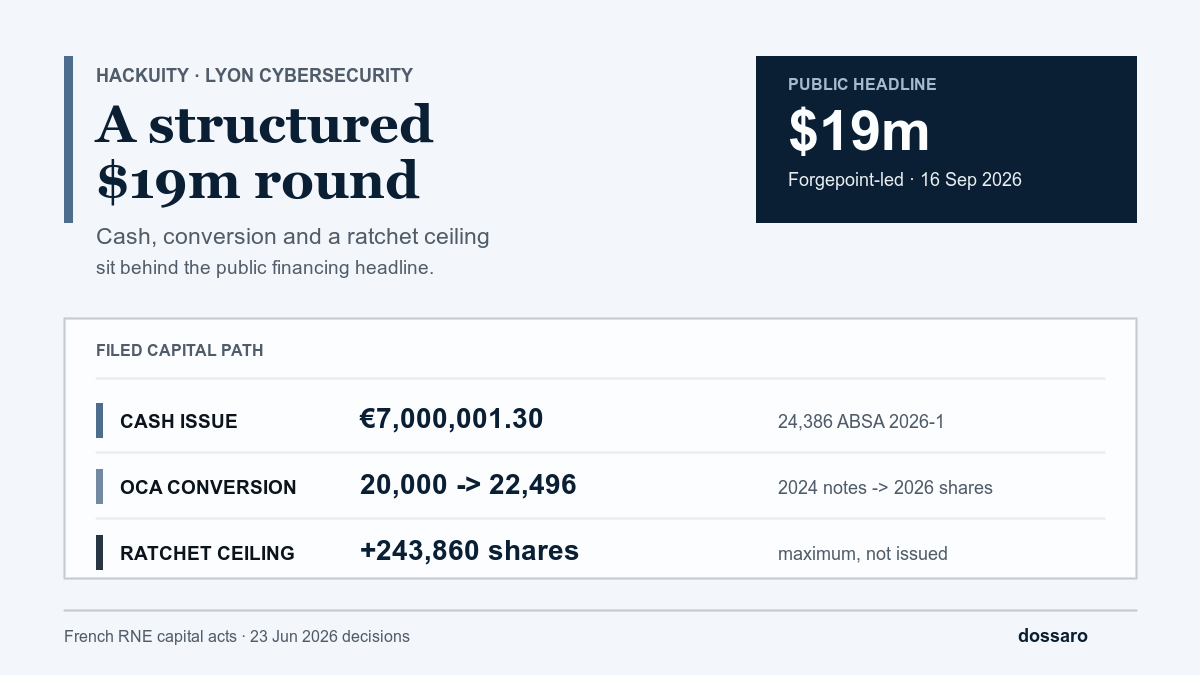
Hackuity's $19 million funding headline sits on a more specific capital structure. French filings show a €7,000,001.30 cash tranche that created 24,386 shares, the conversion of 20,000 convertible bonds into 22,496 more shares, and warrants that could create up to 243,860 additional shares if their ratchet terms are triggered. The public announcement is a dollar amount; the filed record is an instrument map.
That distinction changes the investor question. This is not evidence that the full $19 million was paid into Hackuity as cash, and it is not evidence that the maximum ratchet has been exercised. It is evidence that the Lyon cybersecurity company raised capital through a layered structure in which existing holders' eventual dilution depends on instruments and triggers, not just the round headline.
The public round is clear; its mix is not
Hackuity announced the round on 16 September 2026. Bpifrance's release says Forgepoint Capital led a $19 million investment, bringing reported total funding to $38 million. Bright Pixel, Bpifrance and Seventure are named as existing investors. Forgepoint's investment note describes the same round and says Hackuity's platform connects more than 130 security tools. SecurityWeek independently reports the $19 million raise and the company's earlier funding.
The public account explains the commercial use of the money: vulnerability operations, artificial-intelligence development and international expansion. It does not identify the security type, the number of shares issued or the relationship between the dollar headline and the euro-denominated capital documents. The French register supplies that missing layer.
A €7m tranche created 24,386 shares
The 8 June 2026 unanimous shareholder decisions authorised a private issue of 24,386 ordinary shares labelled AO2026. Each share carried a BSA Ratchet 2026-1 warrant, together forming an ABSA 2026-1. The subscription price was €287.05 per share, including €277.05 of issue premium.
The president's 23 June decision records the completion of the issue. A Caisse d'Epargne certificate confirms that €7,000,001.30 was deposited for Hackuity's capital increase. The president's filing says the 24,386 shares raised nominal capital by €243,860 and brought the company from €1,061,100 to €1,304,960 before the bond conversion.
| 2026 instrument | Filed amount or count | What the record establishes |
|---|---|---|
| Cash ABSA 2026-1 issue | €7,000,001.30 | 24,386 new shares subscribed in cash |
| Nominal capital increase | €243,860 | 24,386 shares at €10 nominal value |
| Subscription price | €287.05 per share | €277.05 issue premium per share |
| Attached BSA Ratchet 2026-1 | Up to 10 shares per warrant | Maximum is contingent, not an issued share count |
The arithmetic is exact: 24,386 multiplied by €287.05 equals €7,000,001.30. The certificate proves that deposit, not that the $19 million announcement and the €7 million tranche are the same amount. Exchange rates, other securities or other parts of the round may sit outside this filing.
The old bonds became 22,496 new shares
The same 2026 decisions modified the terms of 20,000 OCA 2024 convertible bonds issued in July 2024. Once the cash issue was completed, those bonds converted into 22,496 new AO2026 shares, each also carrying a BSA Ratchet 2026-1. The president's 23 June filing records the conversion and raises nominal capital from €1,304,960 to €1,529,920.
The conversion is a separate economic event from the cash issue. It turns a debt-like instrument into equity and gives the bondholders the same warrant-linked share label as the new cash subscribers. It also means the 46,882 AO2026 shares in the current statutes are not a simple proxy for cash paid in the 2026 round: 24,386 came from the cash subscription and 22,496 came from the conversion.
The updated statutes list 152,992 issued ordinary shares: 64,398 AO shares, 41,712 AO2022 shares and 46,882 AO2026 shares. AO2026 therefore represents 30.64% of the current issued share count. That is current issued dilution, not a forecast of who owns the company. The filings do not identify the private-placement subscribers in the public extracts, and the evidence does not support an investor percentage or a founder outcome.
The ratchet is a ceiling, not today's dilution
The 8 June decisions authorise up to 243,860 additional AO2026 shares on exercise of the BSA Ratchet warrants. The documents describe a maximum of ten new shares for each BSA Ratchet 2026-1. This is the central capital-structure risk in the filing, but it is a contractual ceiling rather than a statement that the shares exist today.
| Capital state | Shares | Share of the relevant total |
|---|---|---|
| Current issued ordinary shares | 152,992 | 100% of issued capital |
| AO2026 shares already issued | 46,882 | 30.64% of issued capital |
| Maximum additional ratchet shares | 243,860 | 61.45% of a fully diluted 396,852-share ceiling |
If every authorised ratchet share were issued, the denominator would rise to 396,852 shares and the contingent block would equal 61.45% of that theoretical total. That calculation does not predict an exercise, a trigger or a holder's eventual stake. It shows why the headline financing amount is not enough to model dilution: the answer depends on the warrant terms and the conditions that may activate them.
Earlier rounds explain the base underneath the new class
Hackuity's prior filings show why the 2026 class cannot be read in isolation. A 29 July 2022 shareholder decision recorded a €4 million capital increase for 19,268 shares. Caisse des Dépôts et Consignations subscribed €1 million for 4,817 shares, while SONAE Investment Management subscribed €3 million for 14,451 shares. The 2022 RNE act records those named allocations and the associated premium.
| Date | Capital event | Filed result |
|---|---|---|
| 29 Jul 2022 | Priced share issue | €4m for 19,268 shares, reserved to CDC and SONAE |
| 16 Nov 2023 | Employee option exercise | 85 BSPCE exercised; capital reached €1,061,100 |
| 24 Jul 2024 | Convertible issue | 20,000 OCA 2024 issued, later converted in 2026 |
| 8–23 Jun 2026 | ABSA issue and conversion | €7m cash tranche, 22,496-share conversion and ratchet warrants |
The 2023 act records 85 BSPCE exercises from the employee plan approved in 2020. The 2024 statutes record the 20,000 OCA 2024 issuance. Those steps are not a complete cap table, but they establish a sequence from priced shares to employee options, then convertible debt and finally warrant-linked ABSA shares.
What the structure means for investors
For Forgepoint and the other undisclosed 2026 subscribers, the filings point to more than a plain-vanilla equity cheque. They received or were allocated a share class with attached ratchet warrants, while the OCA holders moved into the same AO2026-labelled class through conversion. Existing holders, including the named 2022 investors, face dilution if the warrants are exercised. Employees have a separate historical option path, but no current employee percentage follows from these documents.
That is the commercial consequence of the structure. A financing headline tells a reader how much a company says it raised. The filing tells investors which instruments can change the denominator later. The Kaiko share-funded roll-up shows the same modelling problem from another angle: new shares can finance an expansion of the asset base without looking like cash proceeds. Open Cosmos' preferred waterfall shows why a visible share count still does not answer payout order. Hackuity adds a trigger-dependent layer to that diligence work.
The register still leaves one narrow question open. It does not connect the $19 million public figure to a full security-by-security schedule, name every subscriber in the public extracts or show any actual ratchet exercise. The next decision-changing record would be a later capital filing or a disclosed financing schedule that identifies the subscribers, the conversion terms and whether any BSA Ratchet warrants were exercised.
The precise conclusion is therefore stronger than the headline but narrower than a valuation claim: Hackuity's round included a documented €7 million share issue and a 20,000-bond conversion, and it placed a potential 243,860-share ratchet behind the current 152,992-share capital. Investors can model the ceiling. They cannot yet turn the public $19 million into a complete ownership map.
Continue reading
Related Research
Kaiko's $110m Round Arrived With a €35.5m Share-Funded Roll-Up
Kaiko's $110m strategic round arrived beside €35.5m of share-funded acquisitions, issuing 553,134 shares while investor allocations remain undisclosed.
Open Cosmos' Founder Held About 41% Before Its €300m Round
Open Cosmos' €300m round sits above a register where founder Rafael Jorda held about 41% of stated capital and preferred shares ranked ahead of ordinary.
Depotcharge's €2.7m Pre-Seed Still Leaves Evolve Energy 50/50
Depotcharge announced a €2.7m pre-seed, but Evolve Energy's latest register still shows founder vehicles owning 50% each with no investor allotment visible.
Ontinue Sale Follows Quorum's £93.8m Topco Equity and £27m Debt
EQT is selling Ontinue to Quorum, while filings show a 2024 sponsor control transfer, £93.8m of topco equity and £27m of secured debt behind the platform.