
Open Cosmos' Founder Held About 41% Before Its €300m Round
Open Cosmos' €300m round sits above a register where founder Rafael Jorda held about 41% of stated capital and preferred shares ranked ahead of ordinary.
On this page
Conduct your own private market research
Add dossaro to Claude or ChatGPT and run source-backed register research from your own workspace.
 Add to Claude
 Add to ChatGPT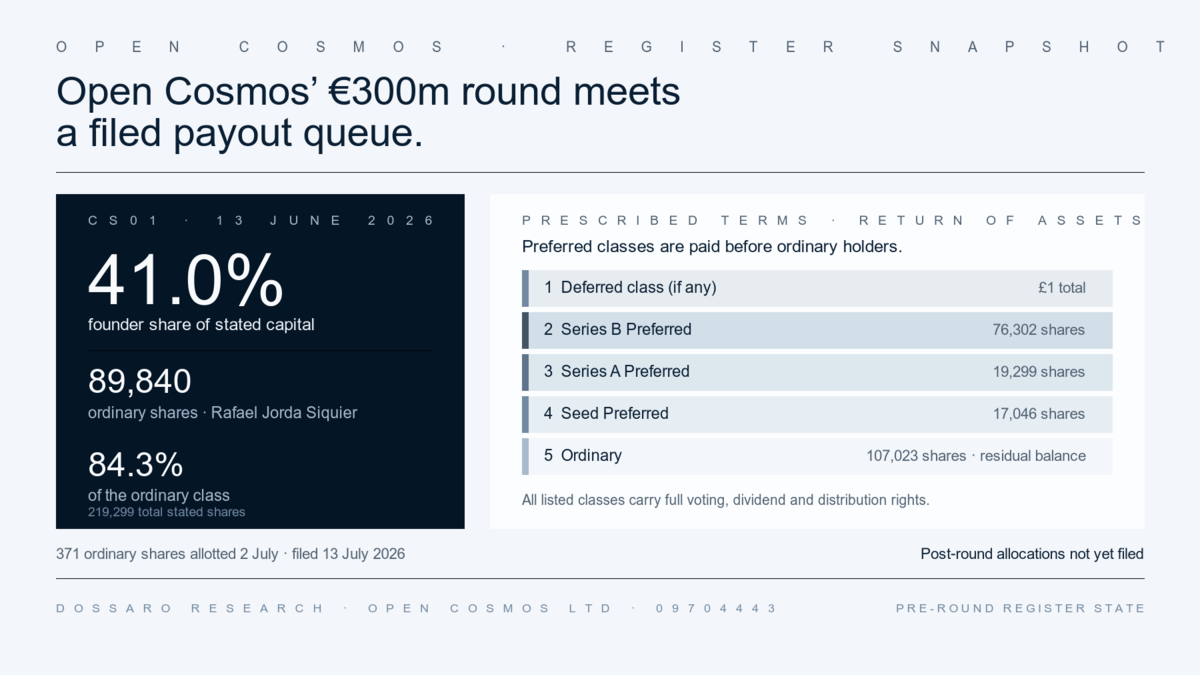
Open Cosmos announced a €300 million financing on 14 September 2026 as it expands satellite manufacturing and real-time intelligence services across Europe. The public event sits beside a more specific register finding: at the latest UK confirmation statement before the announcement, founder and chief executive Rafael Jorda Siquier held 89,840 ordinary shares, about 41.0% of the company’s 219,299 stated shares and about 84.3% of its ordinary class.
That position is economically less simple than the headline percentage suggests. Open Cosmos’ prescribed particulars place Series B preferred shares ahead of Series A, Seed preferred and ordinary shares in a return of assets. Preferred classes also have full voting, dividend and distribution rights. The register therefore shows a founder with most ordinary shares and a large stated-capital position, but not a founder with first claim on every pound of a sale or liquidation.
The public announcement does not yet show how the €300 million was allocated across those classes. The latest visible allotment added only 371 ordinary shares on 2 July, filed on 13 July. As of this evidence cutoff, the post-announcement investor allocation and any new rights remain a filing watchpoint.
The €300m headline is industrial capacity, not a cap table
Open Cosmos’ announcement describes €300 million raised from a syndicate led by Lightrock, with ETF Partners, the International Climate Finance Accelerator, Entrepreneurs First and two international pension funds. Convex Group, the National Security Strategic Investment Fund, Phoenix Court and Claret also participated. The company links the funding to satellite mass manufacturing, its OpenConstellation service and a UK sovereign communications framework.
Open Cosmos says it has factories across Europe, can produce one satellite a day, has reduced Earth-observation delivery from 48 hours to 30 minutes and has more than $370 million in signed contracts over the past three and a half years. It says it employs close to 400 people in the UK, Spain, Portugal and Greece. The Next Web’s independent report confirms the €300 million raise, the European factory expansion, the contract figure and the delivery-time claim.
Those sources establish the event, scale and industrial plan. They do not disclose an issue price, the number of shares issued, the post-money valuation or the allocation between ordinary and preferred classes. A financing announcement can describe cash available to the operating group while leaving the legal and economic split between holders for later filings. The Companies House record answers that narrower ownership question only up to its confirmation-statement date.
The exact UK entity is Open Cosmos Ltd, company number 09704443, incorporated in 2015. Its Companies House profile identifies the active private company and links the filing history used for this comparison. The announcement also names related operating entities in Spain, Portugal and Greece, but the UK share register is the source for the percentages in this article.
The founder percentage rose while the denominator changed
The 2025 confirmation statement dated 13 June recorded 221,502 total shares and 88,200 ordinary shares for Jorda Siquier. That is 39.8% of stated capital. The 2026 confirmation statement, also dated 13 June, recorded 219,299 total shares and 89,840 ordinary shares for him. The raw calculation is 89,840 divided by 219,299, or 40.97%, which rounds to 41.0%.
The ordinary-class denominator moved differently. In 2026 the company reported 106,652 ordinary shares, making Jorda’s 89,840 shares about 84.3% of that class. The 2025 holder list’s ordinary entries sum to 102,294, which places his 88,200 shares at about 86.2% of ordinary holdings at that earlier snapshot. His ordinary block increased by 1,640 shares, while the total stated-capital denominator fell by 2,203 shares.
| Register snapshot | Total stated shares | Jorda ordinary shares | Jorda share of stated capital | Jorda share of ordinary class |
|---|---|---|---|---|
| 13 June 2025 CS01 | 221,502 | 88,200 | 39.8% | 86.2% calculated |
| 13 June 2026 CS01 | 219,299 | 89,840 | 41.0% calculated | 84.3% calculated |
| Change between snapshots | -2,203 | +1,640 | +1.1 percentage points | -1.9 percentage points |
The table is a state-to-state comparison, not a transaction ledger. The 2026 filing contains 56 holder entries across ordinary, Seed Preferred, Series A Preferred and Series B Preferred classes. Some positions changed, some were recorded at zero and the class totals are not a clean continuation of a single issuance series. The denominator change can reflect conversions, redesignations or other corporate actions. It does not prove that the founder purchased shares, negotiated a particular outcome or caused the percentage to rise.
The comparison shows why a public financing story should be tested against the latest legal state before anyone describes a founder as diluted or displaced. Ordinary-share percentages and stated-capital percentages are not interchangeable measures of control or proceeds.
The visible July allotment is only 371 ordinary shares
Open Cosmos filed a statement of capital on 13 July for an allotment made on 2 July 2026. The SH01 records 371 ordinary shares, each with a nominal value of £0.001, paid in cash with no amount unpaid. After that filing, the statement of capital total was 219,670 shares. The class breakdown was 107,023 ordinary, 17,046 Seed Preferred, 19,299 Series A Preferred and 76,302 Series B Preferred shares.
This filing matters because it is the closest visible share issue to the public announcement, but it is not a €300 million reconciliation. At nominal value, the 371 shares represent only £0.371 of share capital. A subscription premium, a separate instrument or a later allotment could carry the financing economics. The SH01 does not identify subscribers, issue price or whether the shares relate to the announced round.
The company had also filed a written resolution passed on 23 March 2026. It authorised directors for five years to allot shares or grant conversion rights up to an aggregate nominal amount of £72.39, equivalent to 72,390 shares at £0.001 nominal value. That authority describes capacity to issue securities. It is not evidence that the authority funded the September financing, nor does it disclose the terms of any subsequent subscription.
The chronology is therefore precise but limited: a 371-share ordinary allotment was made on 2 July, filed on 13 July, and a €300 million financing was announced on 14 September. The public record does not yet connect those events through a post-round statement of capital. Treating the July allotment as the full financing would be as unsupported as treating the headline as proof of a particular founder dilution.
Preferred rights put ordinary shares at the back of the payout queue
The 2026 confirmation statement repeats prescribed particulars for each class. On a return of assets after liabilities, any deferred class is paid first, followed by Series B preferred, Series A preferred, Seed Preferred and then the balance to ordinary shareholders. Each preferred class receives the higher of its preference amount or the amount it would have received on conversion into ordinary shares immediately before the return of capital. The document also says every preferred class has full voting, dividend and distribution rights.
| Class | Shares at 13 June 2026 CS01 | Position in prescribed order | Rights stated in filing |
|---|---|---|---|
| Deferred, if any | Not stated | First, £1 for the class | Class-specific; no amount of shares stated |
| Series B Preferred | 76,302 | Second | Full voting, dividend and distribution rights |
| Series A Preferred | 19,299 | Third | Full voting, dividend and distribution rights |
| Seed Preferred | 17,046 | Fourth | Full voting, dividend and distribution rights |
| Ordinary | 106,652 | Residual balance | Full voting, dividend and distribution rights; no redemption right |
The ordering is the article’s central economic finding. Jorda’s ordinary block can carry most ordinary votes while remaining junior to three preferred classes in a liquidation waterfall. The filing does not supply the preference amounts, the company’s valuation or the proceeds available in a hypothetical sale, so no payout percentage can be calculated. It does show that “41% founder holding” is not the same as “41% of exit proceeds.”
That distinction is familiar in private-market financing. Ground A’s pre-seed analysis separates a founder block from the nominal value and terms of newly created shares. INLEAP’s cumulative funding analysis likewise distinguishes a funding headline from a dated shareholder list. Open Cosmos adds a preferred-class queue to that comparison: ordinary voting weight can coexist with senior economic claims.
Nor does the register establish ultimate beneficial ownership or a complete governance picture. The Companies House PSC record identifies Jorda in a 25% to 50% share and voting-rights band, but the company’s articles, shareholder agreements, board rights and any investor consent arrangements are not reproduced in the confirmation statement. The evidence supports a direct ordinary holding and a filed PSC classification, not a conclusion about every control decision.
What investors can and cannot infer from the record
For investors, the public announcement supports a clear operating thesis. Open Cosmos has secured substantial capital for satellite production, service delivery and sovereign communications work, alongside a reported contract base and a multi-country manufacturing footprint. The independent reporting supports the event and its industrial framing.
The register adds a different decision point. Before the announcement was reflected in a UK filing, the founder still held about 41.0% of stated capital and about 84.3% of ordinary shares. The visible July allotment does not explain the €300 million. Preferred classes sit ahead of ordinary in the prescribed return-of-assets order. These facts are compatible with a founder retaining a large ordinary position while investors hold senior economic protection.
The record does not disclose the post-round number of shares, the new holders, issue prices, preference amounts, conversion outcomes, valuation, investor vetoes or board appointments. It also does not prove that the September financing used the 23 March authority or the 2 July allotment. Those omissions are not a flaw in the announcement; they are the boundary between public event reporting and filed company evidence.
The next decision-changing documents are a post-round SH01 or confirmation statement and any public articles or shareholder-rights filing. They should show whether new Series B, Series A, Seed or ordinary positions were created, whether the founder’s ordinary percentage moved and whether the capital-class totals changed. Until then, the strongest supported thesis is narrow: Open Cosmos’ €300 million round arrived while the founder retained most ordinary shares, but the filed waterfall places preferred capital ahead of ordinary holders for a return of assets.
Sources
Continue reading
Related Research
Ground A's €9.1m pre-seed leaves each founder at 22.75%
Ground A's €9.1m pre-seed created 31.75% of new shares, leaving each founder vehicle at 22.75% and Vsquared Ventures III at 14.17% in the latest register.
INLEAP’s €20m Funding Headline Was Cumulative; Founders Held 80% in the 2025 List
INLEAP says it has raised about €20m since founding, while its latest filed shareholder list shows founder holding companies with 80% and outside holders with 20%.
HyImpulse's €50m Round Lands on a 76.43% Holding Block
HyImpulse's €50m financing meets a register where HylImpulse Holding and Schwarz Holding held 76.43% before the round, leaving post-round control unresolved.
Hackuity's $19m Round Carries a 243,860-Share Ratchet
Hackuity's $19m round includes a €7m cash tranche, a bond conversion and a ratchet ceiling that could add 243,860 shares to the capital structure.