
Foundever's Debt Rescue Gave Participating Lenders 40% of Equity
Foundever cut nearly $900m of debt, while S&P says participating lenders received 40% of equity and existing owners invested $225m as maturities moved to 2030 and 2031.
On this page
Conduct your own private market research
Add dossaro to Claude or ChatGPT and run source-backed register research from your own workspace.
 Add to Claude
 Add to ChatGPT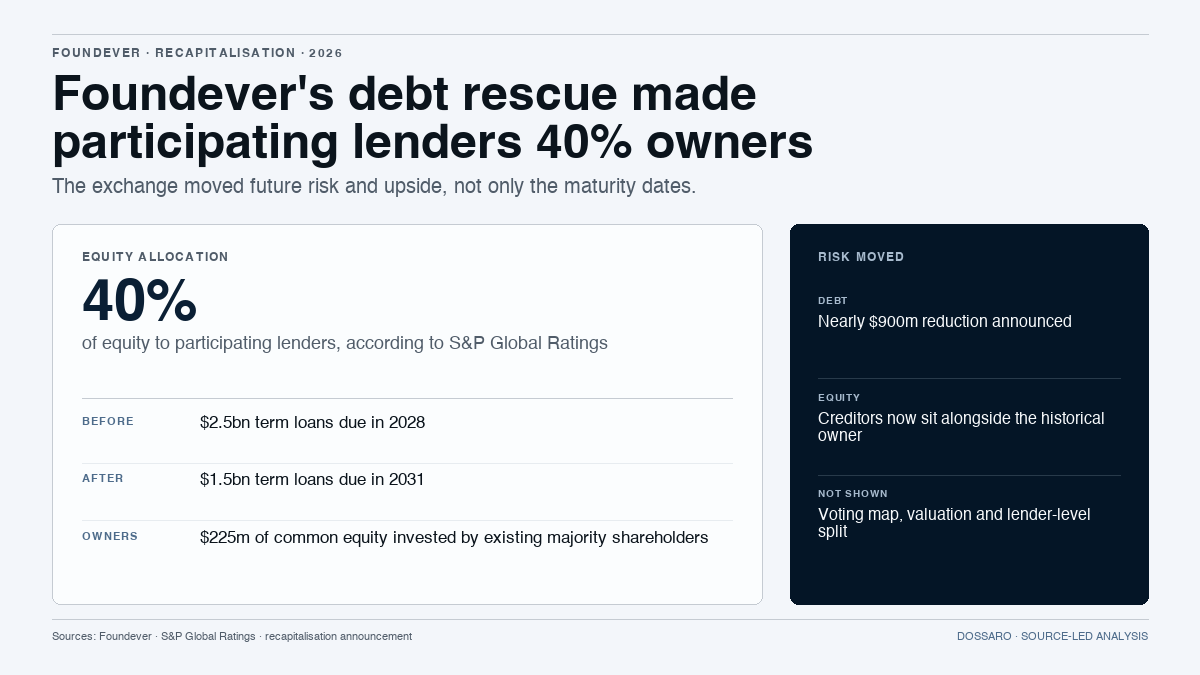
Foundever’s recapitalization did more than remove debt from the balance sheet. S&P Global Ratings says participating lenders received 40% of the company’s equity as approximately $2.5 billion of term loans due in 2028 were exchanged for about $1.5 billion of new term loans due in 2031. Existing majority shareholders invested $225 million of common equity, while the company said the overall transaction reduced debt by nearly $900 million.
That is a transfer of future risk and potential upside, not only a maturity extension. The customer-experience group still has its historical owner in the transaction, but creditors now sit in the equity alongside it. Foundever’s public announcement describes a holistic recapitalization designed to support long-term growth. The ratings account adds the more consequential capital-markets fact: lenders took an ownership position as part of the rescue.
The terms show a capital-stack reset
The public record describes a coordinated transaction with 95.4% of term lenders, all revolving-credit-facility lenders and the existing majority shareholders. Foundever’s own announcement says the term-loan exchange reduced total debt by nearly $900 million, the revolving credit facility was extended to December 2030, and the term loan was extended to March 2031. It also announces a new three-year, $225 million global accounts-receivable facility that replaces the group’s previous factoring arrangements.
S&P’s analysis supplies the bridge between those headline terms and the ownership change. It says a large portion of approximately $2.5 billion of term loans due in 2028 was exchanged for approximately $1.5 billion of new term loans due in 2031. It separately describes a $250 million debt paydown funded with owner equity and existing cash, and says 40% of the equity was distributed to participating lenders.
| Recapitalization element | Publicly reported term | Economic reading |
|---|---|---|
| Term-loan exchange | About $2.5bn due 2028 to about $1.5bn due 2031 | Less near-term principal, with creditors accepting a different risk and recovery profile |
| Owner common equity | $225m | Existing majority shareholders put new cash behind the reorganized capital stack |
| Lender equity | 40% of equity, according to S&P | Participating lenders moved from pure creditors into an ownership position |
| Debt reduction | Nearly $900m, according to Foundever | Lower stated debt burden, without eliminating operating or refinancing risk |
| New receivables facility | $225m for three years | Working-capital liquidity replaces the previous factoring structure |
| Maturities | RCF December 2030; term loan March 2031 | More time to execute, but repayment remains ahead |
The figures should not be collapsed into one “deleveraging” number. The nearly $900 million reduction is a company description of the total effect. The $1.0 billion difference between the old and new term-loan amounts in S&P’s account is a separate description of the exchange and may include the paydown and other transaction mechanics. No public source used here provides a lender-by-lender allocation or a final post-transaction cap table.
Lenders became owners, but the voting map is still unknown
S&P’s 40% figure is the central ownership fact. It changes the economic position of participating lenders: they no longer depend only on contractual debt service and recovery. They also hold a stake in the value created, or lost, after the recapitalization. The equity can give lenders exposure to an operational recovery, while the debt exchange and extended maturities leave them exposed to execution over a longer period.
That does not prove that lenders control Foundever. An equity percentage is not the same as voting control, board appointment power or a majority of the ordinary shares. The public materials do not identify each participating lender, explain whether the 40% is economic, voting or fully diluted equity, or show the rights attached to the new stake. The safest statement is therefore the narrow one S&P supports: participating lenders received 40% of the equity in the recapitalization.
The pre-transaction ownership context matters. S&P says Foundever has been privately owned by the Mulliez family through Creadev since 2011. Arendt, which advised Pidoll, describes the majority shareholder’s support for the liability-management exercise and the $225 million equity investment. Those facts show continuity of an existing owner’s financial commitment, but they do not reveal the owner’s final percentage after the lender distribution.
For comparison, Lowell’s creditor-equity reset shows why a debt rescue should be read as an ownership event. A creditor can receive equity without becoming the day-to-day operator, and the final commercial result depends on governance documents, recovery terms and the value of the business after the reset.
A lower debt number does not remove the risk
Foundever’s announcement emphasizes the balance-sheet relief. That is a reasonable company framing: reducing debt and extending maturities can create time to invest, refinance and stabilize operations. But S&P rated the transaction “tantamount to default” because debtholders received less value than promised under the original terms, and it lowered the issuer rating to D from CCC. That is not a claim that the company entered a formal insolvency proceeding. It is S&P’s assessment of the economic treatment of the debt exchange.
The distinction matters for readers evaluating the rescue. A liability-management exercise can preserve a business while still imposing a loss or concession on creditors. Here, lenders received equity and longer-dated debt in exchange for accepting a different package of value. Existing owners supplied cash, but the owner’s contribution does not by itself tell us whether the recapitalization restored sustainable leverage or merely moved the next financing decision further out.
The maturity dates also make the trade-off visible. The RCF now runs to December 2030 and the term loan to March 2031. That runway may help Foundever execute an operating plan, but it leaves the reorganized company with obligations that must eventually be serviced or refinanced. The lender equity stake makes the same institutions sensitive to both sides of that outcome: cash generation that supports debt repayment and enterprise value that supports their equity.
The receivables facility changes the liquidity plumbing
The new $225 million global accounts-receivable facility is a second structural change. Foundever says it replaces the group’s previous factoring arrangements and will run for three years. S&P says the revolving facility will be reduced to $175 million when the receivables facility begins. That suggests the transaction is not limited to a term-loan exchange. It also changes how working capital is funded and how much general-purpose revolving capacity remains available.
The public sources do not disclose the advance rate, eligibility rules, pricing, recourse, country scope or covenant package for the receivables facility. Those details determine how much of the headline amount can be drawn in practice and what happens if customer collections weaken. The defensible conclusion is narrower: a dedicated receivables facility gives Foundever a replacement liquidity channel, while the existing RCF becomes smaller once that channel is operating.
Leadership changed alongside the financing
Foundever said Laurent Uberti and Olivier Camino stepped down from their roles on 31 July 2026 and that Benoit Leclercq became interim CEO. The company presented the recapitalization as support for long-term growth and said the group would continue serving its customers. Those statements are relevant to operational continuity, but they do not erase the financial reset.
Leadership turnover can matter to a creditor-owned company because the new equity holders need confidence in the operating plan they are underwriting. At the same time, there is no evidence in the public sources that the interim appointment was a condition of lender ownership, that a specific lender nominated management, or that day-to-day control has already moved. The timeline supports coexistence of a management transition and a balance-sheet transition, not a causal claim about one producing the other.
What the public record still cannot answer
The recapitalization establishes a meaningful change in who bears Foundever’s future risk, but several economically decisive terms remain outside the public record. The sources do not identify the lender allocation behind the 40% equity figure, show the voting and board rights attached to that equity, state the final percentage held by the Mulliez family or Creadev, or describe the price and recovery assumptions embedded in the debt exchange.
They also do not disclose the valuation used for the lender equity, the detailed waterfall between the new term loan and equity, or whether any lender group has special consent rights. The $225 million owner investment is described as common equity, but the public announcement does not state the number of shares or the resulting ownership percentage. These are not cosmetic omissions. They determine whether the recapitalization is best understood as a minority lender participation, a negotiated co-ownership arrangement or a step toward a wider control change.
The next document to watch is therefore not another summary release. It is a post-recapitalization capitalization or shareholders’ document that identifies the participating lenders, their allocation, voting rights and any reserved matters. Until that evidence appears, the accurate reading is already strong enough: Foundever reduced debt and bought time, but it did so by putting lenders into the equity and sharing the company’s future upside and downside with them.
Sources
- Foundever recapitalization announcement reports the $225 million owner investment, nearly $900 million debt reduction, maturity extensions, receivables facility and leadership changes.
- S&P Global Ratings analysis reports the approximately $2.5 billion to $1.5 billion term-loan exchange, $250 million paydown, 40% lender equity distribution, Mulliez/Creadev ownership history and “tantamount to default” assessment.
- Latham & Watkins transaction note independently confirms the $225 million equity, debt reduction, maturity extensions and receivables facility.
- Arendt liability-management note describes advice to Pidoll and the consenting lender process.
Continue reading
Related Research
Lowell's Recapitalisation Offers Creditors the New Parent as Orlando Takes DACH
Lowell's 2026 reset offers creditors conditional new-parent equity while Orlando buys its DACH platform, linking debt relief to a cross-border carve-out.
Seqens's Lender-to-Owner Reset Exposes a €930m Acquisition Debt Stack
Seqens says senior lenders will become shareholders, while filings show Sirona BidCo carried €930m of term debt, €29k cash and a €62m dividend.
Advanced Electric Machines’ £16m Funding Is a Parent-Level Equity and Debt Stack
AEM's £16m funding headline combines parent-level preferred equity with government-backed debt secured over the operating company's IP, receivables and assets.
Ontinue Sale Follows Quorum's £93.8m Topco Equity and £27m Debt
EQT is selling Ontinue to Quorum, while filings show a 2024 sponsor control transfer, £93.8m of topco equity and £27m of secured debt behind the platform.