
Advanced Electric Machines’ £16m Funding Is a Parent-Level Equity and Debt Stack
AEM's £16m funding headline combines parent-level preferred equity with government-backed debt secured over the operating company's IP, receivables and assets.
On this page
Conduct your own private market research
Add dossaro to Claude or ChatGPT and run source-backed register research from your own workspace.
 Add to Claude
 Add to ChatGPT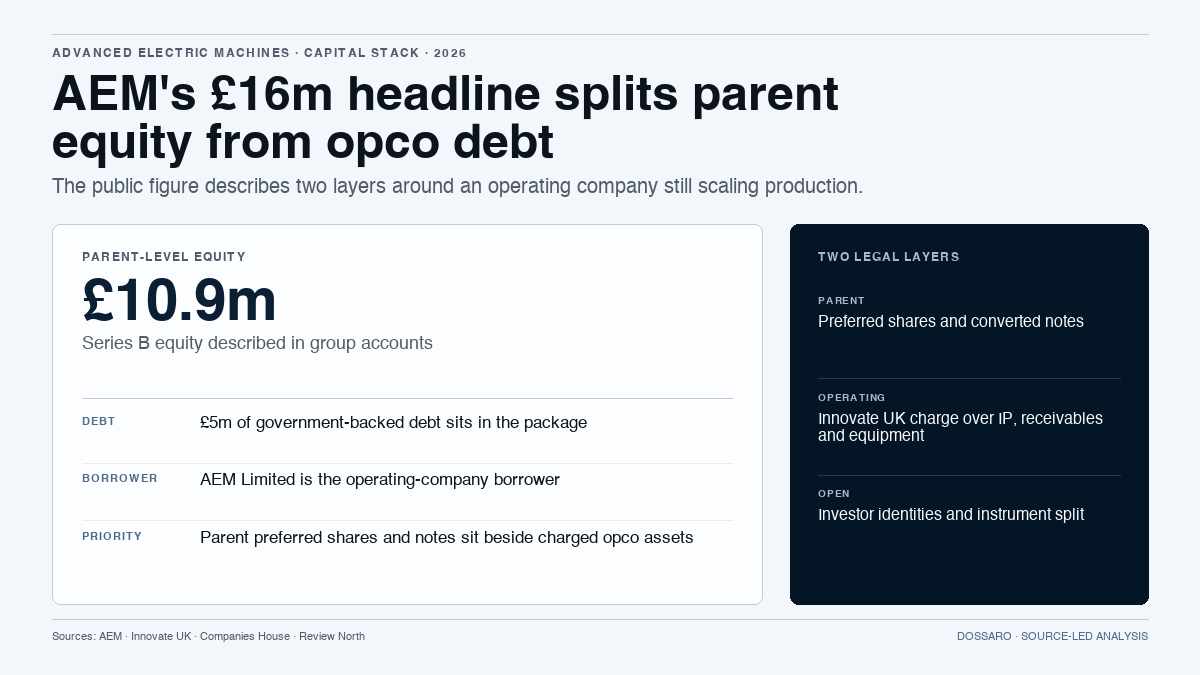
Advanced Electric Machines’ £16 million funding headline describes a capital stack, not a single operating-company equity round. Companies House filings place the new preferred shares and the earlier convertible notes at Advanced Electric Machines Group Ltd, while a registered Innovate UK debenture puts the parent’s assets around a loan to AEM Limited, the operating company. The result is a financing package with different layers of priority around a business that is still investing ahead of scale.
The distinction matters because the public announcement leaves the instrument mix open. AEM’s August news archive says its Titan heavy-duty motor is being developed with the help of a recently announced £16 million business investment. Independent coverage by Review North describes the package as combined equity and government-backed debt, including £5 million of Innovate UK support. Neither source is a cap table or a loan agreement.
The filed record fills that gap without revealing private investor identities or valuation. The parent’s 2025 group accounts describe £10.9 million of Series B equity, including £3 million of convertible loan notes issued in November 2025 and later converted, plus £5 million of government-backed debt. A June SH01 records three cash allotments of preferred shares. An August SH01 records another 111,716 preferred shares. The MR01 charge names Innovate UK Loans Limited as chargee and shows AEM Limited as borrower with the parent as chargor.
The £16m headline does not name one instrument
On the rounded figures in the accounts, £10.9 million of Series B equity plus £5 million of government-backed debt equals £15.9 million. That is close to the £16 million public headline, but it is not presented here as an exact reconciliation. The accounts and the public announcement can aggregate closings or use different timing. The share allotments provide a second check, yet their face arithmetic is also not identical to the accounts figure.
The June 2026 SH01, filed on 1 July, records cash allotments dated 9 and 10 June:
- 64,460 B2 preferred shares at £12.44 each;
- 458,049 B1 preferred shares at £12.44 each; and
- 365,832 B1 preferred shares at £8.71 each.
Those three lines total 888,341 shares and approximately £9.686 million of stated paid amounts. The filing reports 3,964,957 shares after the allotments. The August SH01, filed on 19 August for allotments dated 3 and 4 August, adds 83,580 B1 preferred shares and 28,136 B2 preferred shares at £12.44 each. The 111,716 new shares carry approximately £1.390 million of stated paid amounts and take the reported total to 4,076,673. Relative to the immediately preceding total, the August issue increased the share count by about 2.82%.
These are parent-company filings. They show cash entering the group’s equity layer, but they do not say which investors subscribed, what percentage any holder owns, or whether a named participant received a board right. The amounts paid are issue-price arithmetic, not a valuation.
Companies House places the equity at the parent
The legal separation is the first important finding. Advanced Electric Machines Group Ltd, company number 12058179, is the parent. AEM Limited, company number 10480941, is the operating company that designs and manufactures rare-earth-free motors, generators and integrated drivetrains. Their Companies House profiles and AEM Limited profile identify the two entities but do not, by themselves, explain the funding headline.
The parent’s group accounts, filed on 22 July 2026, say the group has historically relied on external funding. They report a loss before tax of about £4.75 million for the year ended 30 November 2025. The directors say the post-year-end Series B and government-backed debt support the group’s development, industrialisation and commercialisation strategy, and they prepare the accounts on a going-concern basis.
The £3 million of convertible loan notes is especially important to the sequence. The accounts say the notes were issued in November 2025 and subsequently converted into Series B shares. That makes the later preferred allotments part of a continuing parent-level financing story, not evidence that a new £16 million cheque arrived entirely in August. The filings do not identify the noteholders, conversion price or resulting ownership.
The July class filings show another piece of the reset. The SH10 and SH08 forms, both filed on 17 July, record a 9 July redesignation of 127,378 A shares, 421,607 A1 preferred shares and 85,973 A2 preferred shares into ordinary shares. Together, 634,958 shares moved out of those classes. The forms describe the resulting ordinary shares as carrying voting, dividend and capital-return rights, but they do not identify the holders. A redesignation can simplify rights without changing economic ownership, so it is not evidence of a sale or a change of control.
The operating company still carries execution risk
AEM Limited’s accounts put the capital stack next to the operating reality. The subsidiary reported £2.77 million of income and a £4.43 million loss before tax for the year ended 30 November 2025. The accounts say the HDRM150 motor completed validation and the Production Part Approval Process, with initial production deliveries to a European Tier 1 commercial-vehicle supplier beginning in the fourth quarter of 2025. The SSRD passenger-car platform remained in development.
That combination is commercially significant. AEM has crossed a validation and initial-delivery milestone, but it is not yet reporting a profitable production business in the filed period. New capital therefore funds the conversion of engineering progress into repeatable manufacturing and customer revenue. The company’s own public material says the investment accelerates electric powertrain development, while the accounts describe industrialisation and commercialisation as continuing work.
The operating company’s legal position also differs from the parent’s equity position. The June 2026 MR01 charge, created and filed on 9 July, identifies Innovate UK Loans Limited as chargee. The parent is the chargor and AEM Limited is the borrower under a debenture dated 10 June. A public lender is therefore connected to the operating risk through a parent security structure, rather than receiving ordinary shares in AEM Limited in the filings reviewed.
Innovate UK’s charge changes the priority question
The registered debenture is broad. The parsed document covers fixed and floating security over property, equipment, intellectual property, book debts, investments, bank accounts, insurance, agreements, goodwill and uncalled capital. It also contains a negative pledge. The instrument describes a first floating charge over assets not otherwise effectively charged and says security ranks ahead of third-party rights except those preferred by law.
That does not mean Innovate UK has enforced anything. The register shows a charge was created; it does not show a default, an enforcement action or a loss of assets. It does show that the government-backed debt has a documented claim around the assets that support AEM’s operations. Intellectual property, receivables and customer agreements are not abstract balance-sheet lines when a motor company is moving from validation to production. They are part of the operating platform that has to generate the cash for every layer of the stack.
The structure is easier to read when placed beside other private-market financing cases. Nscale’s debt holding company analysis shows why the entity that announces a funding round is not always the entity that owns the collateral. HyImpulse’s public-private round illustrates a different version of the same disclosure problem: a large strategic financing headline can leave the holder-level economics open. For AEM, the filings make the parent and secured-lender layers visible even though the investors remain unnamed.
| Evidence layer | What the filed record shows | Economic implication | Remaining boundary |
|---|---|---|---|
| Parent accounts | £10.9m Series B equity, including £3m converted notes, plus £5m government-backed debt | A mixed financing package supports industrialisation and going concern | The £16m public headline is not reconciled to a single closing or instrument |
| June and August SH01s | Preferred cash allotments of about £9.686m and £1.390m; August adds 111,716 shares | New cash entered the parent and the reported share count rose 2.82% in August | No investor names, valuation, holder dilution or board rights |
| SH08 and SH10 | 634,958 A, A1 and A2 shares redesignated as ordinary | Class rights were reset around the financing sequence | The forms do not identify holders or prove a control change |
| MR01 debenture | Innovate UK Loans Limited secured fixed and floating claims; parent chargor, AEM Limited borrower | IP, receivables, equipment and agreements sit inside the registered security perimeter | The charge amount, default status and enforcement outcome are not shown in the parsed window |
What the filings still cannot tell us
The filings support a precise but limited conclusion. AEM’s £16 million announcement is best understood as a parent-level equity-and-debt package around a loss-making operating business. Preferred shares and converted notes sit at the group layer. Innovate UK’s debt is documented through a security package that reaches the parent’s assets for a loan to the subsidiary. The operating company has evidence of technical progress, but the accounts still show a substantial loss before tax.
The record does not support a private investor league table. It does not reveal the post-money valuation, the percentage issued to any investor, the terms of the B1 or B2 preferences beyond the filed issue prices, or whether any holder gained control. It also does not show a default or tell us how much of the registered security has been drawn. Those are the next documents that would change the analysis.
The commercial consequence is therefore about priority and execution. Equity holders have supplied parent-level risk capital while a government-backed lender has a registered claim around assets used by the operating subsidiary. AEM must turn HDRM150 deliveries and the SSRD programme into repeatable revenue before that layered financing can be judged by outcomes rather than by runway. Until a later filing discloses the investors, conversion terms, debt balance or enforcement status, the safest description is a secured industrialisation stack, not an unencumbered £16 million growth round.
Sources and method
This analysis uses AEM’s official August news archive, the independent Review North report, and Drives & Controls coverage. The legal-entity and filing evidence comes from Advanced Electric Machines Group Ltd at Companies House and AEM Limited at Companies House. Calculations use the share counts and issue prices stated in the parent SH01 forms. They are not a valuation and do not infer undisclosed ownership, proceeds, motive, default or control.
Continue reading
Related Research
Nscale's $3bn AI Debt Sits on a New Holding-Company Security Stack
Nscale's $3bn AI-data-centre facilities follow a holding-company roll-up, a $3.695bn premium reset and GLAS charges over parent and Arkon equity.
HyImpulse's €50m Series A Turns Rocket Sovereignty Into a Public-Private Risk Bet
HyImpulse's €50m Series A extension pairs public and private capital with a €350m order book, but filings do not yet show who bears the new equity risk.
Enpulsion's Lift Me Off Deal Exposes A Funding-Dependent Handover
Enpulsion's Lift Me Off deal coincided with a founder exit, buyer-side appointment and accounts warning that funding and sale completion still mattered.
Limetax’s €36m Roll-Up Sits Beside a Regulated Auditor Parent and a Separate HQ
Limetax announced €36m for a tax-firm roll-up. German filings show a €25,000 regulated auditor owning a separate €25,000 HQ entity; the borrower remains unidentified.