
Limetax’s €36m Roll-Up Sits Beside a Regulated Auditor Parent and a Separate HQ
Limetax announced €36m for a tax-firm roll-up. German filings show a €25,000 regulated auditor owning a separate €25,000 HQ entity; the borrower remains unidentified.
On this page
Conduct your own private market research
Add dossaro to Claude or ChatGPT and run source-backed register research from your own workspace.
 Add to Claude
 Add to ChatGPT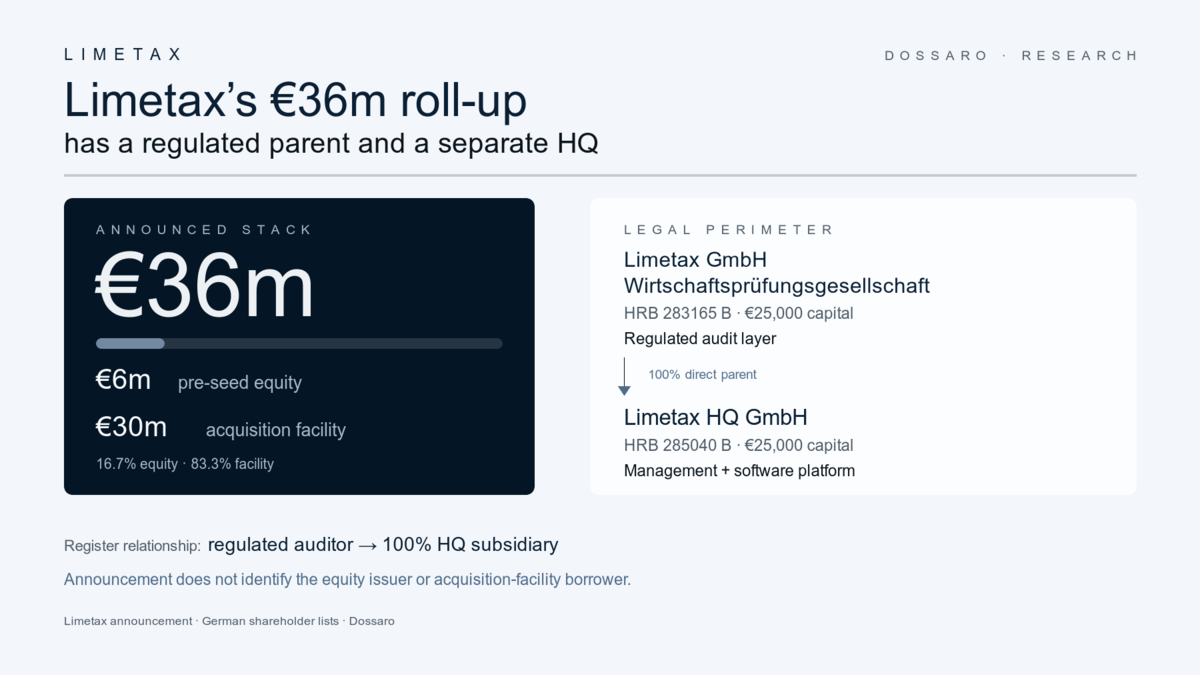
Limetax has announced a €36 million financing package for a German tax-and-accounting roll-up. German register documents show the legal architecture beside that headline: Limetax GmbH Wirtschaftsprüfungsgesellschaft is a €25,000 regulated audit company and the sole shareholder of a separate €25,000 Limetax HQ GmbH, the founder-led management and software vehicle. The public announcement does not specify which entity issued the equity or borrowed the acquisition facility.
That distinction changes how investors should read the financing. The package combines €6 million of pre-seed equity with a €30 million acquisition facility. The first is capital; the second is borrowing capacity. The filings establish a parent-and-subsidiary perimeter, not the allocation, drawdown or security terms of the €36 million.
The €36 million is a mixed financing stack
Limetax’s 9 September announcement describes the raise as €6 million of pre-seed equity led by Motive Partners, with Activant, Heliad and named angels participating, plus a €30 million acquisition facility from German banks. Motive’s investor account confirms the same split and says Limetax is taking equity stakes in established tax and accounting practices while deploying its ATLAS platform. Startbase’s report and Graft and Grit’s coverage repeat the amount, the investor group and the roll-up plan.
On the announced total, equity is 16.7 percent and the facility is 83.3 percent. Those percentages describe the financing mix, not ownership. A facility is a commitment to lend subject to its terms, so the public number does not establish how much debt had been drawn by 9 September, what assets secure it or which legal borrower signed it.
The company says it had combined four firms across seven locations, with about 150 employees and annualised revenue in the double-digit millions, eight months after launch. It says its software is deployed in each firm and that early cases reduced work from about 20 hours to six. Those operating figures are company statements. The legal records answer a narrower question: which entities existed when the financing headline arrived, what each was formed to do and how they relate directly.
The regulated auditor came first
The older entity is Limetax GmbH Wirtschaftsprüfungsgesellschaft, registered in Berlin under HRB 283165 B. The chronological extract shows a company incorporated on 22 January 2026 as Limetax GmbH, with €25,000 of capital and a purpose covering information-technology and support services for accounting and tax practices. Christoph Gamon and Maximilian Meyer were its initial directors.
On 19 February, the registered company name changed to Limetax GmbH Wirtschaftsprüfungsgesellschaft. The purpose moved to legally permitted audit work, management of its own assets and related professional services. Gamon and Meyer ceased to be directors, and Thilo Bogislav Kausch-Blecken von Schmeling was appointed. The company’s legal notice identifies the Berlin address and the HRB number, and names Thilo in the regulated role.
The shareholder list for that company names Limetax Lux Audit S.à r.l., based in Hesperingen, Luxembourg, as the holder of all 25,000 shares. That is a direct registered ownership fact. It does not identify the ultimate beneficial owners of the Luxembourg company, and it does not turn the German auditor into the disclosed borrower for the acquisition facility.
The timing gives the older company a defined place in the group. It was created before the public financing announcement, then changed into the regulated professional-services layer while the founders moved out of its management. The register therefore supports describing it as the audit entity, not as a generic synonym for every Limetax activity.
The HQ is a subsidiary, not a peer
Limetax HQ GmbH is a second Berlin company, registered under HRB 285040 B. Its formation contract is dated 3 March 2026 and its registration followed in March. Its capital is also €25,000. The stated purpose covers management, personnel, information technology, marketing, compliance and administration for tax and audit companies, together with software and digital applications.
Christoph Gamon and Maximilian Meyer are the HQ’s directors with sole representation. The shareholder list dated 3 March and registered in March names Limetax GmbH Wirtschaftsprüfungsgesellschaft as the holder of all 25,000 HQ shares. The direct relationship is therefore the reverse of a loose “two-entity” description: the regulated auditor is the 100 percent registered parent of the founder-led HQ.
| Entity | Register state | Capital | Stated role | What the records establish |
|---|---|---|---|---|
| Limetax GmbH Wirtschaftsprüfungsgesellschaft | Berlin HRB 283165 B; regulated name registered 19 Feb 2026; Thilo Kausch-Blecken von Schmeling director | €25,000 | Legally permitted audit and own-asset activities | Owns 100 percent of Limetax HQ; financing allocation is not disclosed |
| Limetax HQ GmbH | Berlin HRB 285040 B; formed and registered in March 2026; Gamon and Meyer directors | €25,000 | Group management, administration and software | Is directly owned by the regulated auditor; facility terms are not disclosed |
This parent link is more informative than the shared address at Zionskirchstraße 73A. It separates the entity carrying the professional audit mandate from the entity whose stated purpose includes group services and platform software. It still does not prove that liabilities, intellectual property or acquisition contracts are ring-fenced between them.
Why the split changes diligence
Roll-up investors need to know where regulated responsibility, acquisition debt and platform economics sit. A separate professional-services company can be a normal response to German rules for audit firms. A management and software company can centralise functions that would be difficult to place inside that regulated entity. That commercial logic explains why two €25,000 companies might sit in one group.
The structure also prevents a common shortcut. The public financing release uses “Limetax” as a group name, but a group name is not a legal borrower. The register shows the auditor owns HQ; it does not show whether the €6 million equity subscribed for shares in HQ, the regulated company, a parent above both or another financing vehicle. It likewise does not identify which company drew the €30 million facility to buy the four practices.
That gap matters for underwriting. The headline gives a large acquisition capacity, while the visible German entities each start with €25,000 of nominal capital. Nominal capital is not a measure of enterprise value or debt capacity, but it is a reminder to locate the actual contracts. A buyer or lender would need the borrowing entity, guarantees, security package and acquisition consideration before assigning the facility to either HRB number.
The public account supplies useful operating context. Limetax says the platform runs on DATEV and that its agents handle bookkeeping, payroll and financial statements with human review. The company also says the early cases moved from 20 hours to six. Those claims explain the roll-up’s operating pitch; they do not replace the legal perimeter. Fundcraft’s financing analysis shows the same diligence issue from another angle: a group financing headline can sit beside a subsidiary-level capital event without making the two amounts interchangeable. Advanced Electric Machines’ financing stack makes the complementary point that debt and equity carry different underwriting questions even when announced together.
What the next filings need to show
The next useful evidence is not another description of the €36 million. It is a filing or contract that maps money to the legal perimeter. A post-announcement capital increase or shareholder list could show where the €6 million equity landed and at what price. A charge registration, facility notice or acquisition filing could identify the borrower and the security supporting the €30 million capacity. Accounts would show whether the four practice acquisitions were funded by debt, equity, seller financing or a mixture.
Until that evidence appears, the strongest reading is precise. Limetax has announced a financing stack weighted toward acquisition capacity, and German records show a regulated auditor that owns a separate founder-led HQ. The parent relationship is documented. The issuer, borrower, debt ranking and acquisition consideration are not.
For investors, that changes the next question from “How large is Limetax’s raise?” to “Which legal entity carries each part of the roll-up?” The answer will determine where professional liability sits, where acquisition leverage sits and where the platform’s equity value is actually recorded.
Continue reading
Related Research
Fundcraft's €12m Growth Financing Sat Beside a €1.24m Internal Capital Conversion
Fundcraft announced €12m of group growth financing while its French AIFM converted €1.24m of shareholder debt into capital without a cash remittance.
Advanced Electric Machines’ £16m Funding Is a Parent-Level Equity and Debt Stack
AEM's £16m funding headline combines parent-level preferred equity with government-backed debt secured over the operating company's IP, receivables and assets.
Ethris's €30m EIB Debt Followed a 2.7% Gates Equity Step
Ethris secured €30m of EIB venture debt after a 2,723-share Gates Foundation capital increase diluted existing holders by about 2.7% in the latest July list.
Seqens's Lender-to-Owner Reset Exposes a €930m Acquisition Debt Stack
Seqens says senior lenders will become shareholders, while filings show Sirona BidCo carried €930m of term debt, €29k cash and a €62m dividend.