
Ethris's €30m EIB Debt Followed a 2.7% Gates Equity Step
Ethris secured €30m of EIB venture debt after a 2,723-share Gates Foundation capital increase diluted existing holders by about 2.7% in the latest July list.
On this page
Conduct your own private market research
Add dossaro to Claude or ChatGPT and run source-backed register research from your own workspace.
 Add to Claude
 Add to ChatGPT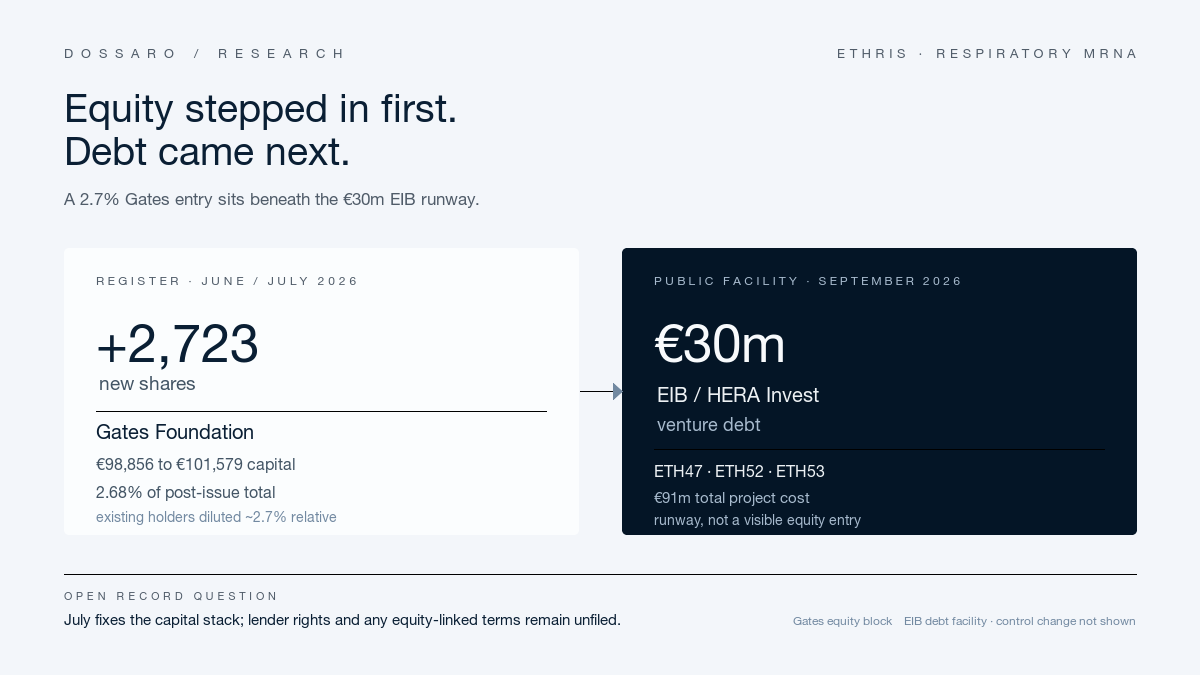
Ethris entered a new financing phase with two different kinds of capital. On 11 September 2026, the European Investment Bank (EIB) and the European Commission's Health Emergency Preparedness and Response Authority (DG HERA) announced a €30 million venture-debt agreement for the Munich respiratory-mRNA company. The latest German shareholder list, dated 22 July, records a separate equity step before that announcement: the Gates Foundation entered with 2,723 new shares.
Those shares represent 2.68% of the post-issue nominal capital. They diluted every pre-existing holder by about 2.68% on a relative basis, but the list does not show a sale or a control transfer. EIB is not named as a shareholder in the July list. The public record therefore describes a layered financing stack: new equity from Gates, followed by public venture debt for clinical development, with no visible change in the control map.
The EIB facility is a runway instrument
The EIB's financing release says the €30 million will support Ethris's respiratory mRNA portfolio. Its lead candidate, ETH47, is in a Phase 2a asthma trial and is intended to move into Phase 2b trials in asthma and chronic obstructive pulmonary disease. The release also names ETH52 and ETH53, programmes focused on mucosal influenza vaccines and pandemic preparedness.
The bank's project sheet adds the financing mechanics that a headline announcement leaves out. It records a 31 July 2026 signature, an approximate total project cost of €91 million and a loan under the EIB's Venture Debt Instrument. The sheet describes the financing as direct, equity-type financing for research, development and innovation, and says the programme is intended to extend cash runway, de-risk the development plan and attract third-party investors. Those are the EIB's stated objectives, not a disclosure of Ethris's valuation or of investor returns.
Independent coverage from Undiluted also identifies the instrument as €30 million of venture debt from the EIB under HERA Invest. It places ETH47, ETH52 and ETH53 in the same funding envelope and reports that HERA Invest is a €130 million top-up to InvestEU for clinical-stage medical-countermeasure companies. BioM independently describes the Planegg-based company and the focus on ETH47, while noting the financing's pandemic-preparedness rationale.
The commercial consequence is straightforward. Ethris is using a public lending instrument to fund a costly clinical step without a corresponding EIB entry in the shareholder record reviewed here. Debt and equity can support the same programme while giving capital providers different claims on the business. The EIB announcement explains the development runway; the register explains the ownership denominator.
The register puts a new equity block on the timeline
The exact legal entity is ETHRIS GmbH, registered at the local court of Munich under HRB 182200, with its seat in Planegg. The March shareholder list shows €98,856 of nominal share capital before the new block. It lists Laureus Capital GmbH with 23,169 shares, HS LifeSciences GmbH with 16,310, Cipla (EU) Limited with 12,721, the founders Christian Plank and Carsten Rudolph with 12,369 each, OrbiMed Private Investments V with 7,408 and MedQap GmbH with 7,236.
The June list then records a capital increase. Gates Foundation, identified in the filing as a Seattle, United States organisation, holds shares numbered 98,857 to 101,579. The list marks the change "Capital Increase" and records share capital of €101,579. The July list keeps the same total and the same 2,723-share Gates block. It also records that a 209-share block was legally transferred from the holder named Adolel Evergreen AG in June to Olenia AG in July. That is a holder transfer within the existing denominator, not another capital increase.
| Evidence point | Register or public result | Business meaning | Boundary |
|---|---|---|---|
| 4 March 2026 shareholder list | €98,856 capital before the Gates block; established investors and founders listed | Baseline for the denominator and pre-issue positions | It is not a valuation or a fully diluted cap table |
| 15 June 2026 shareholder list | €101,579 capital; 2,723 Gates Foundation shares marked “Capital Increase” | New equity added nominal capital and a 2.68% post-issue block | Issue price, rights and proceeds are not stated |
| 22 July 2026 shareholder list | The €101,579 total and Gates's 2,723 shares remain; a 209-share block is marked legally transferred to Olenia AG | The latest parsed list preserves the equity step and shows one separate transfer | It does not establish events after the filing date |
| 31 July to 11 September 2026 EIB record | €30m venture debt signed 31 July and announced publicly in September | A public lender is funding clinical development alongside the equity stack | The list does not name EIB as a shareholder or disclose debt terms beyond the EIB description |
2,723 shares changed the denominator, not the control map
The arithmetic is small enough to make the financing structure visible. The capital increase is exactly €2,723 because the filing assigns a €1 nominal amount to each of the 2,723 new shares. Dividing 2,723 by the post-issue total of 101,579 gives 2.6807%, or 2.68% when rounded to two decimals. The July document displays the position as 2.68%.
For every earlier holder, the denominator changed from 98,856 to 101,579. The old position is therefore multiplied by 98,856 divided by 101,579, or 97.32% of its former percentage. That is a relative dilution of about 2.68%. It is not a 2.68 percentage-point reduction for every investor. A holder with 23,169 shares moves from about 23.4% in the March list to about 22.8% in the July list. HS LifeSciences moves from about 16.5% to 16.1%, while each founder's 12,369 shares move from about 12.5% to 12.2%.
The direction matters. The records show an issuance to Gates, not a transfer of someone else's shares to Gates. No single existing holder is displaced, and the July list does not assign a controlling block to Gates. The names and percentages show an equity entry without a visible control reset. Voting agreements, preference rights and board arrangements are not stated in these lists, so the safe conclusion is limited to what the capital and holder records establish.
This is the same distinction that sits behind Nexeon's preference-share filing: a financing headline and a shareholder document can describe different parts of the same capital stack. INLEAP's cumulative funding record likewise shows why the nominal share denominator matters before a reader converts a headline amount into an ownership claim.
The same discipline underpins Dossaro's private-company ownership workflow: resolve the legal entity, then keep each ownership or financing claim attached to the record that can support it.
Debt and equity answer different risk questions
The Gates block sits in the register because equity changes the legal ownership denominator. The EIB facility sits in the public project record because it is a loan for research and development. Ethris's own announcement describes the same €30 million agreement and the clinical path for ETH47. Neither public announcement says that the EIB received shares, and the latest shareholder list does not name the bank.
That separation affects how investors and counterparties should read the funding. Gates's 2.68% block participates in the company's equity economics under rights that the lists do not spell out. The EIB's venture debt is presented as long-term financing that addresses limited access to commercial debt and supports a development plan. It may extend runway without adding the lender to the ordinary shareholder list, although the project sheet's “equity-type” wording signals that venture debt can include terms beyond a plain bank loan. The available documents do not state warrants, conversion rights, covenants, pricing or repayment triggers, so none of those terms can be assigned here.
The stack also explains why the €30 million should not be added mechanically to a new equity valuation. The EIB project sheet estimates total project cost at €91 million, but it does not call that figure a company valuation. The shareholder lists provide nominal capital, not the price paid for each share. Together, the sources show financing capacity and ownership arithmetic, not a post-money valuation.
July narrows the gap, but does not close it
The July list is important because it is the latest shareholder document that could be parsed for this article. It preserves the June capital total and Gates's 2,723 shares, making the equity step visible immediately before the EIB announcement cycle. It also changes the name attached to a 209-share block through a stated legal transfer. That is a different economic mechanism from the Gates issuance and should not be folded into the dilution calculation.
The evidence cutoff remains the July filing date. A later shareholder list, a capital measure or a debt instrument could change the picture. The current record does not establish whether the EIB facility carries warrants or conversion rights, whether Gates received any special rights, how much cash the capital increase raised, or whether any shareholder agreement changes voting power. It also does not show the commercial relationship between the Gates equity and the EIB debt beyond their place in the financing timeline.
The next decision-changing records are therefore specific: a later shareholder list or capital filing, the EIB loan documentation if it becomes public, and any corporate filing that sets out rights attached to the Gates shares. Until those documents appear, the defensible retelling is precise. Ethris added a 2.68% Gates Foundation equity block, then secured €30 million of EIB venture debt for respiratory mRNA development. The capital denominator changed; the public register does not show a matching change in control.
Continue reading
Related Research
Nexeon's £100m Round Added Capital Around an Existing KDB Stake
Nexeon's £100m investment round added capital around an existing KDB preference stake, while staged allotments leave the latest recipients unnamed in filings.
INLEAP’s €20m Funding Headline Was Cumulative; Founders Held 80% in the 2025 List
INLEAP says it has raised about €20m since founding, while its latest filed shareholder list shows founder holding companies with 80% and outside holders with 20%.
ZuriQ's $25.5m Seed Created A 28.6% Preferred Block
ZuriQ's $25.5m seed closed legally in May, creating a 28.6% preferred block and adding a Quantonation-linked director before its July reveal.
CloudNC’s $20m announcement sits beside a voting preferred-share filing
CloudNC announced $20m, while its latest SH01 records 44.9m voting Series B shares with priority economics, no named allottees and no direct currency match.