
Basecamp’s $140m Series C Put a Preference Waterfall Behind the Headline
Basecamp’s $140m Series C was filed in staged C1 and C2 allotments with a 1x preference priority, a pre-emption waiver and no public allocation by investor.
On this page
Conduct your own private market research
Add dossaro to Claude or ChatGPT and run source-backed register research from your own workspace.
 Add to Claude
 Add to ChatGPT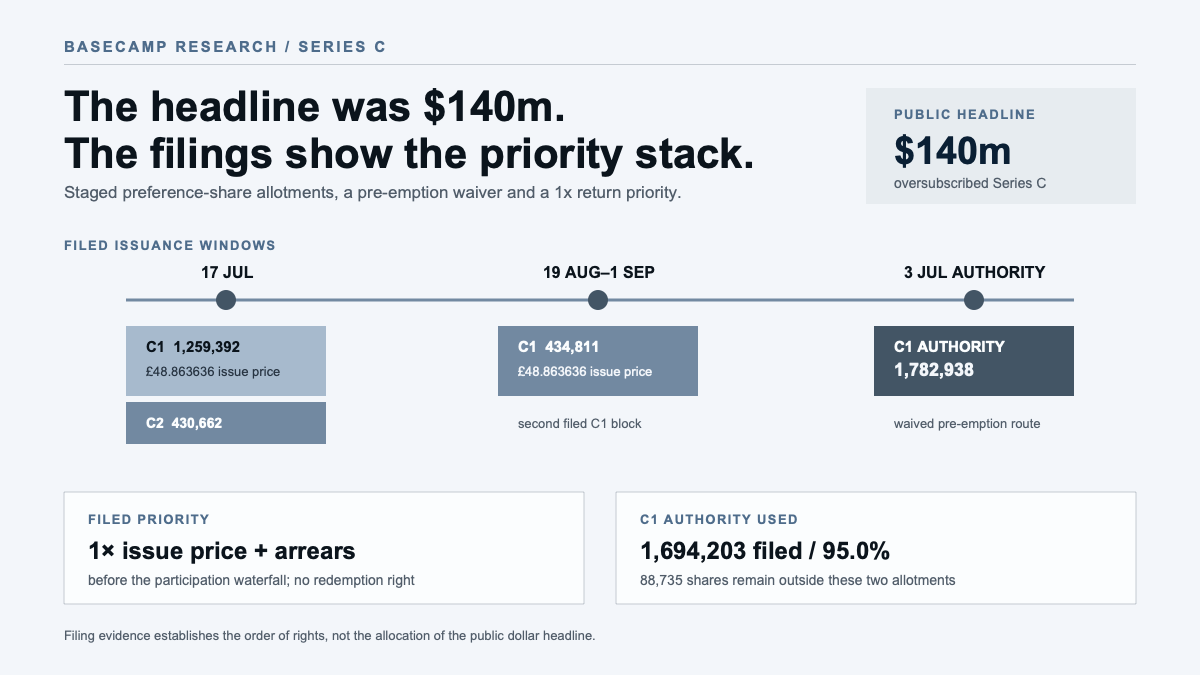
Basecamp Research’s $140 million Series C did more than add a headline financing number. Companies House filings show a staged issue of C1 and C2 preference shares, a waiver of pre-emption rights and a liquidation priority that puts a 1x return of issue price plus arrears ahead of the ordinary participation stack. The filings do not identify which named investor received which allotment, but they do show the economic architecture being built around the round.
The distinction matters because the public announcement and the legal capital record answer different questions. Basecamp’s company announcement, corrected and issued on 23 September 2026, describes an oversubscribed $140 million Series C led by S32. It names returning and new backers including NVIDIA’s NVentures, Anthology Fund, NATO Innovation Fund and True Ventures. Tech.eu’s independent report puts the company’s total funding at $225 million.
The filings instead use pounds, share classes and allotment dates. A 21 July SH01 records 1,259,392 C1 preference shares and 430,662 C2 preference shares. A second SH01 filed on 16 September records a further 434,811 C1 shares for the allotment period from 19 August to 1 September. Together, the two filings show 1,694,203 C1 shares and 430,662 C2 shares across the staged issuance. Their stated issue prices are £48.863636 for C1 and £43.977272 for C2.
That is not a conversion of the $140 million headline into sterling. The filings do not disclose a valuation, an investor-by-investor subscription schedule or the cash consideration paid by each named backer. They show how the share capital and priority rights were documented.
The public round and the filed capital record do different jobs
Basecamp says the new capital will train its EDEN models and advance a therapeutics pipeline designed with artificial intelligence. S32 general partner Andy Conrad is joining the board, while the investor list spans specialist life-sciences, technology and strategic funds. Those facts explain the commercial purpose of the financing and the coalition the company wants to associate with it.
The Companies House record supplies a narrower but more durable answer: what securities were allotted and under what authority. The filing history lists the 21 July SH01, the 3 July shareholder resolutions filed on 14 August and the 16 September SH01. The resolutions adopted new articles, waived statutory pre-emption rights for the relevant allotments and authorised directors to issue up to 1,782,938 C1 preference shares. An option authority of £1,186,635 was also approved, but the two SH01s are the evidence used here for the C1 and C2 allotments.
| Evidence surface | What it says | What it does not say |
|---|---|---|
| Basecamp announcement | $140m oversubscribed Series C, led by S32, with a named investor group | Each investor’s cheque, valuation or allocation of the filed classes |
| Tech.eu coverage | The round takes reported total funding to $225m and includes NVIDIA’s NVentures and Anthology Fund | The legal terms of the new preference shares |
| 21 July SH01 | 1,259,392 C1 and 430,662 C2 shares at stated sterling issue prices | Whether every share maps one-for-one to the public dollar headline |
| 16 September SH01 | A further 434,811 C1 shares for the 19 August to 1 September period | The identity of the subscriber for that allotment |
| 3 July resolutions | C1 authority, new articles and a pre-emption waiver | A final investor-by-investor cap table or control result |
The sequence is therefore not a contradiction. The press release describes a financing event. The SH01s record the corporate actions used to issue securities around that event.
The C1 authority was used in two stages
The resolutions authorised 1,782,938 C1 preference shares. The two SH01s record 1,259,392 and 434,811 C1 shares, or 1,694,203 in total. That uses about 95.0% of the specific C1 authority and leaves 88,735 shares outside the two allotments on the face of the documents.
| C1 authority and filings | Shares | Share of authority | Reading |
|---|---|---|---|
| Authority approved by the 3 July resolutions | 1,782,938 | 100.0% | Maximum C1 allotment authorised in that resolution |
| 21 July SH01 | 1,259,392 | 70.6% | First filed C1 block |
| 16 September SH01 | 434,811 | 24.4% | Later filed C1 block |
| Total C1 shown in the two SH01s | 1,694,203 | 95.0% | 88,735 shares of the authority are not in these two allotments |
The staged pattern is commercially relevant. It gives the company room to close or document subscriptions across more than one filing window while keeping the same preference class in view. It also warns a diligence reader not to treat the date of the press release as the only date that matters. The 21 July and 16 September filings describe separate allotment windows, and the resolution that made them possible was effective from 3 July.
The C2 block is also important. The first SH01 records 430,662 C2 preference shares at £43.977272. The later filing continues to show the same C2 block while adding the second C1 allotment. The result is a two-class preference stack, not a single undifferentiated “Series C” line.
The rights change the order of the payout
The new articles describe a preference structure that changes who gets paid first if the company is liquidated or returns capital. C1 and C2 holders receive a priority based on the issue price and accrued arrears before the ordinary participation waterfall. The rights provide a 1x issue-price-plus-arrears floor, with the relevant participation formula applying after that priority. The shares do not carry a redemption right.
In plain terms, a 1x preference is an order-of-operations rule. It does not tell a reader what Basecamp is worth today, and it does not prove that any investor will receive a particular return. It says that, in a qualifying distribution, preference holders are not simply placed in the same queue as ordinary holders. The amount invested in the preference classes, together with any arrears specified by the articles, is considered before the remaining value is divided under the participation rules.
| Filed term | Economic reading | Boundary |
|---|---|---|
| C1 and C2 preference classes | The round created more than one class with defined priority rights | The filings do not allocate either class to named investors |
| 1x issue price plus arrears priority | Preference holders have a first-return mechanism in a qualifying distribution | It is not a current valuation or a guaranteed cash return |
| Participation formula after the priority | The articles preserve a route to share in residual value | The outcome depends on the distribution event and the precise formula |
| No redemption right | The company is not required to repurchase the shares on a fixed schedule | There is no evidence here of a put, exit date or investor liquidity promise |
This is why the headline financing amount is only the first layer of the story. A cap table that lists 10% of the shares without the class rights could misstate the economic position. Conversely, the existence of a preference waterfall does not establish who controls the board or who ultimately owns the company.
Open Cosmos’ preferred-financing analysis shows the same diligence principle from another transaction: the headline amount and the return hierarchy must be read together. CloudNC’s Series B terms adds a second comparison, where class rights and conversion mechanics are more informative than a round label alone.
What the filings do not prove about the investor list
The public release names S32, Anthology Fund, Catalio, European Tech Collective, Firebrand River, Inception, King Philanthropies, NATO Innovation Fund, PostScriptum, Redalpine, Rockefeller, Singular, Sovereign AI, True Ventures and NVIDIA. The legal filings used for this analysis do not tie those names to particular C1 or C2 allotments. A company can announce a syndicate before an allotment schedule is visible in a public register, and a filing can record a legal subscriber without explaining an investor’s commercial brand.
That distinction rules out several tempting but unsupported conclusions. The documents do not establish that NVIDIA received C1 shares, that S32 received the largest block or that the board appointment gives S32 control. They also do not reveal the price paid by each investor, the fully diluted option pool or any shareholder agreement that could add veto or consent rights.
The strongest finding is narrower. Basecamp documented its Series C through staged C1 and C2 allotments, used a pre-emption waiver to create the issuance route, and placed a 1x preference priority behind the new classes. Those are capital-structure facts, not guesses about the allocation of the $140 million.
The next document that would change the analysis
The next decision-changing evidence is a post-registration confirmation, an updated shareholder list, the underlying 3 July or 14 August corporate documents, or a transaction document that names subscribers and sets out the full economic terms. Those records could connect the public investor list to the C1 and C2 classes, confirm whether the remaining 88,735 C1 authority was used and show whether voting or consent rights sit alongside the preference waterfall.
Until then, the defensible conclusion is precise. Basecamp Research’s $140 million Series C was not filed as a single generic share-count event. Companies House records show two C1 allotment windows, a C2 preference block, a pre-emption waiver and a 1x issue-price-plus-arrears priority. The public announcement explains why the capital was raised. The filings explain who would stand first in the capital structure before anyone can responsibly say who received the money.
Continue reading
Related Research
Open Cosmos' Founder Held About 41% Before Its €300m Round
Open Cosmos' €300m round sits above a register where founder Rafael Jorda held about 41% of stated capital and preferred shares ranked ahead of ordinary.
CloudNC’s $20m announcement sits beside a voting preferred-share filing
CloudNC announced $20m, while its latest SH01 records 44.9m voting Series B shares with priority economics, no named allottees and no direct currency match.
Hackuity's $19m Round Carries a 243,860-Share Ratchet
Hackuity's $19m round includes a €7m cash tranche, a bond conversion and a ratchet ceiling that could add 243,860 shares to the capital structure.
The Exploration Company’s $450m Series C Is Not Yet Visible in Its German Parent Register
The Exploration Company announced a $450m Series C, but its latest German parent shareholder list still shows €194,197 of capital and no new round entry.