
Model ML's UK Company Owed £1.02m To Its Group Before HSBC Invested
Model ML's UK company owed £1.02m to its group and had one parent-owned £1 share before later rounds took the startup's funding above $100m.
On this page
Conduct your own private market research
Add dossaro to Claude or ChatGPT and run source-backed register research from your own workspace.
 Add to Claude
 Add to ChatGPT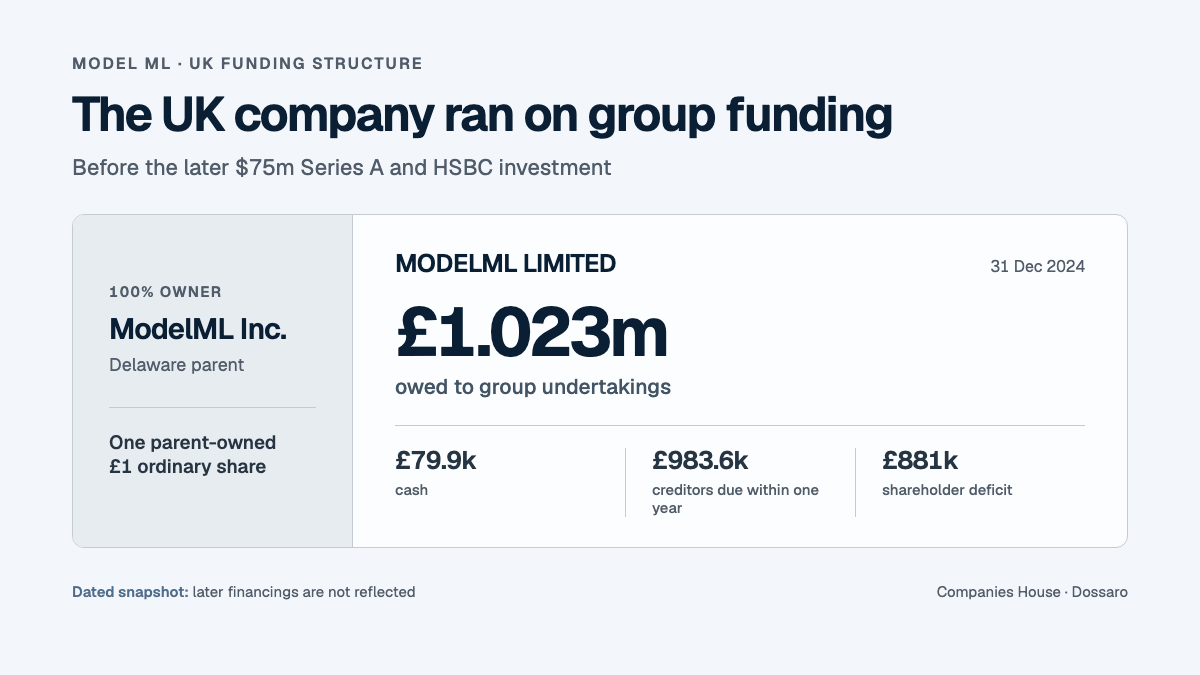
Model ML's UK company owed £1.023 million to group undertakings at the end of 2024. The same accounts showed £79,926 of cash, £983,599 of creditors due within one year and an £881,222 shareholder deficit.
Those figures put a concrete capital path beneath HSBC Asset Management's new investment in the financial-services artificial-intelligence company. Tech.eu reported on 11 August that HSBC's asset-management arm made an undisclosed equity investment through its flagship venture-capital strategy, taking Model ML's total funding above $100 million.
The London company beneath that headline is MODELML LIMITED. Companies House records show that it was incorporated on 31 January 2024 with one £1 ordinary share owned by ModelML Inc., its Delaware parent. The first accounts identify the same parent as the 100% owner and ultimate controlling party.
That structure changes how the financing should be read. The UK company is an operating subsidiary funded from within the group, not the visible cap-table destination for the outside investors named in Model ML's rounds. The exact legal entity that issued HSBC's new equity remains undisclosed, but the UK record already shows where investor capital had to travel to support the London operation.
One £1 Share Sat Above More Than £1m Of Group Funding
MODELML LIMITED's first accounts cover the period from incorporation through 31 December 2024. They describe a very small legal-capital base and a much larger operating obligation to the group.
| UK company position at 31 December 2024 | Amount |
|---|---|
| Cash at bank and in hand | £79,926 |
| Other debtors | £22,451 |
| Creditors due within one year | £983,599 |
| Amount owed to group undertakings | £1,023,060 |
| Net current liabilities | £881,222 |
| Shareholder deficit | £881,222 |
The accounts state that going concern relied on continuing investor support. They also report an average of one employee for the period. Together, those facts describe an early UK subsidiary whose local balance sheet depended on capital supplied elsewhere in the group.
The deficit is not a current measure of Model ML's financial health. It is a dated snapshot from before the company's later funding. Its value is structural: it shows that the London operation was already financed through its parent chain rather than through new shares issued by the UK company.
The UK Cap Table Stayed At One Parent-Owned Share
The incorporation filing names ModelML Inc. as subscriber for the single ordinary share. A confirmation statement made up to 30 January 2025 still showed that one parent-owned share. The next statement, made up to 23 January 2026, reported no updates.
| Date | Visible UK ownership state | External financing context |
|---|---|---|
| 31 January 2024 | ModelML Inc. subscribes for one £1 ordinary share | UK company incorporated |
| 31 December 2024 | ModelML Inc. remains 100% owner; £1.023m owed to group | First UK accounts close |
| 1 May 2025 | UK ownership unchanged in the latest statement | Sir Noel Quinn joins Model ML's advisory team |
| 24 November 2025 | UK company still sits under the Delaware parent | Model ML announces a $75m Series A |
| 23 January 2026 | Confirmation statement records no updates | One-share UK state remains visible |
| 11 August 2026 | No newer UK share filing in the public record | HSBC Asset Management investment reported |
The outside investors appeared in Model ML's public financing story, not in this UK share register. Model ML said in November 2025 that FT Partners led a $75 million Series A with Y Combinator, QED, 13Books, Latitude and LocalGlobe. The company said that round followed a seed raise six months earlier.
This is a common international startup structure. A US parent can issue preferred equity to global investors and then fund local subsidiaries through intercompany accounts. The subsidiary can employ staff, contract with customers and operate in London without recreating the parent-level investor cap table in Britain.
The distinction resembles Wordsmith's Delaware-parent structure, where investor and founder economics sit above the UK operating company. Model ML adds a balance-sheet view of the same mechanism: the parent relationship is visible not only in ownership but in the £1.023 million group creditor balance.
The 2024 Snapshot Predates Both Later Financings
The timing prevents a distress reading. The accounts close nearly eleven months before the $75 million Series A and more than nineteen months before the HSBC investment. Either financing could have changed the group's liquidity and the amount sent into the UK operation.
The accounts also use a going-concern basis that relied on continuing investor support. For a young subsidiary under a venture-funded parent, that can be ordinary group-financing practice rather than evidence of a standalone funding crisis. The UK company had been operating for less than a year at the reporting date.
What remains commercially relevant is the direction of support. Local cash of £79,926 covered only 7.8% of the £1.023 million owed to group undertakings. That comparison is not a recovery ratio because the intercompany balance need not have been immediately called. It does show the scale of parent support relative to the cash held by the UK entity.
For investors, customers and counterparties, the underwriting unit is therefore the wider Model ML group. The UK balance sheet cannot explain the parent company's total cash, intellectual property, revenue or capitalization. Nor can a one-share UK register allocate the economics of the HSBC investment. Those questions sit at the parent or transaction level.
Noel Quinn Joined Before HSBC Asset Management Invested
Model ML appointed Sir Noel Quinn to its advisory team on 1 May 2025. Quinn had previously served as HSBC's group chief executive. His appointment came more than a year before HSBC Asset Management's investment.
That chronology establishes familiarity between Model ML and a former senior HSBC executive. It does not establish that Quinn selected, arranged or influenced the investment. HSBC Asset Management invested through a venture strategy that Tech.eu says combines fund commitments with co-investments in high-growth venture-backed companies.
The advisory relationship is still relevant to how Model ML built institutional credibility. The November Series A announcement quoted Quinn alongside a roster of former senior executives from UBS, Morgan Stanley, Julius Baer and Barclays. Model ML was selling workflow automation to the same financial institutions whose former leaders were advising it.
The capital and commercial stories meet at that level. Model ML's product targets banks, asset managers and advisory firms. Its advisers bring senior financial-industry networks. HSBC Asset Management later became an investor. The sources support that sequence, but not a causal chain.
The Next Accounts Will Show What Reached London
The next UK accounts are the most useful near-term document. A 2025 balance sheet should capture the period in which Model ML raised its seed and $75 million Series A. It can show whether the UK company received more intercompany funding, converted any group balance into equity, increased its workforce or built a larger local cash position.
Parent-level transaction evidence would answer the other half. A Delaware capitalization record or investment document could identify the security HSBC acquired, the issuing entity and the precise investing vehicle. Until then, the public announcement should be attributed to the Model ML group rather than mapped onto MODELML LIMITED's single UK share.
The current record is already enough to change the geography of the headline. Model ML may be London-founded and operationally active in Britain, but its visible UK company was a one-share Delaware subsidiary that owed £1.023 million to its group before the later financings. The next document needs to show how much of the more than $100 million raised at group level ultimately reached that London balance sheet.
Continue reading
Related Research
Wordsmith's $114m Funding Sits Above A £1 UK Subsidiary
Wordsmith AI has announced $114 million of funding above a one-share UK subsidiary, while Ross McNairn's latest register state preserves founder control rights.
Qureight's $20m Round Sat Above Preferred Equity and HSBC Security
Qureight's $20m Series B followed a £2m senior C1 issue and four HSBC security filings, placing lenders and preferred capital ahead of older equity.
Wexler's Founders Held 54%, But £4.66m Ranked First
Legora bought a Wexler that was 54% founder-owned on its last visible share count, but £4.66m of seed preference ranked ahead of ordinary shares.
Sudolabs' Buyer Vehicle Took 100% Of The Operating Company
Sudolabs' buyer vehicle took 100% of its Slovak operating company, while its former 35/35/30 parent was renamed and the founders stayed managers.