
OLIX's $312m Round Diluted The Founder Stake Behind The £946m Headline
OLIX's $312m Series B diluted James Dacombe from 38.6% to about 34.1%, while 110,203 growth shares make part of the stake hurdle-dependent.
On this page
Conduct your own private market research
Add dossaro to Claude or ChatGPT and run source-backed register research from your own workspace.
 Add to Claude
 Add to ChatGPT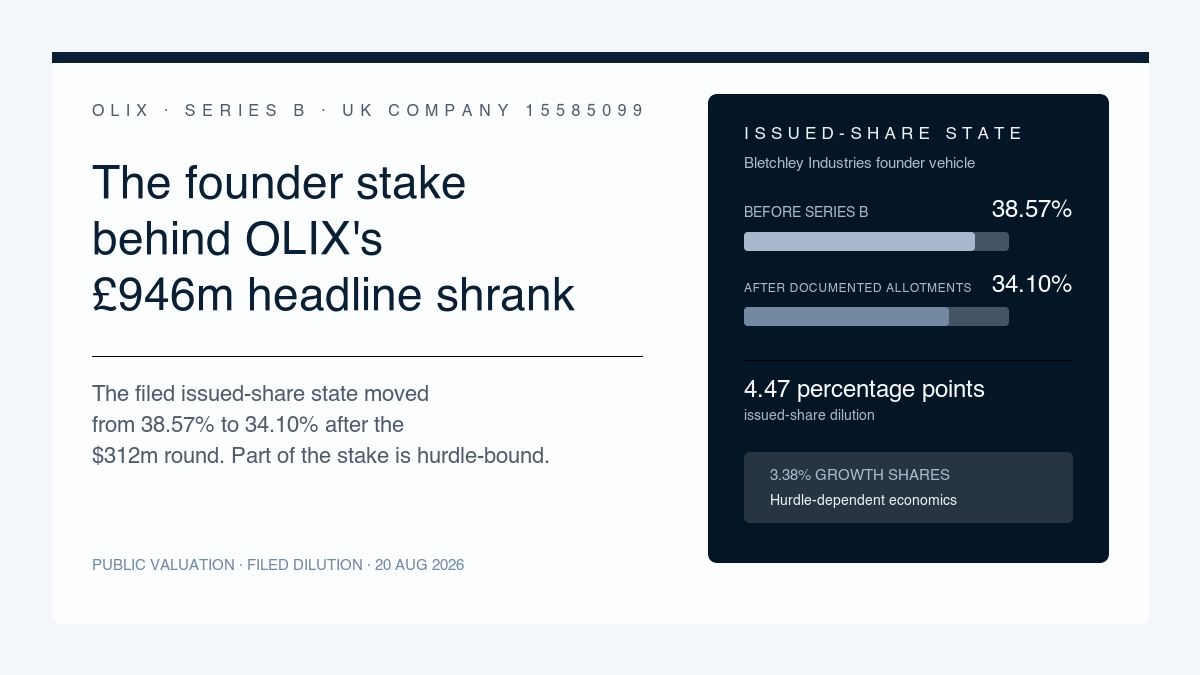
OLIX's $312 million Series B did not leave the founder's ownership percentage where the headline arithmetic put it. Companies House filings show that James Dacombe's holding vehicle moved from 38.57% of issued shares before the round to about 34.10% after the documented allotments. Of that post-round position, 110,203 shares are growth shares whose full economics depend on a hurdle amount set outside the filed articles.
That changes the meaning of the widely repeated £946 million founder estimate. Applying the pre-round percentage to the reported roughly £2.45 billion sterling valuation produces the headline number. Applying the post-allotment issued-share percentage gives about £835 million on the same simple basis, roughly £110 million less. Neither is a net-worth calculation, but the denominator change is real and filed.
For investors, the deeper point is not whether James Dacombe is or is not a billionaire. It is that OLIX's financing increased the company's valuation while diluting the identifiable founder vehicle and placing part of its stake behind a private hurdle. The round's legal capital state is more conditional than the public wealth story suggests.
The public round was a strategic bet on inference hardware
OLIX announced the Series B on 3 August 2026 at a reported $3.3 billion valuation. Cooley's financing announcement names Fundomo, Arm and Hudson River Trading as participants, alongside Reed Hastings and existing backers Hummingbird Ventures, Crane, Plural, Creandum, Phoenix Court and Transition. The round followed a $220 million financing in February.
The company's own website describes OLIX as building an infrastructure layer for frontier AI inference. It says current systems run different token-generation tasks on general-purpose chips and that its approach uses specialised chips connected as a production line. The engineering pitch matters to the financing story because the new capital is underwriting a hardware and manufacturing path, not a software business with an already visible recurring-revenue base.
The UK government's Sovereign AI announcement confirms the state-backed investment and identifies OLIX as a London-based company founded in 2024 by Dacombe. It says the company is developing inference chips that specialise in different parts of an AI model's process and frames the investment as support for domestic AI capability and high-skilled jobs.
Those sources establish the public stake in the round: a young British chip company attracted private capital, a state venture fund and industrial investors at a multibillion-dollar valuation. The filings answer a different question: how much of the company the founder vehicle represented after the money entered.
Bletchley Industries held the founder position
OLIX Computing Limited, company number 15585099, was incorporated in March 2024 as Flux Corp Ltd and renamed in January 2026. The latest Companies House overview confirms the entity, its active status and the former name.
The confirmation statement made up to 21 March 2026 recorded 2,878,572 issued shares. James Dacombe had transferred 1,000,000 ordinary shares to Bletchley Industries Ltd on 30 January. The shareholder schedule then showed Bletchley with those 1,000,000 ordinary shares plus 110,203 growth shares, or 1,110,203 shares in total. That was 38.57% of the issued capital at the time.
Bletchley is not a label for Dacombe's direct holding. It is a separate founder vehicle. The UK government's release identifies it as the holding company whose name Dacombe chose to connect OLIX to Bletchley, and Companies House records Dacombe as controlling more than 75% of Bletchley. The corporate layer therefore matters when a financing headline converts a company valuation into a personal wealth estimate.
The Series B denominator moved from 2.88 million to 3.26 million
The OLIX filing history lists two August SH01 filings after the July allotments, followed by new articles filed on 12 August. Together with the confirmation statement, those filings record four material Series B allotment blocks:
| Share class or block | Shares issued | Issue price | What it changes |
|---|---|---|---|
| R4A preference shares | 347,476 | £670.62 | Creates the main new preferred layer |
| R4 SAFE shares | 6,269 | £603.56 | Adds a smaller preference-linked class |
| Ordinary shares | 20,991 | £0.01 | Adds low-nominal ordinary capital |
| Later R4A allotment | 2,822 | £670.62 | Extends the new preferred layer |
The 377,558 new shares increased issued capital from 2,878,572 to 3,256,130. Bletchley's 1,110,203 shares therefore became about 34.10% of the issued total. Its 1,000,000 ordinary shares represented about 30.71%; the 110,203 growth shares represented about 3.38%.
The cash arithmetic is also substantial. The R4 preference allotments imply roughly £238.7 million of issue proceeds, broadly consistent with a $312 million round after currency conversion. The filings therefore expose both sides of the transaction: new investors bought a large preferred block, and the founder vehicle's percentage fell because the denominator expanded.
Growth shares make the remaining stake conditional
The 110,203 growth shares carry votes, but their distribution entitlement is limited to an aggregate one penny unless a contractual “Growth Share Hurdle Amount” is reached. If the hurdle is met, the articles allow those shares to participate or convert according to the governing documents. The numeric hurdle itself is not stated in the filed articles because its definition points to the shareholders' agreement.
That distinction stops the post-round 34.10% from being read as 34.10% of ordinary-equivalent wealth. The filing proves that the shares exist, carry votes and sit inside Bletchley's position. It does not disclose the hurdle amount or show whether the condition will be met. The ordinary block is about 30.71% of issued capital; the remaining 3.38 percentage points have a different economic starting point.
The same issue-price history gives another useful comparison. Hummingbird Ventures vehicles held 169,065 R3C shares issued at £221.81. The latest R4A price of £670.62 is about 3.02 times that earlier issue price. On a simple issue-price comparison, the Hummingbird tranche moves from roughly £37.5 million of subscription value to about £113.4 million of reference value, a paper increase of roughly £75.9 million. That is not a realised return and does not account for class rights, dilution or later transfers, but it shows why the round cannot be reduced to a founder wealth story.
The £946m estimate uses the wrong visible state
Reports including IBTimes UK applied the pre-round 38.6% stake to the reported £2.45 billion valuation and arrived at about £946 million. That is a clear calculation, but it uses the 21 March denominator after the round's legal capital had changed.
Using the post-allotment issued-share percentage instead gives approximately £835 million: 34.10% multiplied by £2.45 billion. The gap is about £110 million on the same headline valuation. It is not a claim about Dacombe's cash wealth, because the valuation may use a fully diluted denominator, the growth-share hurdle is undisclosed and shareholder transfers are not continuously filed.
The defensible conclusion is narrower. OLIX's $312 million financing diluted the founder vehicle by about 4.47 percentage points, and part of even that vehicle's issued-share position carries conditional economics. The round made the company more valuable in the public narrative while making the founder's visible ownership more complex in the legal record.
Dossaro's Wordsmith analysis similarly separated a parent-level financing headline from the operating company's visible UK control state. In OLIX, the key split is inside one UK issuer: the headline valuation sits above a post-round denominator, and the founder vehicle contains both ordinary and hurdle-bound growth shares.
The next confirmation statement should show whether any post-round transfers changed Bletchley's position. The shareholders' agreement would show the Growth Share Hurdle Amount, while a fully diluted capitalisation table would settle how the $3.3 billion valuation maps onto each class. Until those records are public, the filed state supports a dilution and rights analysis, not a precise personal fortune.
Continue reading
Related Research
Wordsmith's $114m Funding Sits Above A £1 UK Subsidiary
Wordsmith AI has announced $114 million of funding above a one-share UK subsidiary, while Ross McNairn's latest register state preserves founder control rights.
ZuriQ's $25.5m Seed Created A 28.6% Preferred Block
ZuriQ's $25.5m seed closed legally in May, creating a 28.6% preferred block and adding a Quantonation-linked director before its July reveal.
Neuraspace Secured €15.6m With €14.39m Of State Funding Undisbursed
Neuraspace secured €15.6 million while Portugal's register showed €14.39 million of awarded project funding still undisbursed, exposing a liquidity timing gap.
Amber's €7m Series A Put 99.19% of New Shares With Two Institutions
Amber's €7m Series A created 11,113 shares: Ventech and NRW.BANK took 99.19%, lifting their combined holding to 36.09% and diluting three founder vehicles.