
Neuraspace Secured €15.6m With €14.39m Of State Funding Undisbursed
Neuraspace secured €15.6 million while Portugal's register showed €14.39 million of awarded project funding still undisbursed, exposing a liquidity timing gap.
On this page
Conduct your own private market research
Add dossaro to Claude or ChatGPT and run source-backed register research from your own workspace.
 Add to Claude
 Add to ChatGPT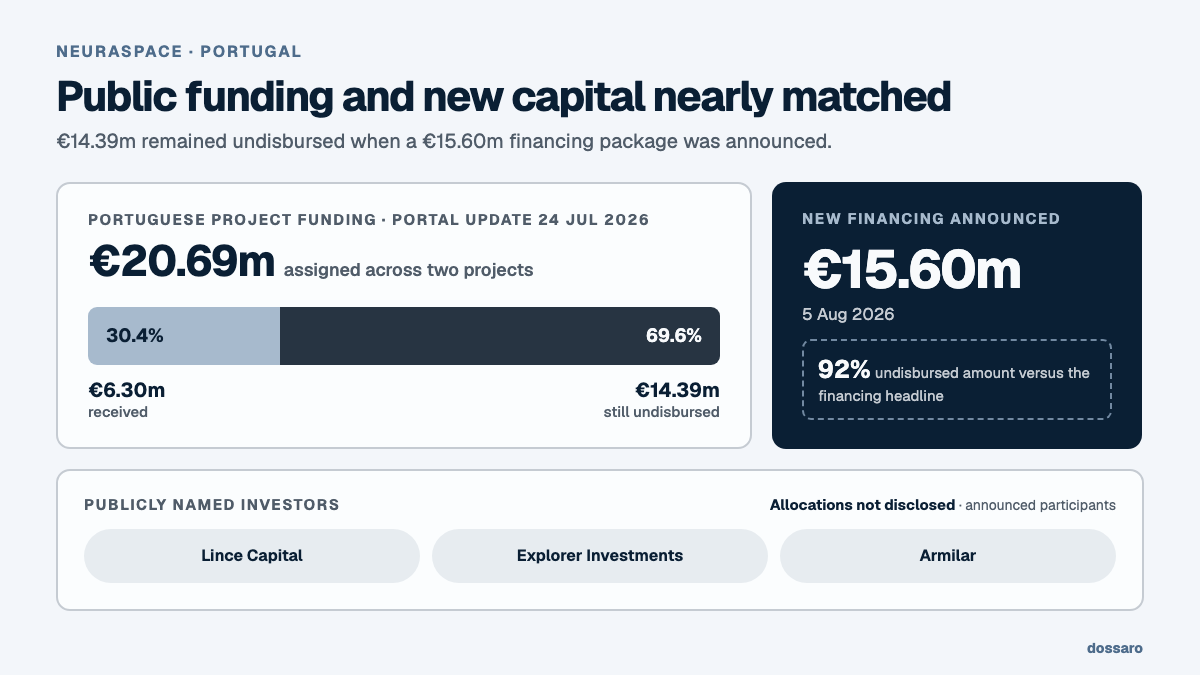
Neuraspace secured €15.6 million of new financing while Portugal's public funding register showed that €14.39 million of money already assigned to its projects had not yet been received. The two amounts are almost mirror images.
The Portuguese space-technology company was assigned €20.69 million across two projects under the country's Recovery and Resilience Plan. By the register's 24 July 2026 update, €6.30 million had been received, or 30.4% of the assigned total. The difference equals about 92% of the new financing headline.
That does not mean Portugal is late, that the company is distressed or that the assigned money is guaranteed. Public project payments normally depend on eligible spending, evidence and milestones. It does mean Neuraspace operates on two capital clocks: private financing can arrive at closing, while public money follows the execution schedule of each project.
For private-market investors, this is the economic tension behind the growth announcement. Lince Capital, Explorer Investments and existing investor Armilar Venture Partners enter a company whose technology has already been substantially de-risked by public commitments, but whose liquidity remains exposed to the timing and conditions of those commitments.
Portugal Had Paid 30.4% Of Assigned Funding
Portugal's public beneficiary record identifies NEURASPACE S.A. by tax number 516136658 and separates assigned financing from amounts received.
| Funding measure at 24 July 2026 | Amount | Decision-relevant meaning |
|---|---|---|
| Assigned across two projects | €20.69m | Maximum public programme amount shown for the beneficiary |
| Received | €6.30m | Cash recorded as received through the programme |
| Still undisbursed | €14.39m | Assigned amount that remained dependent on execution and payment timing |
| New financing headline | €15.60m | Fresh financing announced on 5 August |
| Undisbursed amount versus new financing | 92.2% | The public timing gap is nearly the size of the financing headline |
The comparison does not prove that Neuraspace raised €15.6 million solely to bridge public payments. The financing supports commercial, institutional and defence expansion. It does show that the company needs enough liquidity to execute projects before all assigned support appears as received cash.
That distinction matters because a grant or state-backed project can reduce long-term technical and market risk without removing short-term financing risk. Salaries, sensor infrastructure and suppliers must be paid on operating timelines. Reimbursement and milestone payments can follow later.
Two Projects Create Two Different Payment Clocks
The beneficiary record allocates the €20.69 million across a space-debris programme and a later defence project. Their progress is materially different.
| Public project | Assigned funding | Received | Scheduled conclusion |
|---|---|---|---|
| Neuraspace: AI Fights Space Debris | €11.02m | €6.29m | 31 December 2026 |
| NeuraspaceDEF | €9.67m | €0 | 15 June 2028 |
Nearly all cash received by the portal update belonged to the first project. The defence programme accounted for €9.67 million of assigned funding but showed no receipt yet. Its 2028 end date also gives it a much longer execution window.
This split supports the ordinary reading that a large undisbursed balance can reflect project timing rather than a payment problem. It also makes the liquidity consequence more concrete. Neuraspace is carrying one programme toward a near-term completion date while beginning another whose public funding may arrive over almost two more years.
The company says the first programme built artificial-intelligence tools, proprietary sensors and automated operations for space traffic management. In its February programme disclosure, Neuraspace reported €18.77 million of eligible investment for the project, more than €27 million of institutional funding from the European Space Agency and Portugal's plan, and €2.5 million of private investment from Armilar.
Those are company statements about programme impact and aggregate support. The public portal is the source for the assigned-versus-received snapshot used here.
The €15.6m Package Mixes Private And Public Capital
Tech.eu reported on 5 August that Neuraspace had secured €15.6 million of new financing involving Lince Capital, Explorer Investments and Armilar, together with funding awarded under Portugal's recovery plan.
The available sources do not divide the €15.6 million among new private equity, existing investor participation and public programme amounts. They also do not publish the issue price, share classes, investor allocations or post-financing ownership.
| Capital participant or source | Publicly supported role | What remains unknown |
|---|---|---|
| Lince Capital | Announced private investor in the new financing | Allocation, price, ownership and rights |
| Explorer Investments | Announced private investor in the new financing | Allocation, price, ownership and rights |
| Armilar Venture Partners | Existing investor and announced participant | Follow-on amount and post-round percentage |
| Portuguese recovery plan | €20.69m assigned across two projects | Payment schedule, remaining milestones and eligible-cost conditions |
Armilar's original 2022 disclosure confirms its earlier €2.5 million investment. It does not disclose how Armilar, Lince and Explorer divide the new package.
The correct ownership conclusion is therefore deliberately narrow: named investors participated, but the public evidence does not yet support a cap table. The current financing can be analysed as a liquidity and risk-transfer event without inventing allocations.
Private Capital Bridges Timing Without Owning The Grant
The financing gives Neuraspace resources while the state-backed work is being delivered. That can reduce the risk that a technically successful project is slowed by a mismatch between operating bills and reimbursement timing.
Private investors do not directly receive the undisbursed €14.39 million. Their economic interest is in the company that uses public support to build technology, customer relationships and infrastructure. If programme milestones are completed and payments arrive, the company can convert assigned support into operating capacity without raising the same amount from shareholders.
If payments move more slowly, eligible costs rise or milestones change, private capital absorbs more of the timing burden. Investors therefore gain exposure to a publicly de-risked asset while retaining execution risk around delivery, cash conversion and any programme conditions.
This pattern is visible elsewhere in European industrial financing. Dossaro's analysis of PaperShell's EU-backed factory financing showed how a public commitment can be large relative to the company's balance sheet while still requiring private capital and execution. Neuraspace adds a more precise payment-state view because Portugal publishes both assigned and received amounts for the exact beneficiary.
The comparison is commercially useful. A headline grant number answers how much support a programme has approved. A received figure answers how much of that support has moved through the payment process. Investors need both.
Public Support Has Already Reduced Technical Risk
The benign case for the financing is strong. Neuraspace says the first programme helped build a two-hemisphere sensor network, automated collision-risk operations and a platform serving institutional and commercial customers. The company reported €1.8 million of revenue in 2025, more than 30 employees and more than 500 satellites monitored.
Public funding has therefore supported tangible operating capability rather than only a proposed research plan. Private investors are entering after sensors, software and institutional relationships have been built.
That is also why the undisbursed amount should not be treated as a distress signal. The first project runs through December 2026, and the defence project through June 2028. A 30.4% receipt ratio across projects with different schedules can be consistent with normal milestone delivery.
The investment question is not whether public support is good or bad. It is who finances the interval between approval, eligible work and receipt. The current evidence shows that the interval is large enough to matter: €14.39 million at the portal update, almost the size of the €15.6 million financing announcement that followed.
The Next Documents Must Separate Equity From Project Money
Three disclosures would materially sharpen the picture.
| Next document | Question it would answer |
|---|---|
| Capital increase or subscription schedule | How the €15.6m package is allocated among investors and instruments |
| Project payment schedule and milestone notices | When the remaining €14.39m can be received and under what conditions |
| Post-financing accounts | How much cash is unrestricted, how much is tied to projects and how quickly it is being used |
Until those documents arrive, the evidence supports a clear but bounded conclusion. Neuraspace has secured new private and public financing around technology that Portugal has already backed heavily. The state register simultaneously shows that most of the assigned project money had not yet been received.
That makes the new financing more than a growth headline. It is a bridge between two capital systems with different clocks. The next portal update and corporate financing records will show whether the clocks converge, and how much ownership private investors received for carrying the gap.
Continue reading
Related Research
PaperShell's €40m EU Grant Leaves A €43m Financing Test
PaperShell's signed 2025 annual report links an €83m factory and €40m EU grant to a planned IPO, while private capital must still fund roughly half.
Perceptual Robotics' Senior D Class Now Holds 69% Of Shares
Perceptual Robotics paired about £2.1m of preferred equity with public support, while its senior D class now represents 69% of issued shares.
Spain Puts €1.019bn Behind An AI Gigafactory With A Private Majority
Spain's AI gigafactory company is 51.01% privately held while €719m enters through SETT and another €300m supports EuroHPC infrastructure outside its cap table.
Oceanloop's €38.5m Headline Is Mostly a 2024 EIB Facility
Oceanloop's €38.5m financing headline is 83% debt tied to a 2024 EIB facility, while €6.5m equity enters a 22-position roll-up with dilution unresolved.