
Agon's $30m Launch Round Used Four Seed Classes And Rewrote Control
Agon's $30m launch round became £23.02m of filed cash across four Seed classes, while founder and investor board rights moved into the articles.
On this page
Conduct your own private market research
Add dossaro to Claude or ChatGPT and run source-backed register research from your own workspace.
 Add to Claude
 Add to ChatGPT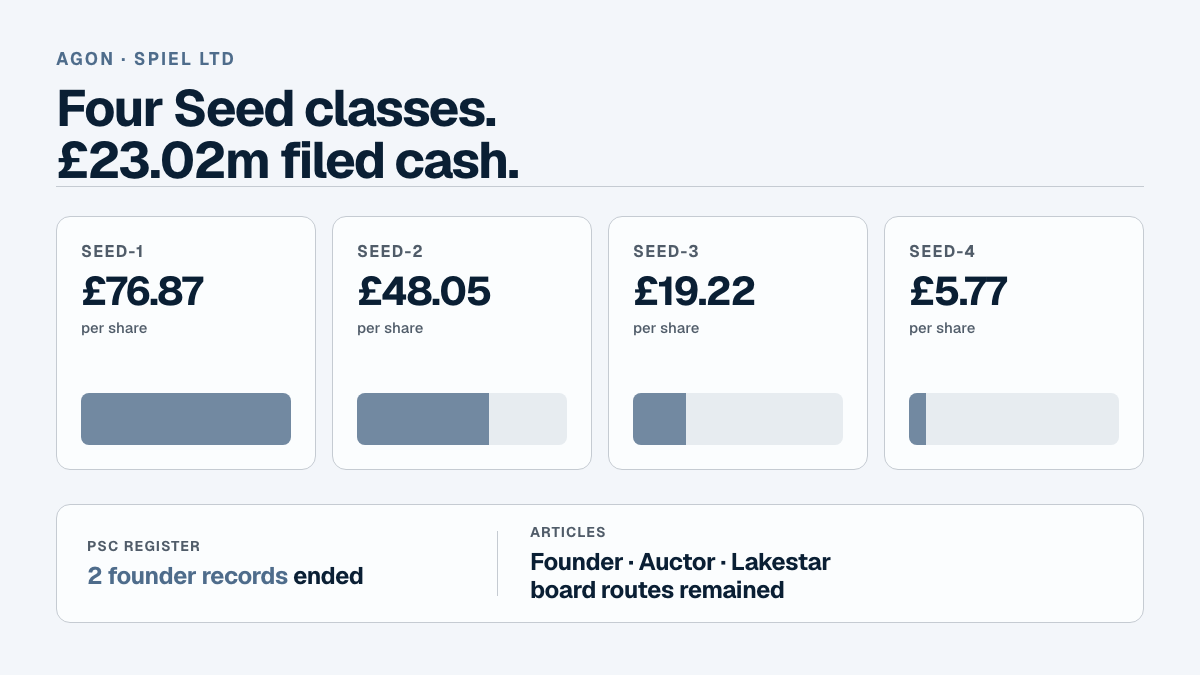
Agon's $30 million launch round was legally assembled through four priced Seed share classes and several allotments, not one undifferentiated cheque. Filings by its principal UK company, SPIEL LTD, record £23,023,122.60 of cash subscriptions across forms filed in May and July 2026.
The financing also changed how control appeared in the public record. Co-founders Junaid Hussain and Tristam Constant each ceased to be registered individually as a person with significant control, or PSC. At the same time, the company's new articles preserved named governance positions for the Founder, Auctor Group and Lakestar.
That combination matters more than the launch-round headline. The public filings show economic rights being separated into four price points while formal influence moved from the simple PSC register into a more detailed governance contract. They do not, however, identify who received each class or establish a precise post-round cap table.
£23.02m Of Filed Cash Sat Behind The Seed Mechanics
Agon's launch followed $7 million in founding pre-seed capital and a $23 million seed round. The company's legal adviser confirmed the $30 million total, while Tech Funding News and Resilience Media reported Lakestar, 201 Ventures, D3, XYZ Venture Capital, Lux Capital and Northzone among the investors.
The Companies House filing history exposes a different dimension: the sterling cash consideration, the legal closing dates and the share classes used to receive it.
The largest filing, submitted on 12 May, recorded 447,940 shares allotted for £18,719,786.26 in cash. It combined ordinary shares with Seed-1, Seed-2, Seed-3 and Seed-4. Two further Seed-1 allotments brought the calculated filed cash to £23,023,122.60.
| Filing and allotment | Share class | Shares | Price per share | Filed cash consideration |
|---|---|---|---|---|
| 12 May, allotted 30 April | Ordinary | 9,702 | £76.87 | £745,792.74 |
| 12 May, allotted 30 April | Seed-1 | 162,030 | £76.87 | £12,455,246.10 |
| 12 May, allotted 30 April | Seed-2 | 37,462 | £48.05 | £1,800,049.10 |
| 12 May, allotted 30 April | Seed-3 | 174,062 | £19.22 | £3,345,471.64 |
| 12 May, allotted 30 April | Seed-4 | 64,684 | £5.77 | £373,226.68 |
| 19 May, allotted 21 April | Seed-1 | 19,405 | £76.87 | £1,491,662.35 |
| 17 July, allotted 15 May | Seed-1 | 36,577 | £76.87 | £2,811,673.99 |
| Total | 504,922 | £23,023,122.60 |
The calculation is mechanical: shares multiplied by the cash price stated on each SH01 form. It should not be converted into a dollar reconciliation with the $30 million announcement because the currencies, closing dates and announced pre-seed component differ. What the filings establish is narrower and more useful: at least £23.02 million of cash share subscriptions entered the UK company through the disclosed allotments.
Four Prices Signal Different Economic Bargains
The four Seed classes ranged from £5.77 to £76.87 per share. That spread does not mean one investor necessarily received a better bargain than another. Share price alone is not comparable without knowing the rights, timing and exchange mechanics attached to each class.
What can be said is that this was not a uniform equity issuance. The articles adopted on 15 April and filed on 7 July defined Seed-1 through Seed-4 separately. The later allotment forms then used those classes at their respective prices.
The structure can accommodate investors entering at different times or under different negotiated terms. It may also capture conversions or earlier commitments. The public documents do not identify the recipients, so assigning Seed-1 to Lakestar or any other named investor would go beyond the evidence.
The price ladder also makes fully diluted ownership impossible to calculate from headline capital alone. Options, conversion rights and the internally inconsistent capital totals shown across two later filings leave too much uncertainty for a reliable final percentage table.
For future financing, that distinction can become consequential. A later investor comparing entry prices needs to know whether an earlier class carried a preference, conversion protection or a different voting bargain. A supplier or strategic partner assessing stability needs the current governance rules rather than the launch-round total. The public filings provide the outline of those questions, but not the contractual answers.
Both Founders Left The Individual PSC Register
SPIEL LTD's control record changed around the financing. Junaid Aasef Hussain's PSC cessation was effective on 15 April. Tristam Constant's cessation was effective on 15 May.
A PSC cessation is not a declaration that a founder lost practical control. The UK threshold generally captures more than 25% of shares or voting rights, board-appointment power, or other significant influence. The filings show that the two individuals ceased to meet the conditions under which they had been recorded. They do not disclose each founder's exact residual stake.
The sequence is nevertheless economically significant. Founder ordinary capital had been issued in February and March at £0.001 per share. The large April and May allotments then expanded the capital base at much higher prices. The PSC cessations are consistent with the founders moving below an individually reportable threshold during that financing process, but the public record cannot isolate dilution from every other possible control condition.
This is the same distinction visible in Mindgard's financing record: disappearing from the PSC register answers a statutory threshold question, not the broader question of who can shape the company.
Governance Rights Survived Outside The 25% Threshold
Agon's new articles explain why PSC status is only part of the control story. They define Tristam Constant as the Founder and reserve a founder director position. They also give Auctor Group Pte Ltd a conditional appointment right and establish a Lakestar investor director position.
Auctor is associated with co-founder Junaid Hussain, while Lakestar was publicly named as a lead investor. The articles therefore distinguish three channels of board influence even after the individuals' PSC records ended: a founder seat, an Auctor-linked appointment right and an investor seat.
These rights are conditional and should not be described as permanent control. Their exercise depends on terms in the articles, including shareholding conditions. Nor do they prove that any one party controls the board. They show that the financing bargain protected specific routes to board representation outside a simple ownership percentage.
The pattern resembles Cambridge Aerospace's protected-holder structure, where the commercially important question was not just how much new money arrived, but which governance rights remained attached to particular constituencies.
This separation also explains why a financing can dilute a founder's reportable ownership without erasing the founder from decision-making. Equity percentages determine one layer of power. Reserved appointment rights, class consents and board composition determine another. Agon's filings make both layers visible, even though they stop short of showing how the rights operate in every future vote.
The Launch Headline Hid A Negotiated Control Architecture
Agon's public launch offered a clean story: $30 million of capital for an AI training platform serving defence and national-security organisations. The register presents the financing as a negotiated sequence instead.
Different Seed classes accepted cash at four prices. The two individual founders ceased to appear as PSCs. New articles then preserved board-access routes for a named founder, a founder-linked company and Lakestar. That does not amount to a complete ownership map, but it establishes that the round recoded both economics and governance.
The next decisive evidence would be the register of members or a shareholder schedule, followed by the executed shareholders' agreement. Those documents could map the four Seed classes to named holders, reconcile the latest capital totals and show whether the board rights visible in the articles remained exercisable after every closing. Until then, the defensible conclusion is structural: Agon's $30 million launch round was a multi-class financing that moved formal influence beyond the individual PSC register without making founder involvement disappear.
Continue reading
Related Research
Cambridge Aerospace's $300m Series C Includes A $37m Old-Holder Block
Cambridge Aerospace moved 158,087 founder and early-holder shares into Series C, a block carrying about $37.2m at the filed class reference price.
Mindgard’s $30m Round Followed A Founder Threshold Drop And A US Subsidiary Pledge
Mindgard raised a $30m Series A after its founder fell below the UK PSC threshold and First Citizens took security over its entire US subsidiary.
Edgify's New Class Can Turn 16% Of Equity Into 36.5% Of Votes
Edgify's authorised Seed Prime class can represent 16.1% of equity but 36.5% of votes, while Rank and Mangrove receive specific governance rights.
Oshen's $5m Round Began Before the Announcement
Oshen's founders held 94.5% before its $5m round, while June resolutions authorised a potential 24.3% share envelope and ratified earlier ASAs.