
FNZ Built A €3bn Custody Bank Before Reported Sale Talks
FNZ Bank's reported €400 million-plus sale follows a custody carve-in that produced €3.0 billion of assets and €250.1 million of book equity.
On this page
Conduct your own private market research
Add dossaro to Claude or ChatGPT and run source-backed register research from your own workspace.
 Add to Claude
 Add to ChatGPT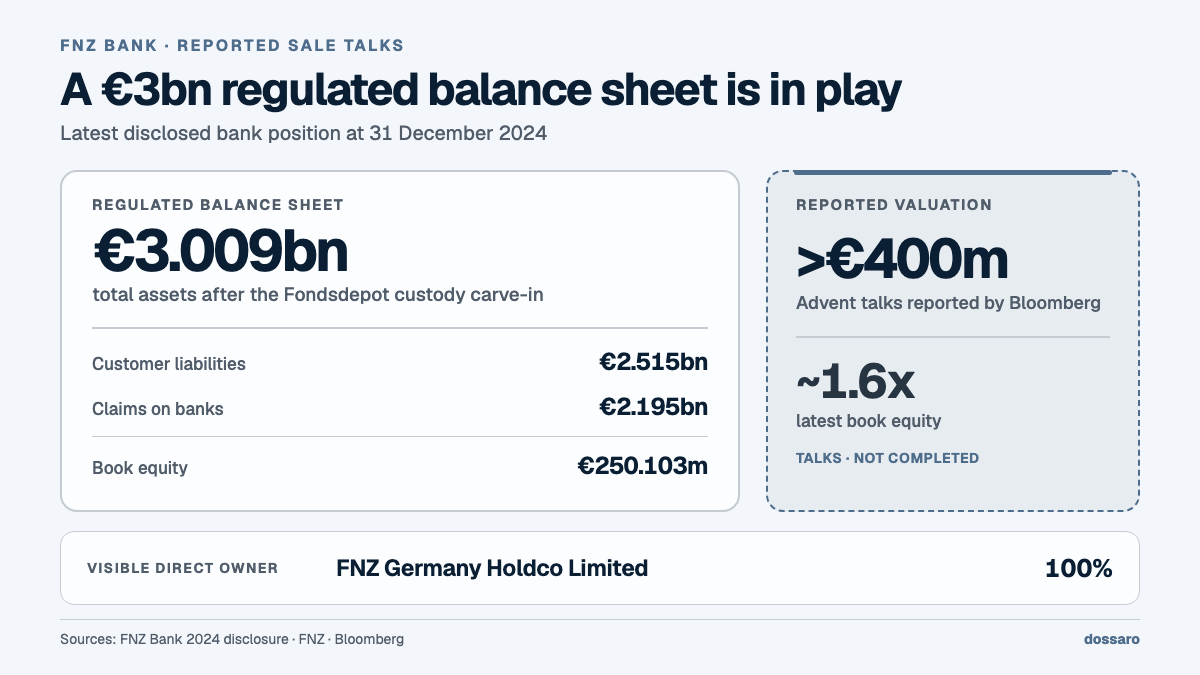
FNZ assembled a German custody bank with €3.009 billion of assets and €250.103 million of book equity before entering reported sale talks that could value the business above €400 million.
That lower-bound valuation is only about 1.6 times FNZ Bank's latest disclosed book equity. It is a useful transaction lens because the asset being discussed is not simply wealth-management software. The bank's official 2024 disclosure shows €2.515 billion of customer liabilities, €54.292 million of subordinated liabilities and a balance sheet dominated by claims on other banks.
Bloomberg reported on 23 July that Advent was in advanced talks to buy FNZ's German custody-banking arm. The report said discussions could still be delayed or fail, other bidders could emerge, and FNZ and Advent declined to comment.
The deal is therefore not complete, and neither its final price nor its perimeter is public. The source-backed finding is narrower: FNZ combined Fondsdepot Bank's deposit and custody business into one regulated institution in December 2024, then put that newly assembled bank into play at a reported valuation modestly above its latest book equity.
For private-market readers, that changes the commercial question. FNZ may be monetising custody distribution while reducing regulatory and balance-sheet intensity. A buyer may gain more than two million customer relationships and a large administration platform, but only a signed transaction will show exactly which assets, liabilities and operating obligations move.
The Reported Price Is About 1.6 Times Book Equity
FNZ Bank's official 2024 disclosure report reconciles its regulatory disclosures with the audited single-entity balance sheet. It reports €250.103 million of equity at 31 December 2024.
Dividing the reported €400 million valuation threshold by that equity produces 1.599 times. Because Bloomberg reported a value above €400 million rather than an agreed price of exactly €400 million, the responsible shorthand is “about 1.6 times book equity” as a lower-bound lens.
| Valuation lens | Amount | Decision-relevant reading |
|---|---|---|
| Reported valuation threshold | Above €400.0m | Talks, not an agreed or completed price |
| Year-end book equity | €250.103m | Audited balance-sheet denominator |
| Lower-bound price to book | About 1.6x | Not a software revenue multiple |
| Balance-sheet profit | €22.868m | Latest disclosed retained result, not transaction cash |
Book equity does not capture all franchise value. A custody bank's customer relationships, distribution agreements, licences and operating infrastructure can support a premium. The calculation nevertheless tells investors what kind of asset is being discussed: a regulated institution whose reported valuation sits relatively close to the capital recorded on its balance sheet.
That differs from the typical reading of a wealth-technology transaction, where recurring platform revenue and growth often dominate the headline multiple. The same distinction mattered in Rail Europe's acquisition of Omio against a negative-equity balance sheet: a transaction headline becomes more informative when the filed balance-sheet state is visible beside it.
The Bank Was Assembled In December 2024
On 2 December 2024, FNZ said it had completed the transfer of Fondsdepot Bank's deposit and custody business into FNZ Bank. The two entities were already sister companies in the FNZ group.
The disclosure report provides the legal and accounting detail. It says the entire deposit and custody business of Deutsche Haftungsdach GmbH, formerly Fondsdepot Bank GmbH, moved to FNZ Bank at book value without shares being issued in return. The transfer took effect on the same date as FNZ's announcement.
FNZ described the combined institution as serving more than two million customers and administering around €130 billion of assets. It also said the established Fondsdepot Bank offers, online-banking access and distribution-partner relationships would continue.
| Date | Event | What changed |
|---|---|---|
| 2 December 2024 | Deposit and custody business transferred | FNZ combined the activities in one regulated institution |
| 31 December 2024 | First disclosed post-transfer year-end | FNZ Bank reported €3.009bn of assets and €250.103m of equity |
| 23 July 2026 | Sale talks reported | Advent was said to be negotiating a value above €400m |
| Next decisive event | Signed announcement or talks ending | Buyer, price, perimeter and conditions become verifiable |
This chronology is the article's central tension. The balance sheet visible to investors was assembled only weeks before the 2024 reporting date. Roughly 19 months later, the bank was reportedly the subject of advanced sale talks.
Customer Liabilities Define The Regulated Perimeter
FNZ Bank's €3.009 billion of assets should not be confused with the €130 billion of assets under administration cited at the integration. Assets under administration describe the scale of client investments serviced on the platform. Balance-sheet assets and liabilities are the bank's own accounting positions.
The disclosed bank balance sheet was heavily weighted toward claims on credit institutions. Those claims were €2.195 billion, or 72.9% of total assets. On the other side, customer liabilities were €2.515 billion, equal to 83.6% of total assets.
| 2024 balance-sheet position | Amount | Share of total assets | Commercial translation |
|---|---|---|---|
| Total assets | €3.009bn | 100.0% | Size of the regulated balance sheet |
| Claims on credit institutions | €2.195bn | 72.9% | Largest disclosed asset position |
| Claims on customers | €166.380m | 5.5% | Customer-credit exposure in the reported state |
| Cash reserve | €146.535m | 4.9% | Balance-sheet liquidity position |
| Customer liabilities | €2.515bn | 83.6% | Deposit-side obligation, shown against assets for scale |
| Subordinated liabilities | €54.292m | 1.8% | Funding junior to senior liabilities, but not equity |
The table does not imply distress. Customer liabilities are a normal part of the banking model and are backed by asset positions. Their importance is strategic: a buyer of the bank, if that is the final legal perimeter, would acquire a supervised balance sheet rather than only a set of software contracts.
That brings capital, liquidity, governance and regulatory obligations into the investment case. FNZ's disclosure says the bank maintained risk-management systems covering capital adequacy and liquidity, and it reports €209.350 million of common equity tier one capital after regulatory adjustments. Book equity and regulatory capital are related but not interchangeable, which is why the 1.6-times calculation uses only the audited book-equity denominator.
The Visible Owner Is One UK Holding Company
The disclosure names one direct legal shareholder. FNZ Germany Holdco Limited, based in London, held 100% of FNZ Bank at the end of 2024.
| Ownership layer | Named entity | Disclosed position | Evidence boundary |
|---|---|---|---|
| FNZ Bank SE | FNZ Germany Holdco Limited | 100% | Direct legal shareholder in the bank's disclosure |
| Ultimate ownership | Not enumerated in the report | Not disclosed | No beneficial-owner inference is made |
| Reported buyer | Advent | Talks only | No ownership change until a transaction closes |
That simple direct-ownership structure makes the high-level sale logic easy to state but not the payout economics. A share sale by the holding company, an asset transfer or a narrower business perimeter could move different obligations and produce different proceeds. Bloomberg's “German custody banking arm” description does not settle the legal structure.
The direct owner's proceeds, tax position and use of cash are also outside the public record. A reported valuation is not proof of money received by FNZ Group, its founders or any other investor.
A Buyer May Pay For Distribution, Not Just Equity
The strongest counter-reading is that book equity understates the value of the operating franchise. FNZ Bank had more than two million customers and approximately €130 billion of assets under administration when the carve-in completed. Those relationships, together with licences, systems and distribution channels, can make 1.6 times book look less like a weak premium and more like a price for strategic access.
Advent could also see operational improvement or consolidation upside that is absent from the 2024 snapshot. The balance-sheet date arrived only 29 days after the transfer, so that report does not show a full year of the combined institution's economics.
For the seller, a transaction can still be attractive even if the headline multiple appears restrained. Divesting a bank can release management attention and reduce the need to operate regulatory capital, liquidity and governance systems inside a broader technology group. It can also sharpen FNZ's focus on wealth-platform infrastructure.
These are plausible economic motives, not disclosed deal terms. The useful due-diligence workflow is the same one applied in M&A target screening: resolve the exact entity, anchor the event to dated primary documents and keep the legal perimeter separate from the press headline.
The next documents will determine whether the reported talks become a genuine balance-sheet exit. A signed sale announcement should identify the buyer and consideration. The purchase perimeter should show whether the regulated bank, customer liabilities and supporting operations move together. FNZ Bank's 2025 annual report should reveal a full year after the carve-in, while post-close ownership and regulatory filings would confirm control.
Until then, the defensible conclusion is precise. FNZ assembled a €3.009 billion German custody bank in December 2024 and entered reported sale talks about 19 months later. At above €400 million, the reported valuation starts at roughly 1.6 times the bank's latest book equity. The unresolved question is not whether the asset has distribution value. It is exactly how much regulated balance sheet a buyer would be paying to own.
Continue reading
Related Research
Rail Europe's Parent Had Negative Equity Before Omio Deal
Rail Europe's parent reported negative equity and its operating company lost €6.27m before Omio's proposed acquisition, putting price and debt at the centre.
Apollo's easyJet Deal Puts A 1.5x Floor Below A Sub-50% Stake
easyJet's proposed private structure caps Apollo below 50% of ordinary shares but adds a 14% to 17% preference, a 1.5x floor and consent rights.
iwoca's £250m Facility Sits Behind an Orphan Issuer
iwoca's £250m facility is built around two new companies: an issuer whose formal control and insolvency decisions sit outside the operating company.
Athora's German Strategy Reversed From A €19bn Expansion To A €3.5bn Sale
Athora agreed to sell its €3.5bn German platform after abandoning a €19bn AXA expansion, reversing a strategy that would have added 900,000 policies.