
Apollo's easyJet Deal Puts A 1.5x Floor Below A Sub-50% Stake
easyJet's proposed private structure caps Apollo below 50% of ordinary shares but adds a 14% to 17% preference, a 1.5x floor and consent rights.
On this page
Conduct your own private market research
Add dossaro to Claude or ChatGPT and run source-backed register research from your own workspace.
 Add to Claude
 Add to ChatGPT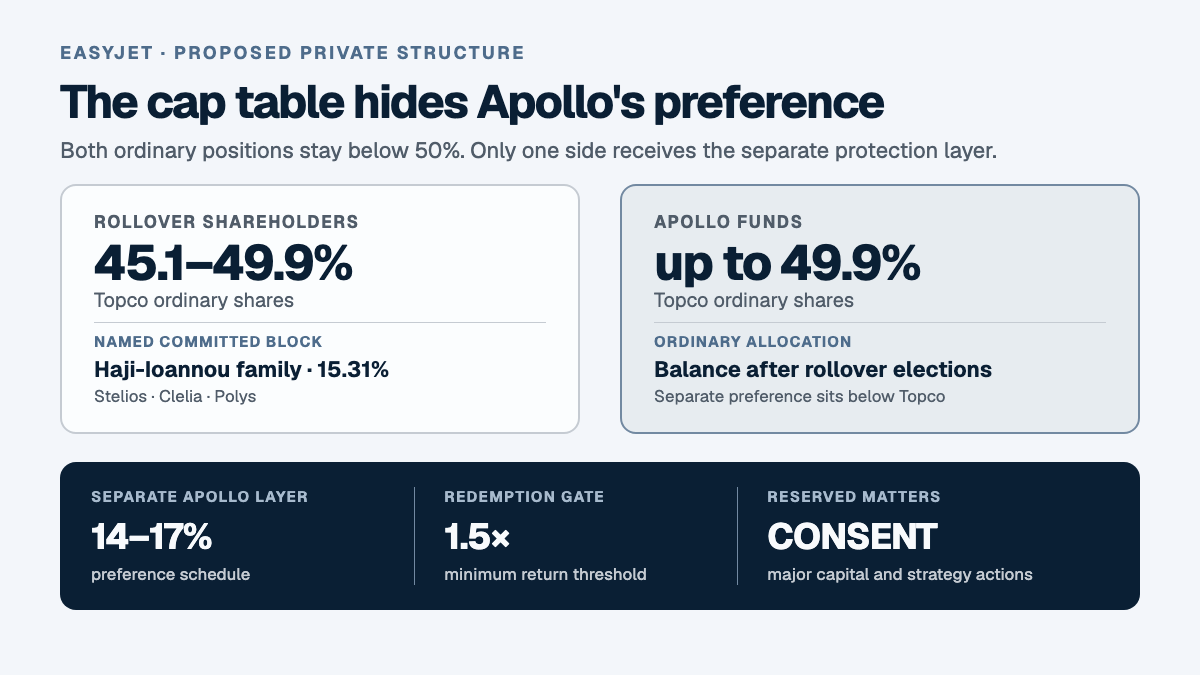
Apollo's proposed easyJet structure keeps its ordinary ownership below 50%. It does not keep Apollo's economics level with those of shareholders who roll their easyJet stock into the private company.
The firm-offer announcement anticipates that Apollo-managed funds will hold up to 49.9% of the new holding company's ordinary shares. Rollover shareholders are expected to hold 45.1% to 49.9%, with an EU trust holding up to 5%. On that layer, Apollo's ordinary shares and the rollover ordinary shares rank alongside each other.
The separate equity term sheet adds the consequential asymmetry. Apollo's investor receives preference shares carrying a 14% cash return or a 15% accrued return, with specified step-ups capped at 16% and 17%. The issuer cannot call those shares for redemption until their holders have received a minimum 1.5 times their invested capital.
That is the commercial finding for private-market readers: the headline cap table can satisfy an ownership limit while a different security changes who gets protected first, who can delay redemption and who must approve major capital decisions.
The Ordinary Cap Table Stops At 49.9%
Apollo-backed Eagle Bidco announced a recommended cash offer of £7.15 per easyJet share on 6 August 2026. The offer values easyJet's issued and to-be-issued ordinary share capital at approximately £5.7 billion. Axios independently reported the agreement and the choice between cash and rollover equity.
The post-transaction ownership ranges are designed around airline ownership and control requirements. They are not a final cap table because eligible easyJet shareholders can still elect the alternative offer and elections above the cap would be scaled back.
| Proposed Topco holder group | Ordinary-share position | What fixes the final amount |
|---|---|---|
| Rollover shareholders | 45.1% to 49.9% | Valid elections and any pro-rata scale-back |
| EU trust | Up to 5.0% | Management-incentive and ownership-compliance structure |
| Apollo funds | Balance, capped at 49.9% | Final rollover and EU trust allocations |
The table is deliberately limited to ordinary shares. It shows why the phrase “Apollo owns less than half” can be accurate and still economically incomplete. Apollo's separate preference sits below Topco in the proposed holding structure and is not captured by the ordinary percentages.
Apollo's Preference Has Four Rates And A Redemption Gate
The preference schedule has two normal states and two stepped-up caps. A 14% annual dividend is payable quarterly in cash. If cash dividends are not paid in full, the security instead accrues at 15%, accumulating daily and compounding quarterly. Failure to redeem when required, or a covenant breach, can lift the cash rate to as much as 16% and the accrued rate to as much as 17%.
| Preference state | Contractual rate | Economic consequence |
|---|---|---|
| Cash dividend paid | 14% annually | Cash leaves the structure each quarter |
| Cash not paid in full | 15% accrued | Unpaid return compounds quarterly |
| Specified non-redemption or breach | Up to 16% cash | Cash cost can step higher |
| Specified non-redemption or breach with accrual | Up to 17% accrued | Compounding claim can grow faster |
The term sheet then restricts the issuer's ability to redeem: holders must receive a minimum 1.5 times multiple on invested capital before Midco 1 can call the preference shares. That wording does not guarantee Apollo a realised 1.5x return. It establishes a gate on an issuer-led redemption under the proposed instrument.
This distinction mirrors the central lesson in Moa Technology's liquidation-preference structure: a percentage on an ordinary cap table does not reveal the payment order written into a different class of security.
The Named Rollover Owners Commit A 15.31% Block
The announcement identifies the largest committed rollover block by name. The Haji-Ioannou family concert party gave irrevocable undertakings covering 116,061,871 easyJet shares, approximately 15.31% of the current issued ordinary capital. The rollover elections remain binding even if a higher competing offer is made.
| Party to undertaking | Beneficial owner or vehicle | easyJet shares | Issued capital |
|---|---|---|---|
| Sir Stelios Haji-Ioannou | easyGroup Holdings Ltd | 29,577,501 | 3.90% |
| Sir Stelios Haji-Ioannou | easyGroup Ltd | 15,400 | 0.00% |
| Clelia Haji-Ioannou | Clelia S.C.P. | 43,258,360 | 5.71% |
| Clelia Haji-Ioannou | Clelia Haji-Ioannou | 250,000 | 0.03% |
| Polys Haji-Ioannou | Hodram Inc. | 42,960,610 | 5.67% |
| Total | Haji-Ioannou family concert party | 116,061,871 | 15.31% |
At the £7.15 offer price, that block has a counterfactual cash value of about £829.8 million. It is not disclosed cash proceeds because the family elected the rollover alternative. The calculation simply translates the size of the equity being committed to the private structure.
The family block also does not establish its final Topco percentage. All eligible rollover elections together are capped at 49.9%, and excess demand would be scaled back pro rata. The executed allocation will matter more than the initial election.
Equal Ordinary Shares Do Not Mean Equal Instruments
The transaction documents make a fair point for Apollo. Its funds are underwriting the acquisition, and the rollover shares will rank pari passu with Apollo's ordinary shares for ordinary dividends, distributions and capital returns. Rollover holders also retain leveraged exposure to any value created above Apollo's fixed preference return.
But the comparison has to include the entire stack.
| Term | Rollover shareholders | Apollo investor |
|---|---|---|
| Topco ordinary economics | Pari passu | Pari passu |
| Separate Midco preference | None disclosed | 14% cash or 15% accrued, with step-ups |
| Issuer redemption threshold | None disclosed | 1.5x minimum for preference holders |
| Initial liquidity | Three-year lock-up, then restrictions | Separate transfer permissions apply |
| Protective consent | Material-holder rights if thresholds are met | Additional Significant Shareholder reserved matters |
Apollo's additional consent list covers specified new equity issuance, capital returns, strategic changes, tax-residence changes and unbudgeted capital expenditure above £200 million. These are protective rights, not proof of unrestricted day-to-day control. They still matter because they place major financing and strategic actions behind Apollo's written approval.
EU Voting Control Can Diverge From Economic Protection
The structure also separates formal voting control from economic protection. If EU nationals would not control a majority of votes on a one-share, one-vote basis, the board can increase votes attached to EU-held shares and reduce votes attached to non-EU shares to preserve an EU majority.
Ownership compliance can also trigger disenfranchisement, compulsory transfers or buy-backs. The general sequence is last in, first out for affected ordinary holders. The term sheet excludes Apollo investor ordinary shares from that general compulsory-transfer sequence.
These provisions are designed to preserve easyJet's operating rights as an airline. They also create an unusually clear example of why economic exposure, legal ownership and voting control should be analysed separately. An M&A target-screening workflow that records only buyer, price and headline stake would miss the instrument carrying the return schedule and the rules that can reweight votes.
Completion Documents Must Show What Became Real
The offer is still conditional. The final ownership percentages depend on rollover elections, the EU trust allocation and any scale-back. The amount ultimately issued as preference capital is not established by the headline ordinary-share ranges.
The next decisive evidence is therefore specific: the completed scheme, final election results, executed Topco shareholder agreement, Midco 1 preference issuance and first post-close ownership filings. Those documents should show whether the proposed separation between sub-50% ordinary ownership and sponsor-level economic protection became the actual private-company structure.
Until then, the defensible conclusion is narrower but still material. Apollo's proposed easyJet stake is capped below 50% at the ordinary-equity level. Its proposed protection is not.
Continue reading
Related Research
Moa Technology's £22.2m Round Put £44.4m First In Line
Moa Technology's £22.2m Series C created 46.4% of its issued shares and a roughly £44.4m first claim after accounts warned the round was essential.
Dwelly's $170m Round Mixed Founder Liquidity With Secured Debt
Dwelly's filings show £44.3m of new Series B cash, 19,406 founder shares sold to EQT and General Catalyst, and Trinity secured across the business.
Rail Europe's Parent Had Negative Equity Before Omio Deal
Rail Europe's parent reported negative equity and its operating company lost €6.27m before Omio's proposed acquisition, putting price and debt at the centre.
FNZ Built A €3bn Custody Bank Before Reported Sale Talks
FNZ Bank's reported €400 million-plus sale follows a custody carve-in that produced €3.0 billion of assets and €250.1 million of book equity.