
Athora's German Strategy Reversed From A €19bn Expansion To A €3.5bn Sale
Athora agreed to sell its €3.5bn German platform after abandoning a €19bn AXA expansion, reversing a strategy that would have added 900,000 policies.
On this page
Conduct your own private market research
Add dossaro to Claude or ChatGPT and run source-backed register research from your own workspace.
 Add to Claude
 Add to ChatGPT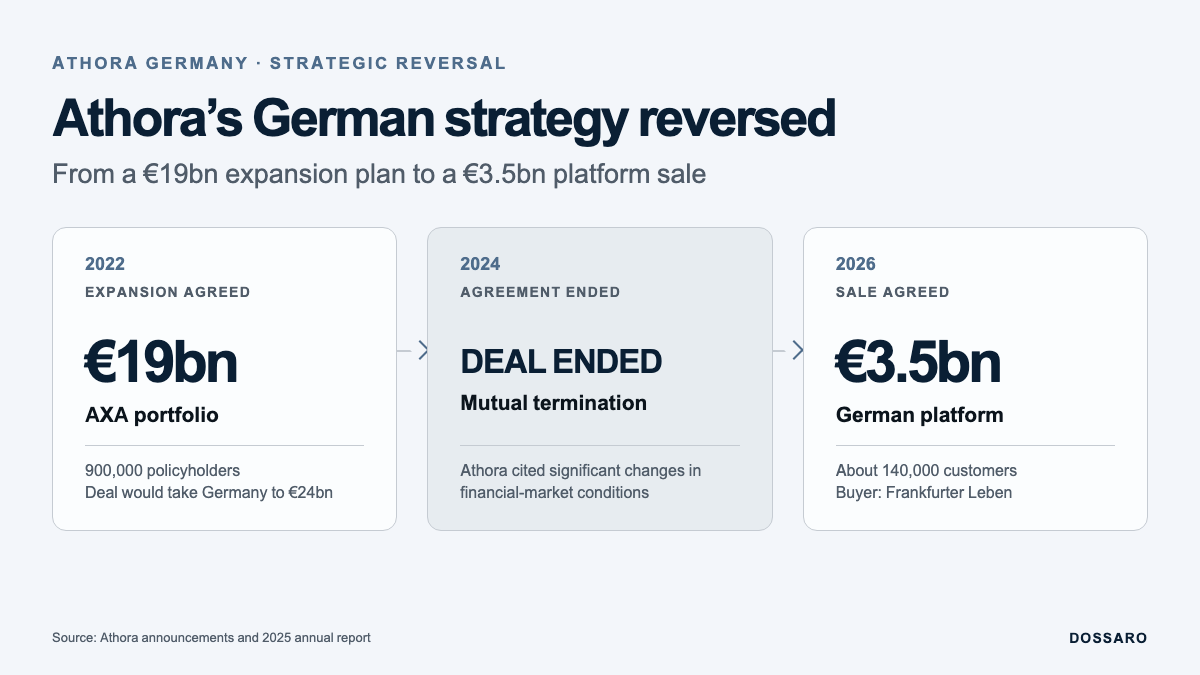
Athora has agreed to sell its €3.5 billion German life-insurance platform to Frankfurter Leben, reversing a strategy that four years earlier was meant to turn Germany into one of the group's scaled markets.
In July 2022, Athora agreed to acquire a closed AXA Germany portfolio with €19 billion of assets and 900,000 policyholders. Athora said that transaction would lift its German business to €24 billion of managed investments and 1.1 million customers.
The parties abandoned that purchase in May 2024 after what Athora called significant changes in financial-market conditions. On 13 August 2026, Athora entered a definitive agreement to sell the German platform it already owned.
The sequence is a strategic reversal, not proof that the failed AXA deal caused the exit. Athora has not disclosed the sale price, valuation or capital released. But the public record does establish a clear change in direction: a business built to acquire closed books and add scale is now leaving Athora's group and moving to another German consolidator.
A €19bn Expansion Became A €3.5bn Exit
The scale gap makes the change unusually visible.
| Event | Portfolio scale | Customers or policyholders | Strategic direction |
|---|---|---|---|
| 2022 AXA acquisition agreement | €19bn of assets | 900,000 incoming policyholders | Expand Athora Germany to €24bn and 1.1m customers |
| 2024 mutual termination | Transaction abandoned | No transfer completed | Expansion halted after financial-market changes |
| 2026 Frankfurter Leben sale agreement | €3.5bn of AuMA | About 140,000 customers | Sell the existing German platform |
The AXA portfolio alone was more than five times the size of Athora Germany's current €3.5 billion platform. Its 900,000 policyholders were more than six times the approximately 140,000 customers Athora reported for Germany at the end of 2025.
Those ratios do not compare transaction values. Assets under management and policyholder counts measure operating scale, not what an acquirer pays. They show how transformative the 2022 plan would have been and how different the 2026 direction is.
Athora's original AXA announcement put a €610 million purchase price on the portfolio and expected a five-year transition. Subject to completion, Athora Germany would have managed €24 billion of investments and served 1.1 million customers.
That transaction never completed. Athora and AXA mutually terminated the agreement in May 2024. Athora attributed the decision to significant changes in financial-market conditions since signing, while saying at the time that it remained committed to growth in Germany.
The 2026 sale is therefore more than a disposal of a small subsidiary. It closes the strategic path Athora publicly described after the failed expansion.
The Platform Being Sold Was Capitalised, Not Collapsing
Athora's latest figures do not support a distress narrative.
Its 2025 annual report gives Athora Germany a 172% Solvency II capital coverage ratio at year-end, up from 134% a year earlier. It reports €3.5 billion of assets under management and administration, about 140,000 customers and 107 employees.
The German business manages closed books of traditional life, unit-linked and pension policies. That means it does not depend on writing large volumes of new business. Its economics depend on administering long-duration obligations efficiently, matching assets and liabilities, and maintaining sufficient regulatory capital.
Athora also said the sale is not expected to have a material effect on the group's key financial metrics or targets. The German operation represents €3.5 billion of Athora's €139 billion of group AuMA, or about 2.5%.
That supports a rational capital-allocation interpretation. Germany may be adequately capitalised while still being too small to justify continued ownership after the route to much greater scale disappeared. Selling it can simplify Athora's country portfolio without implying that policyholder obligations were under immediate financial pressure.
Frankfurter Leben Is Buying The Scale Athora No Longer Wanted
The buyer has the opposite strategic incentive.
Frankfurter Leben specialises in acquiring and managing life and pension portfolios in run-off. Athora says the group already serves about 700,000 policyholders through five regulated insurance companies. Adding Athora Germany would expand that operating base, although the final customer and asset perimeter remains subject to regulatory approval and closing.
Frankfurter Leben also said DWS would support the transaction as a long-term financing partner and work strategically with the buyer. The announcement does not disclose how that financing is structured, how much equity or debt is involved, or what return DWS expects.
The commercial logic is nevertheless identifiable. Closed-book consolidation rewards scale because fixed technology, administration, actuarial and regulatory costs can be spread across more policies. Athora's German website describes a modern IT infrastructure capable of integrating additional books as central to the platform.
Frankfurter Leben is therefore not merely acquiring €3.5 billion of managed assets. It is acquiring policy-administration capacity, regulated legal entities and a customer base that can sit inside a larger German run-off platform.
That is also why the exact transaction perimeter matters. Athora says the sale comprises Athora Verwaltungs GmbH, Athora Deutschland Holding GmbH & Co. KG and its subsidiaries. The statement does not yet provide a complete closing schedule for every entity, asset and contract. As Dossaro's analysis of the FNZ Bank custody sale showed, a regulated-financial-business headline becomes more useful when the legal perimeter and capital treatment are known.
Policyholders Should Separate Ownership From Contract Terms
A life-insurance sale changes the owner of the regulated platform, but it does not automatically rewrite customer contracts.
Athora says customer policies, benefits and contractual commitments remain unchanged, and that the German business will operate normally during the approval process. The proposed transaction is expected to complete in mid-2027, subject to regulatory approvals and closing conditions.
That timetable matters. Until approval and closing, Athora remains responsible for the platform. Regulators will examine whether the buyer can support the liabilities and whether the transfer preserves policyholder protections.
The public sources do not show how the companies will integrate administration, investments or staff after closing. Nor do they quantify cost savings. It would be premature to claim that policyholders will receive better or worse returns, that all 107 employees will transfer on unchanged terms, or that operational systems will be consolidated immediately.
The announced facts are narrower. Policies and commitments remain in force, the business continues to operate, and the buyer is another BaFin-regulated closed-book specialist.
The Missing Price Keeps The Capital Story Open
The central economic question is still unanswered: what does Athora receive for the platform, and how much capital becomes available elsewhere in the group?
Athora's statement gives no consideration, valuation multiple, gain or loss, or expected capital release. It only says the transaction should not materially affect key group metrics and targets.
That omission prevents several tempting calculations. The €3.5 billion AuMA figure is not a proxy for enterprise value. The €610 million price attached to the abandoned 2022 AXA portfolio cannot be applied to the current business because the portfolios, market conditions, capital requirements and transaction structures differ.
It also prevents a clean verdict on Athora's German investment. The platform moved from Athene to Athora in 2018 after its original acquisition, but the public announcement does not reconcile cumulative capital invested, dividends received or disposal proceeds.
The strategically important fact is therefore the direction of travel, not a return multiple. Athora tried to make Germany much larger, abandoned the transaction that would have achieved it, and is now selling the smaller platform to a buyer whose model depends on German closed-book scale.
Regulatory Approval Will Test The New Perimeter
The next decision-changing evidence should arrive before the expected mid-2027 completion.
Regulatory notices and legal filings can confirm the entities transferring to Frankfurter Leben and any pre-closing reorganisation. Athora's future financial reporting may disclose consideration, capital release or a disposal result. Frankfurter Leben or DWS may explain the financing structure and how the platform fits with the buyer's existing five regulated insurers.
After closing, solvency disclosures will show whether the enlarged group preserves capital coverage while integrating the portfolio. Employee and service-company filings may reveal where administration actually sits.
Until then, the defensible conclusion is precise. Athora has agreed to sell a €3.5 billion German platform that it once planned to expand with a €19 billion AXA portfolio. The abandoned acquisition does not prove why Athora chose to exit, but the sequence documents a material reversal from scale-building to divestment.
Continue reading
Related Research
FNZ Built A €3bn Custody Bank Before Reported Sale Talks
FNZ Bank's reported €400 million-plus sale follows a custody carve-in that produced €3.0 billion of assets and €250.1 million of book equity.
Vista's Quantios Deal Crosses £92m Of On-Demand Group Liabilities
Vista's Quantios deal crosses £92m of on-demand group payables and registered Jersey-share security created 69 days before the sale announcement.
Cycles Lapierre Had €108m Due Within A Year After Its €60m Rescue
Cycles Lapierre reported €108.2m due within one year and €45.7m of negative equity after a €60m rescue, exposing its dependence on Accell funding.
Resurgens Took Majority Control Of Qarma As Founders Kept 25–40%
Resurgens took majority control of Qarma through two new vehicles while three continuing shareholder vehicles retained a combined registered band of 25–40%.