
Resurgens Took Majority Control Of Qarma As Founders Kept 25–40%
Resurgens took majority control of Qarma through two new vehicles while three continuing shareholder vehicles retained a combined registered band of 25–40%.
On this page
Conduct your own private market research
Add dossaro to Claude or ChatGPT and run source-backed register research from your own workspace.
 Add to Claude
 Add to ChatGPT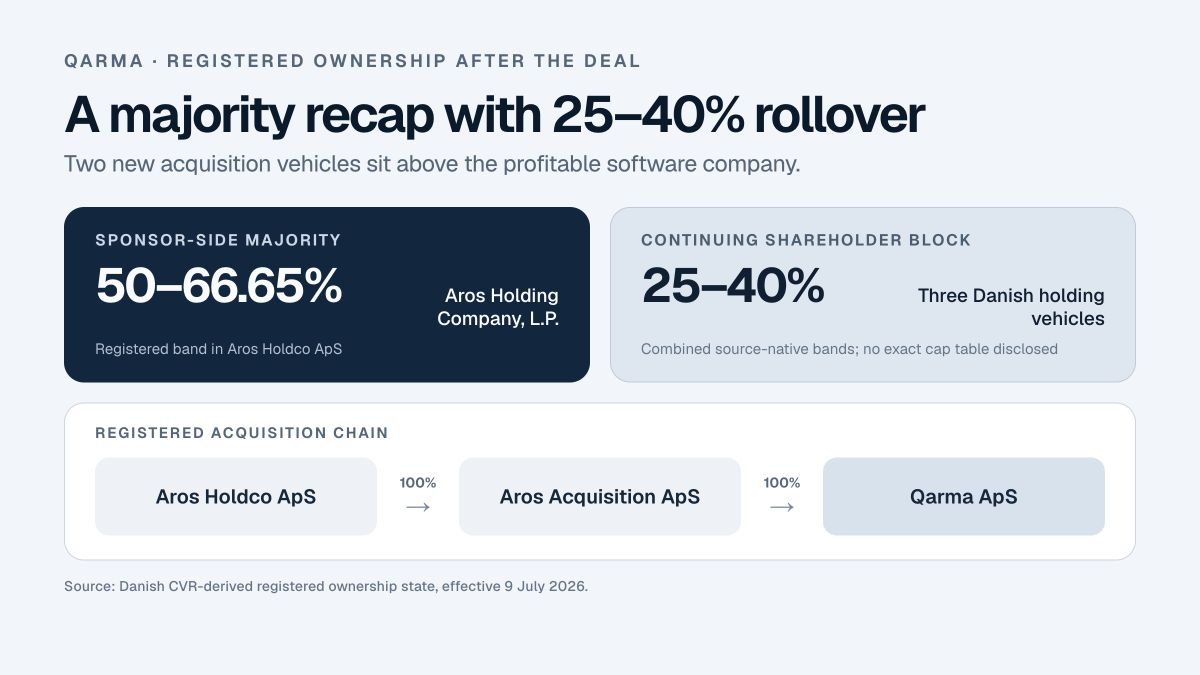
Resurgens Technology Partners took majority control of Danish compliance-software company Qarma through two newly created acquisition vehicles. Three continuing shareholder vehicles retained a combined registered ownership band of 25–40% in the new holding company.
That is the economic structure behind the announcement that Resurgens had made an “investment” in Qarma. The word is not wrong: existing holders kept meaningful exposure and the sponsor may also provide growth capital. But it leaves out the decisive fact that control changed.
The current ownership state places Aros Holding Company, L.P. in a 50–66.65% band at Aros Holdco ApS. J. Ildsvad Holding ApS and S. Ildsvad Holding ApS each hold 10–14.99%, while Riis Mønsted Holding ApS holds 5–9.99%.
The three Danish vehicles therefore own at least 25% and no more than 39.97% together. Their exact percentages, transaction proceeds and shareholder rights are not public. The available evidence supports a majority recapitalisation with substantial rollover, not a complete founder exit.
Two New Companies Sit Between The Sponsor And Qarma
Aros Holdco was incorporated on 28 June 2026. Aros Acquisition ApS followed one day later at the same Copenhagen address. On 9 July, the acquisition company became Qarma's 100% legal owner, according to the public CVR-derived ownership history.
The registered chain is compact:
| Level | Current registered ownership | Economic reading |
|---|---|---|
| Aros Holdco ApS | Aros Holding Company, L.P.: 50–66.65%; three continuing vehicles: 25–40% combined | Sponsor-side majority with material rollover |
| Aros Acquisition ApS | 100% owned by Aros Holdco | Dedicated acquisition vehicle |
| Qarma ApS | 100% owned by Aros Acquisition | Operating company moved into the new chain |
The labels matter. Qarma is not directly owned by several investors after the transaction. Its entire registered capital sits under Aros Acquisition, whose entire capital sits under Aros Holdco. The ownership split that determines the current sponsor-versus-continuing-holder balance is one level higher.
This resembles the distinction in Dossaro's analysis of the Sudolabs operating-company takeover. Broad public language about a “stake” or “investment” can be technically accurate while the registered acquisition chain shows a much clearer transfer of control.
Qarma's evidence is less absolute than Sudolabs'. The Danish Holdco still contains substantial continuing ownership. That is what makes a recapitalisation the more useful description: one group gained majority control, while existing holders reinvested enough exposure to remain economically important.
The Ownership Bands Show Rollover Without Inventing A Cap Table
The Aros Holdco public profile reports four legal-owner bands rather than exact point percentages. Aros Holding Company, L.P. is the only holder in a majority band. J. Ildsvad Holding, S. Ildsvad Holding and Riis Mønsted Holding occupy the three minority bands.
Adding the minimums gives 25%. Adding the maximums gives 39.97%, which can safely be rounded to 40%. It would be wrong to choose an exact number inside that interval or to treat 40% as the disclosed position.
The range is still economically useful. A combined block of 25–40% is large enough for the continuing holders to participate materially in another sale or refinancing. It also means the sponsor did not need to remove the founders and management from the upside to take control.
What the range does not show is equally important. The public record does not disclose whether every vehicle has the same voting rights as its economic interest, whether reserved matters require minority consent or whether managers own additional interests above the Danish Holdco. It also does not show who received cash and who rolled all or part of their prior position.
The correct finding is therefore bounded: Aros Holding Company holds the majority band, and the three named continuing vehicles hold 25–40% together. Any more precise payout or control analysis requires the shareholder agreement or direct ownership filings.
Resurgens Representatives Joined The Board On The Control Date
Qarma's board also changed on 9 July, the same date Aros Acquisition became the operating company's sole legal owner. Seth Green and Lee Ward joined alongside founder and chief executive Jacob Ildsvad Nedergaard.
The Resurgens team page identifies Green as a principal and Ward as a vice president. Their simultaneous appointments connect the sponsor announced in August with the registered July governance change.
Board seats are not a complete control agreement. The public record does not expose vetoes, board quorum rules or appointment rights. But the timing makes the governance consequence visible: the ownership chain and sponsor representation arrived together, 35 days before the public announcement.
Founder continuity is part of the design rather than evidence that control did not change. Jacob Ildsvad remained chief executive and joined the board. The sponsor obtained a majority position and board representation while retaining the operating founder and substantial seller-side economic exposure.
Qarma Was Profitable Before The Transaction
Qarma was not a loss-making asset that needed a sponsor to repair an immediate funding crisis. Its latest public register-derived company figures show positive earnings and a stronger 2025 result.
| Qarma measure | 2024 | 2025 | Change |
|---|---|---|---|
| Gross profit | DKK 21.164m | DKK 26.927m | +27.2% |
| EBIT | DKK 7.148m | DKK 9.227m | +29.1% |
| Profit before tax | DKK 8.457m | DKK 8.163m | -3.5% |
| Net income | DKK 6.611m | DKK 6.380m | -3.5% |
| Equity | DKK 13.667m | DKK 19.940m | +45.9% |
The 2025 balance-sheet total was DKK 42.691 million. Equity represented approximately 46.7% of that amount. The Qarma profile also reports 40 employees, including 36 full-time equivalents in May 2026.
These are private-company accounting figures, not revenue or recurring-revenue disclosures. Gross profit is the best available scale measure because Danish small-company accounts do not necessarily publish turnover. The numbers show a profitable software company with expanding operating earnings, not its valuation.
That distinction strengthens the recap thesis. Resurgens obtained control of a company whose gross profit and EBIT were already growing, while the continuing holders kept a large enough block to benefit if the sponsor can expand Qarma's product, customer base or geographic reach.
Majority Control And Founder Rollover Split The Next Exit
A majority recap divides the transaction into two value moments. Existing owners may receive liquidity now, but the rollover block preserves exposure to the next exit. The sponsor controls the new ownership platform and deploys its operating playbook, while the continuing holders share in the upside they help create.
For Resurgens, the structure secures control without requiring a complete management break. For Qarma's continuing shareholders, the 25–40% band preserves meaningful participation but places the majority decision position with the new sponsor-side vehicle.
This is why the primary-versus-secondary split matters. If most of the consideration bought existing shares, the event delivered more immediate liquidity to sellers. If a material portion entered Qarma as primary capital, the same structure also increases the company's resources for growth. The public evidence cannot allocate the money between those uses.
Nor does the registered band reveal the valuation of the rollover. A minority interest retained in a sponsor-controlled Holdco may carry different governance, transfer and payout terms from the former direct Qarma shares. Applying a guessed transaction value to the 25–40% range would create a false precision the documents do not support.
“Investment” Is Accurate But Incomplete
The strongest benign reading of the announcement is straightforward. Resurgens invested in Qarma, the founders remained invested, and the transaction may include new growth capital. Private-equity announcements often use “investment” for both minority deals and control transactions.
The problem is not the word itself. It is what a reader can mistakenly infer from it. Nothing in the public headline signals that two new companies now sit above Qarma, that one Holdco owner occupies the majority band or that three continuing vehicles together retained 25–40%.
Those facts change the commercial interpretation. This was not simply another investor joining an unchanged cap table. The operating company moved into a new acquisition chain, sponsor representatives joined the board and control shifted while management preserved meaningful economic exposure.
The next decision-changing evidence is specific. Direct Virk ownership filings or the shareholder agreement would narrow the bands and show voting rights. Transaction documents could separate primary capital from seller proceeds. The first Aros Holdco accounts may reveal acquisition financing and the accounting value assigned to Qarma.
Until then, the defensible conclusion is structural. Resurgens controls Qarma through a two-vehicle acquisition chain, while three continuing shareholder vehicles retained 25–40% of the new Holdco. The public “investment” was a majority recap with real founder and management rollover.
Continue reading
Related Research
Sudolabs' Buyer Vehicle Took 100% Of The Operating Company
Sudolabs' buyer vehicle took 100% of its Slovak operating company, while its former 35/35/30 parent was renamed and the founders stayed managers.
Street Group's Founders Held 92.8% Before Hg's £200m Deal
Street Group's founders held 92.8% before Hg's deal valued the company above £200m, mapping to more than £185m of paper value at 12.5 times 2025 revenue.
Friendsurance's Founder Raised His Stake Before The Cover Genius Exit
Before Cover Genius bought Friendsurance, founder Tim Kunde increased his stake from 8.03% to 11.11%, while Hevella entered the exit with 54.03%.
Wexler's Founders Held 54%, But £4.66m Ranked First
Legora bought a Wexler that was 54% founder-owned on its last visible share count, but £4.66m of seed preference ranked ahead of ordinary shares.