
Cycles Lapierre Had €108m Due Within A Year After Its €60m Rescue
Cycles Lapierre reported €108.2m due within one year and €45.7m of negative equity after a €60m rescue, exposing its dependence on Accell funding.
On this page
Conduct your own private market research
Add dossaro to Claude or ChatGPT and run source-backed register research from your own workspace.
 Add to Claude
 Add to ChatGPT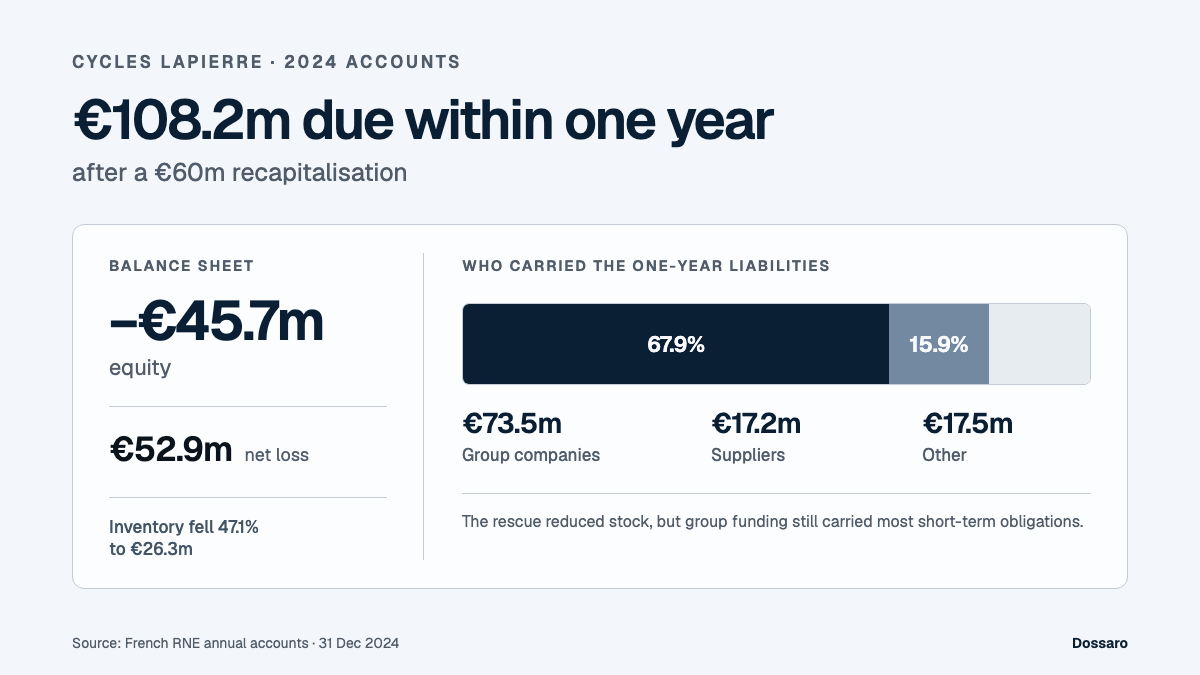
Cycles Lapierre reported €108.2 million of debt and deferred income due within one year at the end of 2024, after a €60 million rescue had recapitalised the French bicycle company. Its equity was negative by €45.7 million.
The French company record shows why Lapierre remained vulnerable even after emergency shareholder funding. Of the €108.2 million total, €73.5 million was owed to group companies and €17.2 million to suppliers. The business depended on Accell Group for liquidity while carrying a large short-term creditor load of its own.
That dependence survived a change of control. In February 2026, Accell announced that its shareholding would transfer for the benefit of super-senior lenders as part of a refinancing and debt reduction. By August, Cycling Weekly reported that the Dutch parent had entered suspension of payments, a court-supervised process for a company unable to meet its obligations, and that local insolvency proceedings had begun across the group.
The accounts do not provide a cash-use schedule for the €60 million. They establish a narrower result: the recapitalisation did not create a durable balance-sheet buffer, and the French subsidiary still relied on group support when lender ownership replaced KKR's consortium.
The Rescue Reduced Inventory But Not The Funding Dependence
Cycles Lapierre's 2024 accounts describe emergency liquidity from Accell's shareholders in December 2023. That support produced a €60 million capital increase at the French company and funded a plan built around restructuring, tighter personnel management and accelerated inventory sales.
The inventory work was substantial. Net inventory fell from €49.7 million in 2023 to €26.3 million in 2024, a reduction of €23.4 million or 47.1%. Converting bicycles and components into sales and cash was essential after the pandemic-era boom left the industry with too much stock.
The income statement moved in the other direction. Revenue fell 6.7% to €113.0 million, while the operating loss widened to €46.3 million. The company ended the year with a €52.9 million net loss.
| Cycles Lapierre measure | 2024 position | Economic reading |
|---|---|---|
| Revenue | €113.0m | Down 6.7% year on year |
| Operating loss | €46.3m | Approximately negative 41.0% of revenue |
| Net loss | €52.9m | Nearly nine tenths of the €60m recapitalisation |
| Equity | Negative €45.7m | The capital increase had not restored a positive equity base by year-end |
| Net inventory | €26.3m | Down €23.4m, or 47.1% |
The comparison between the €52.9 million loss and the €60 million capital increase measures scale, not cash consumption. Accounting losses include non-cash items and do not identify where each euro of new capital went. Cycles Lapierre, for example, fully impaired a €19.45 million participation in Accell Group Europe during the period.
That impairment still matters commercially. A rescue can strengthen an operating company only temporarily when asset values fall, trading losses continue and the wider group remains the main funding source.
Two Thirds Of The One-Year Liability Wall Sat Inside Accell
The liability composition makes the group link explicit. All €108.2 million of debt and deferred income was presented as due within one year.
| Liability category | Amount | Share of €108.2m |
|---|---|---|
| Amounts owed to group companies | €73.5m | 67.9% |
| Suppliers | €17.2m | 15.9% |
| Other liability categories | €17.5m | 16.2% |
| Total due within one year | €108.2m | 100.0% |
The €73.5 million group balance did not necessarily require immediate cash settlement on ordinary commercial terms. Intercompany claims can be rolled, subordinated, waived or refinanced. Their size nevertheless shows that Lapierre's continuity depended on decisions made above the French subsidiary.
Suppliers carried a different exposure. The €17.2 million payable balance sat outside the equity rescue and behind a business still trying to reduce stock and operating losses. Once group funding failed, supplier payment and continued deliveries became part of the court process rather than a decision controlled only by Lapierre and its parent.
The company also disclosed €12.8 million of receivables financing with Rabobank and ING. That facility could convert invoices into working capital, but it did not replace the broader support needed to finance losses, suppliers and the rest of the operating cycle.
This structure is what changed when lenders took control. They did not inherit only brands such as Lapierre, Raleigh, Haibike and Batavus. They inherited operating companies whose liquidity links were part of the previous ownership model.
Lender Control Changed The Owner, Not The Operating Need
KKR led the consortium that bought Accell for a reported €1.56 billion in 2022. The acquisition met the bicycle market near the end of its pandemic surge. Demand then weakened, inventories rose and the group required repeated financial support.
On 18 February 2026, Accell announced additional funding, a substantial debt reduction and a transfer of the shareholding for the benefit of its existing super-senior lenders. Management said the prolonged post-Covid downturn had undermined the effect of the previous recapitalisation.
The transaction shifted ownership and reduced debt at the parent level. It did not automatically give each subsidiary a self-funded balance sheet. Lapierre's 2024 accounts had already shown €73.5 million of group claims and a reliance on a July 2025 support letter in which Accell promised at least twelve more months of backing.
That support chain created a mismatch. Lenders could become owners of the group while still needing to supply fresh liquidity to operating companies. If the new owners could not agree on a durable group solution, the ownership transfer alone could not keep cash moving through the subsidiaries.
The August outcome confirms that the gap was not closed. Accell said no viable solution had been found for the business in its current form and moved into suspension of payments in the Netherlands. Local proceedings followed for group companies.
| Date | Financing or control event | What changed |
|---|---|---|
| December 2023 | €60m Cycles Lapierre capital increase | Emergency shareholder liquidity reached the French subsidiary |
| 31 December 2024 | €108.2m due within one year | Group and supplier exposure remained concentrated and short term |
| July 2025 | Accell support letter | Parent promised at least twelve more months of support |
| 18 February 2026 | Refinancing and lender-control announcement | Shareholding moved for the benefit of super-senior lenders |
| August 2026 | Suspension of payments and local proceedings | Group support no longer provided a viable operating solution |
The Operating Counterpoint Is Real
The balance sheet is not proof that Lapierre lacked a viable core. The inventory reduction removed €23.4 million from a major working-capital problem. Le Monde reported that the operating loss improved to €27.2 million in 2025, €19.1 million better than the 2024 figure.
That improvement can support an independence or sale case. A buyer may value the Lapierre brand, dealer network, product development and French organisation without wanting Accell's full capital structure. A court-supervised separation can also preserve viable activity while leaving legacy claims in the old entity or negotiating them down.
The improvement does not remove the funding question. An operating loss of €27.2 million would still require substantial capital, and the current public sources do not provide a 2025 balance sheet, cash position or working-capital bridge. They also do not show which liabilities a buyer would assume.
The distinction resembles Automata France's liquidation perimeter, where operating assets and customer obligations could not be understood from the parent financing headline alone. For Lapierre, the next transaction must separate the value of the French operation from the group claims that previously financed it.
The French Court Process Will Allocate The Remaining Risk
The latest public evidence identifies the exposed groups but not their recoveries. Super-senior lenders moved from creditors to owners of Accell. Group companies held the largest claims against Lapierre at the 2024 reporting date. Suppliers, employees, customers and financing banks now depend on the perimeter and funding selected in the French process.
The court opening judgment and administrator report are therefore the next decision-changing documents. They can identify the precise procedure, immediate cash requirement, employee perimeter and treatment of intercompany claims. Updated accounts can show whether the 2025 operating improvement also reduced cash use and short-term liabilities.
Those records will decide whether Lapierre can emerge as an independent operating business, be sold with selected liabilities or remain tied to a wider Accell solution. They will also show how much of the old group funding behaves like recoverable debt and how much must absorb the cost of preserving viable activity.
The current conclusion is already firm. Cycles Lapierre received a €60 million recapitalisation, cut inventory by almost half and still ended 2024 with €45.7 million of negative equity and €108.2 million due within one year. Lender control changed who owned Accell. It did not remove the French subsidiary's need for someone to keep funding it.
Continue reading
Related Research
Automata France Entered Liquidation With €48.7m Of Customer-Product Liabilities
Automata France entered liquidation after reporting €48.7 million of customer-product liabilities against €13.9 million of cash and crypto in 2024.
Frank Hummel and Vestas Were SOWITEC's Last Visible Owners
The latest visible SOWITEC owner list showed Frank Hummel at 74.91% and Vestas' vehicle at 25.09% when four core group companies entered insolvency.
Rail Europe's Parent Had Negative Equity Before Omio Deal
Rail Europe's parent reported negative equity and its operating company lost €6.27m before Omio's proposed acquisition, putting price and debt at the centre.
Bruker Bought Noscendo's Software, Not The Venture-Backed Company
After nearly €40m of venture funding, Noscendo entered insolvency. Bruker acquired DISQVER, patents and selected staff while the laboratory closed.