
Automata France Entered Liquidation With €48.7m Of Customer-Product Liabilities
Automata France entered liquidation after reporting €48.7 million of customer-product liabilities against €13.9 million of cash and crypto in 2024.
On this page
Conduct your own private market research
Add dossaro to Claude or ChatGPT and run source-backed register research from your own workspace.
 Add to Claude
 Add to ChatGPT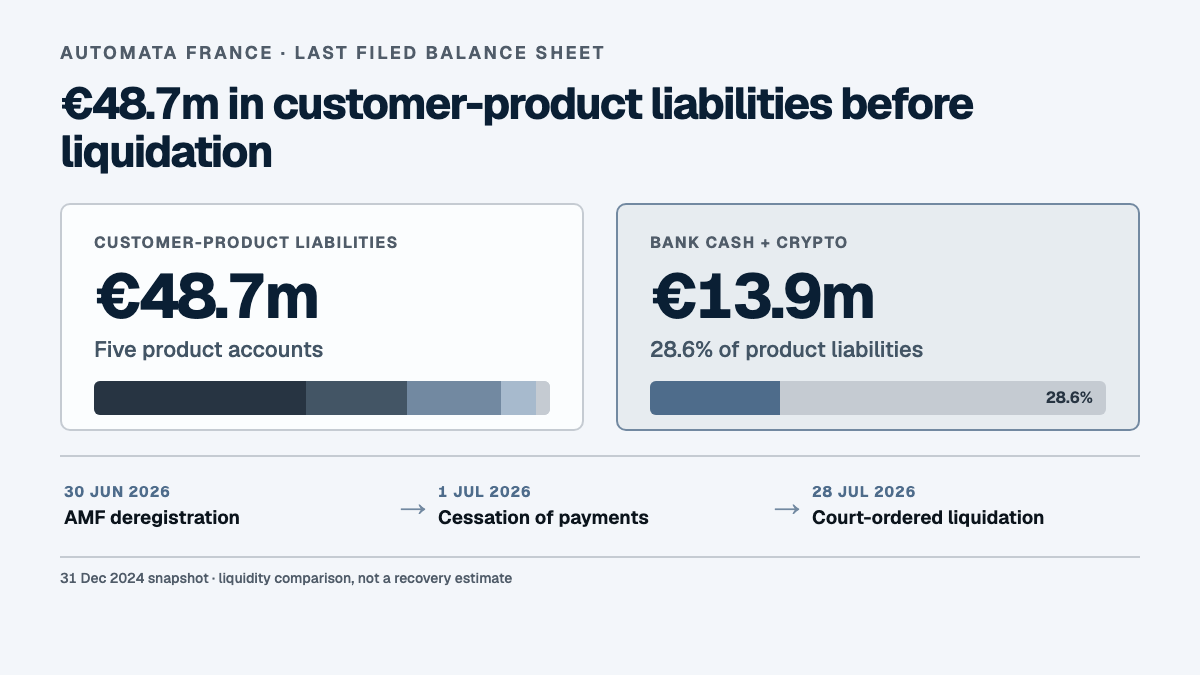
Automata France entered court-ordered liquidation on 28 July 2026 after its last filed accounts showed €48.658 million of customer-product liabilities against €13.907 million of bank cash, crypto and financial instruments.
The comparison means those liquid categories covered 28.6% of the product-liability balance at 31 December 2024. It does not mean customers will recover 28.6%, or that €34.751 million is missing. The company also reported mining equipment, receivables and other assets whose current realizable value is unknown.
What the accounts do establish is that the French entity's customer obligations were not matched one for one by immediately liquid balance-sheet resources. That makes the liquidation a question of asset recovery, contract perimeter and creditor priority, not simply the administrative end of a crypto registration.
The BODACC liquidation notice says the Antibes Commercial Court ordered immediate judicial liquidation and dated Automata France's cessation of payments to 1 July 2026. That date came one day after the French financial regulator's deregistration became effective.
The sequence is striking, but it does not establish causation. The AMF decision, the last filed balance sheet and the court process answer three different questions: why the registration ended, what Automata France reported owning and owing at a historical date, and how current creditors will now be handled.
The Last Accounts Show A €34.8m Liquidity Gap, Not A Loss
Automata France's 2024 annual accounts divide the €48.658 million liability stack among five named customer-product accounts.
| Product liability at 31 December 2024 | Amount | Share of total |
|---|---|---|
| Hearst Vault, two-year | €22.621m | 46.5% |
| Mimo Flex, B2C | €10.738m | 22.1% |
| Cloud Mining, four-year | €10.006m | 20.6% |
| Term Vault, 12-month | €3.764m | 7.7% |
| Mining Vault B2B | €1.529m | 3.1% |
| Total product liabilities | €48.658m | 100.0% |
Against those obligations, the company reported €8.102 million of bank cash and €5.805 million of crypto or financial instruments. The combined €13.907 million was €34.751 million below the product-liability total.
That difference is a liquidity gap, not an accounting hole. Automata France reported €52.374 million of total assets, broadly matching its liabilities. Approximately €27.028 million sat in fixed assets, dominated by mining equipment. Other assets included roughly €7.21 million of receivables from group entities and €2.56 million of vendor-refund receivables.
The distinction matters in liquidation. Cash can be distributed once ownership, segregation and priority are resolved. Hardware must be located, valued and sold. Group receivables have to be collected from counterparties. Contract rights may be disputed or transferred. Each category can produce a different recovery and timeline.
| Filed 2024 balance-sheet lens | Amount | What it does and does not show |
|---|---|---|
| Customer-product liabilities | €48.658m | Dated nominal obligations across five accounts |
| Bank cash | €8.102m | Accounting cash, not a verified current customer reserve |
| Crypto and financial instruments | €5.805m | Dated carrying amount, not current liquidation proceeds |
| Cash plus crypto | €13.907m | 28.6% of product liabilities at the snapshot |
| Net fixed assets | €27.028m | Mostly mining equipment, with current sale value unknown |
| Equity | -€43,442 | Capital impairment at year-end, not a recovery estimate |
The accounts also reported a €187,401 loss and negative equity of €43,442. The sole shareholder resolved in March 2026 to continue the company and restore its equity position. As with Chargepoly's capital impairment before a new financing, that filed state changes the economic reading without predicting the final outcome.
The Product Maturities Pushed Risk Into The Future
Only €3.764 million of the product liabilities was reported as due within one year. Approximately €32.627 million fell due between one and five years, while €12.268 million was due after five years.
That maturity structure helps explain how the business could hold long-lived mining equipment against customer funding. It also means the 2024 liquidity comparison was not a same-day withdrawal test. Most obligations were contractually long-dated.
The benign interpretation is credible: long-dated customer products may have been intentionally matched with productive equipment, crypto holdings and group infrastructure. Mining hardware could generate cash flow or retain resale value, and intragroup receivables could be collected in full.
The adverse interpretation is equally concrete: a forced sale can reduce hardware values, group counterparties can fail to pay and contracts can place customers in different legal positions. The public record does not yet decide between those outcomes.
This is why “28.6% liquid-resource coverage” is the right formulation and “28.6% customer recovery” is not. The first is arithmetic from a dated filing. The second would require a current liquidator inventory, verified claims and a distribution waterfall.
The AMF Decision Was About More Than A Missed Deadline
The AMF decided on 7 May to remove Automata France from the register of digital-asset service providers effective 30 June 2026. Its published decision says the company had conducted crowdfunding activity without the required authorization.
The regulator concluded that this activity demonstrated failures against the good-repute, competence and compliance standards required for registration. Automata France contested the characterization of its activity as crowdfunding.
After deregistration, the company was permitted only to wind down and promptly return control of customer digital assets. Vancelian's cessation FAQ says customer crypto and euro funds are safe, identifies Fireblocks and Modulr as infrastructure providers, and says Safes and Exclusive Offerings remain governed by their contracts and maturities.
Those statements are the company's counterposition, not a liquidator's reconciliation. They may prove consistent with customer outcomes, but the court process now determines what Automata France owns, which obligations remain with it and how claims rank.
A €1,000 Asset Sale Creates A Perimeter Question
Before the AMF deregistration took effect, Automata France sold a defined business to Vancelian Ltd. The BODACC sale notice describes the business as purchasing bitcoin-mining machines and selling computing power to customers through an application. The stated price was €1,000.
That number is attention-grabbing, but its meaning is narrow. The notice does not say that Vancelian Ltd bought Automata France's shares, every mining machine, every customer contract or the company's entire €52.374 million balance sheet for €1,000. It documents one business transfer with a defined activity.
The sale nevertheless creates a decision-relevant question for creditors: which operating assets, contracts, employees, intellectual property and customer relationships moved, and which stayed inside the entity that entered liquidation?
The public timeline shows why that perimeter matters.
| Date | Public event | What it establishes |
|---|---|---|
| 31 December 2024 | Last filed balance sheet | €48.658m product liabilities and €13.907m cash plus crypto |
| 3 March 2026 | Business-sale agreement | Defined mining-computing business sold to Vancelian Ltd for €1,000 |
| 7 May 2026 | AMF decision | Deregistration approved after unauthorized-activity findings |
| 30 June 2026 | Deregistration effective | Automata France restricted to wind-down activity |
| 1 July 2026 | Cessation of payments date | Date later fixed by the commercial court |
| 28 July 2026 | Immediate liquidation ordered | SELARL MJ Lefort appointed liquidator |
| 7 August 2026 | BODACC notice published | Two-month creditor-claim window began |
The transaction and insolvency notices can be monitored through France's BODACC publication system. A sale notice is useful precisely because it defines a legal event more narrowly than brand-level messaging.
The Visible Owner Is Automata Group, Not Vancelian Ltd
Automata France's 2024 capital schedule names one shareholder. UK-registered Automata Group Ltd held all 1,000 shares, equal to 100% of the French company at that reporting date.
The current public company profile names Pierre-Yves Dittlot as president and Xavier Gomez as director general. These are direct legal roles, not evidence of beneficial ownership, personal liability or proceeds from the Vancelian transaction.
| Visible role | Named party | Evidence boundary |
|---|---|---|
| Sole shareholder at 31 December 2024 | Automata Group Ltd | Dated direct legal ownership, not current beneficial ownership |
| President | Pierre-Yves Dittlot | Registered management role |
| Director general | Xavier Gomez | Registered management role |
| Buyer of defined business asset | Vancelian Ltd | Asset buyer, not proven shareholder of Automata France |
| Judicial liquidator | SELARL MJ Lefort, represented by Maître Yann Lefort | Court-appointed liquidation role |
Keeping those roles separate prevents a common error. The Vancelian brand connection and the asset purchase do not prove that Vancelian Ltd owned the French company's shares or assumed all of its liabilities.
The Liquidator's Inventory Now Decides The Economics
The strongest available evidence supports a precise conclusion. Automata France entered liquidation with a last-filed balance sheet that depended heavily on non-cash assets to support customer-product liabilities. Cash and crypto equaled 28.6% of those liabilities at the end of 2024, while mining equipment and receivables carried much of the remaining asset value.
The evidence does not support a customer-loss figure. Eighteen months passed between the balance-sheet date and liquidation. Assets may have been sold, contracts transferred, claims repaid or balances changed. Vancelian says funds are safe. None of those current-state questions can be settled from the 2024 accounts alone.
The next documents are therefore unusually important: the liquidator's opening inventory, the creditor schedule, product-level customer claims, current wallet and bank reconciliations, the exact Vancelian transfer perimeter and any 2025 or interim 2026 accounts.
Until those appear, the economic issue is not whether €48.7 million vanished. It is how much of a long-dated, asset-backed product stack remains inside Automata France, what the liquidator can realize from the assets behind it, and which customers have claims against which legal entity.
Continue reading
Related Research
Chargepoly's €23m Round Followed Capital Loss At Its Stations Unit
Chargepoly raised €23 million after its wholly owned stations vehicle fell below half its capital, shifting existing deployment risk to new investors.
Nalvin Entered Liquidation 48 Days Before Lovable Acquired Its Team
Version Lens Sweden entered liquidation 48 days before Lovable acquired the Nalvin team, separating the talent deal from the venture-backed company.
Bruker Bought Noscendo's Software, Not The Venture-Backed Company
After nearly €40m of venture funding, Noscendo entered insolvency. Bruker acquired DISQVER, patents and selected staff while the laboratory closed.
Naked Energy's £8.875m Round Followed A Funding Warning
Great British Energy invested £7.5 million after Naked Energy disclosed unfinished funding, while a 2x Series B preference protected incumbent capital.