
Chargepoly's €23m Round Followed Capital Loss At Its Stations Unit
Chargepoly raised €23 million after its wholly owned stations vehicle fell below half its capital, shifting existing deployment risk to new investors.
On this page
Conduct your own private market research
Add dossaro to Claude or ChatGPT and run source-backed register research from your own workspace.
 Add to Claude
 Add to ChatGPT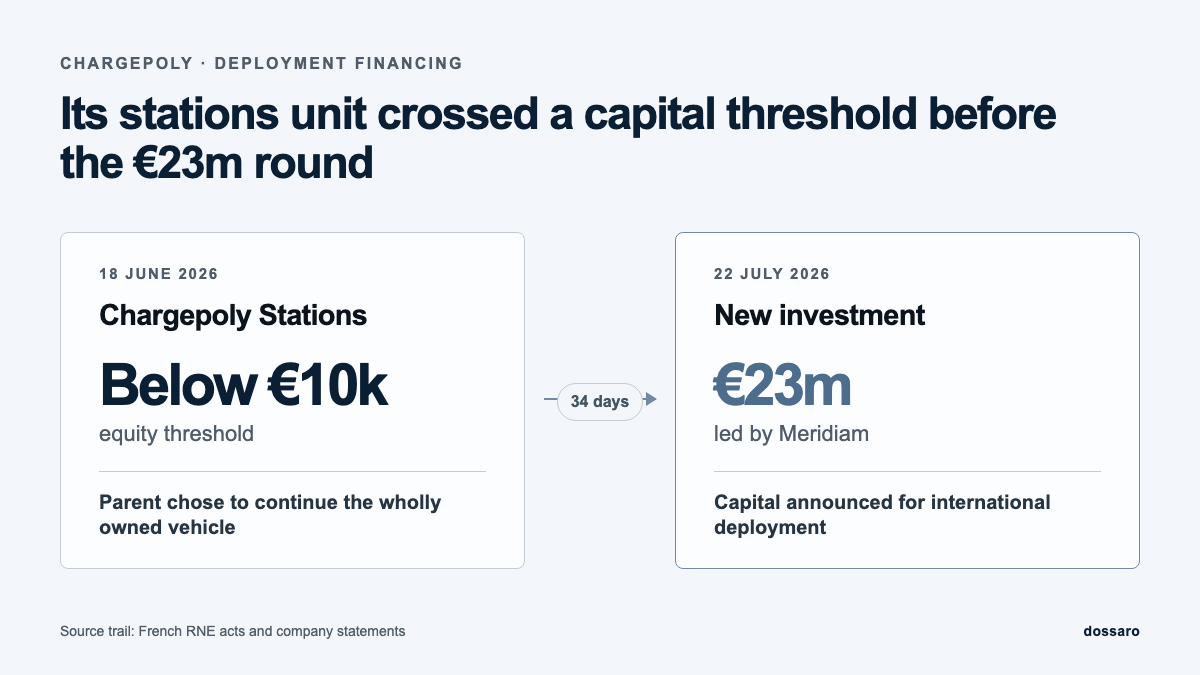
Chargepoly raised €23 million after its wholly owned charging-stations vehicle had fallen below half of its €20,000 share capital and the parent formally decided to keep it alive.
The sequence puts a second function behind the growth financing led by Meridiam. The money is meant to accelerate depot-charging deployments across France, the United Kingdom and Canada. It also arrives after the vehicle built to own and operate those assets had already absorbed enough losses to trigger France's capital-impairment procedure.
That does not make the entire €23 million a rescue. The public documents do not allocate the money between Chargepoly, Chargepoly Stations and individual projects, nor do they identify how much is equity, debt or project capital. They do show that Meridiam is entering after deployment risk has begun to materialise, not before it.
For infrastructure and private-market investors, that distinction changes the underwriting question. The deal is not only about the growth rate of electric-truck charging. It is about which balance sheet will fund physical charging assets until utilisation and customer payments catch up with their cost.
The Asset Vehicle Had Already Crossed A Capital Threshold
Chargepoly created Chargepoly Stations in 2022 with €20,000 of share capital. The incorporation act records the parent as subscriber for all 20,000 shares, making the stations company wholly owned at formation.
The vehicle's stated purpose is operational. It can own and operate charging installations, physical assets, software platforms and related property. The losses recorded there therefore sit in the layer intended to carry deployment economics rather than in a detached administrative shell.
On 18 June 2026, Chargepoly made a sole-shareholder decision acknowledging that the stations company's 2025 accounts had reduced equity below half of share capital. The parent chose not to dissolve it. The decision was filed on 13 July, nine days before the new financing was announced.
| Date | Corporate event | What it establishes |
|---|---|---|
| 17 October 2023 | Incorporation act filed | Chargepoly subscribed all 20,000 Stations shares |
| 18 June 2026 | Sole-shareholder decision | 2025 equity had fallen below half of share capital |
| 13 July 2026 | Continuation decision filed | Parent retained the impaired deployment vehicle |
| 22 July 2026 | €23m investment announced | Meridiam entered alongside existing shareholder Fideve |
The threshold translates into a narrow but hard financial fact. Equity had fallen below €10,000. The decision does not disclose the exact balance, and the underlying 2025 accounts were not available in the source pack. The registered event is therefore capital impairment, not a quantified negative-equity position and not proof of insolvency.
Its timing is still important. Only 34 days separated the parent decision from the financing announcement. The new capital reached the group after Chargepoly had already decided that the stations platform should continue despite the losses accumulated inside it.
Meridiam Is Funding More Than Software Growth
Chargepoly's announcement says Meridiam Green Impact Growth Fund led the €23 million investment alongside Fideve Groupe, described as a long-standing shareholder. Founder Hadi Moussavi said the financing would accelerate international expansion.
Meridiam's own transaction announcement frames the company as an integrated infrastructure operator. Chargepoly designs the charging system, deploys equipment, operates charging points and supplies the Lucie software platform. It says hundreds of direct-current fast-charging points are already operating across France, the United Kingdom and Canada.
That integrated model creates a larger funding requirement than a software-only business. Someone must pay for equipment, installation and project working capital before a depot produces mature utilisation revenue. Chargepoly Stations provides a legal place for those assets and risks to sit.
| Layer | Publicly described role | Financing implication |
|---|---|---|
| Chargepoly SAS | Technology, project delivery and group platform | Holds the operating story and parent-level investor relationship |
| Chargepoly Stations SAS | Owns and operates charging installations and related assets | Carries asset deployment and utilisation risk |
| Meridiam Green Impact Growth Fund | Leads the new €23m investment | Supplies capital after the stations layer recorded impairment |
| Fideve Groupe | Long-standing shareholder joining the transaction | Extends existing investor exposure into the next phase |
The filing does not prove that the stations vehicle receives all, or even most, of the €23 million. The economic connection is narrower: fresh infrastructure capital enters a group whose dedicated asset vehicle had already consumed most of its original equity cushion.
The Earlier €15m Headline Also Contained Different Capital Forms
Chargepoly's earlier financing shows why headline round sizes need an instrument-level bridge. In 2023 the company announced a €15 million Series A to expand in Europe and North America. The registered capital act documents 32,491 new shares at €215.44 each, equal to €6,999,861.04 of subscription consideration.
Only €5,499,967.76 of that amount was fresh cash. Another €1,499,893.28 was satisfied by converting a liquid claim against the company.
| 2023 financing component visible in the capital act | Amount | Share of registered €7.0m subscription |
|---|---|---|
| Fresh cash | €5,499,967.76 | 78.6% |
| Claim converted into equity | €1,499,893.28 | 21.4% |
| Total registered subscription | €6,999,861.04 | 100.0% |
| Difference to public €15m headline | €8,000,138.96 | Not explained by this act |
The difference does not establish that the €15 million announcement was inaccurate. Other closings, loans, convertibles or project instruments may account for it. It does establish that the capital increase itself carried €5.5 million of fresh cash, not €15 million.
That history raises the right question for the current round. The €23 million headline should not be treated automatically as parent-company cash equity. Investors need the subscription and financing documents to separate corporate equity from subsidiary funding, shareholder loans and capital tied to individual projects.
Deployment Losses Can Be Normal And Still Matter
An early infrastructure vehicle can burn through a small equity base without implying that its assets have failed. Charging installations require upfront construction, hardware and grid work. Revenue can lag commissioning. A €20,000 corporate capital figure is also a legal minimum-like cushion, not the economic cost of a multi-country charging network.
That commercial explanation is consistent with Meridiam's role. The fund specialises in long-duration infrastructure and green-growth businesses. It may be supplying exactly the patient capital needed to move Chargepoly from founder and venture financing toward a more asset-intensive deployment model.
The explanation does not remove the risk transfer. It locates it. Chargepoly and its earlier investors carried the first phase, including the losses that impaired the stations vehicle. Meridiam and Fideve now finance the next phase, with the possibility that part of their capital restores the asset layer as well as building new sites.
This resembles QUICKBLOCK's mixed expansion and recapitalisation financing, where a growth headline also had to be read against accumulated balance-sheet losses. Chargepoly adds an infrastructure-specific question because the risk is separated into a vehicle that can own the physical assets.
The French National Business Register can expose the incorporation and capital decisions that make this sequence visible. A France RNE research workflow is most useful here not as a replacement for the financing announcement, but as the bridge between the headline and the legal layer carrying deployment risk.
The Next Filing Must Show Where The €23m Lands
The decisive next documents are Chargepoly Stations' 2025 accounts, the subscription agreement and the next capital filings for both companies. They should show the size of the stations deficit, whether Meridiam bought parent equity and whether capital reaches the deployment vehicle as equity, debt or project funding.
Until then, the source-backed conclusion is specific. Chargepoly's €23 million round funds an international expansion, but it begins from a group structure in which the wholly owned stations vehicle had already lost more than half its capital. Meridiam is not underwriting a clean sheet. It is underwriting the next deployment phase after the first losses were already visible.
Continue reading
Related Research
QUICKBLOCK's £940k Funding Was Also A Recapitalisation
QUICKBLOCK raised £940,000 after reporting £534,213 of net liabilities. Filings map £638,571 to equity, leaving about £301,429 as implied grants.
Rail Europe's Parent Had Negative Equity Before Omio Deal
Rail Europe's parent reported negative equity and its operating company lost €6.27m before Omio's proposed acquisition, putting price and debt at the centre.
Volta's $300m Raise Had A 30.5x Nominal Share-Price Ladder
Volta's $300m raise hid a 30.5x nominal price ladder from $58 Seed shares to $1,769.91 Series A stock, plus preferred rights and $2m of debt set-off.
Entravel's $7.5m Round Funds A Working-Capital Engine
Entravel raised $7.5m after audited accounts showed $548,714 cash, $2.44m of current liabilities, parent support and heavy crypto settlement flows in 2025.