
Entravel's $7.5m Round Funds A Working-Capital Engine
Entravel raised $7.5m after audited accounts showed $548,714 cash, $2.44m of current liabilities, parent support and heavy crypto settlement flows in 2025.
On this page
Conduct your own private market research
Add dossaro to Claude or ChatGPT and run source-backed register research from your own workspace.
 Add to Claude
 Add to ChatGPT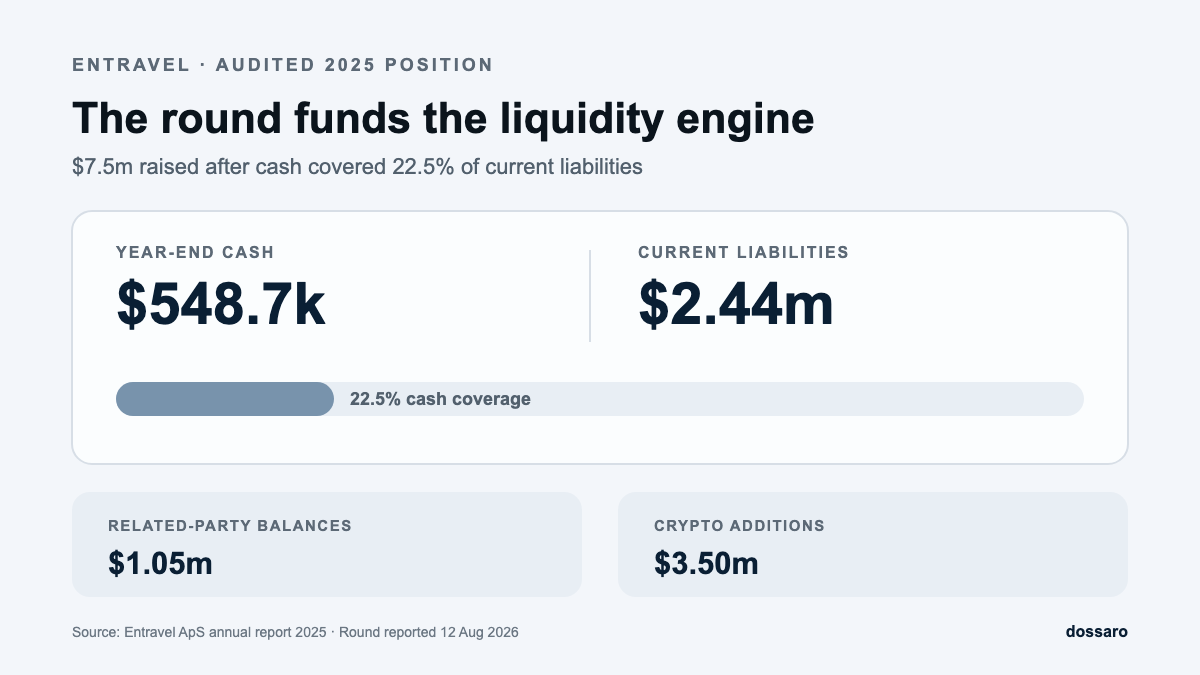
Entravel raised $7.5 million after its Danish operating company ended 2025 with $548,714 of cash, $2.44 million of current liabilities and a parent support commitment.
That balance-sheet contrast makes the financing more than a standard expansion round. Tech.eu reported on 12 August that Ethereal Ventures and Finality Capital co-led the investment, joined by GSR, Varrock, G1 Ventures, Seier Capital, Veris Ventures, Funfair Ventures and WTG Ventures.
The stated uses go directly to Entravel's operating model: larger supplier-credit facilities, higher booking capacity, new markets and a stablecoin-enabled financial layer for settlement, treasury management and working-capital financing. Entravel's audited accounts show why those functions need capital. Suppliers, customers with prepayments, group companies and shareholder lenders were already funding parts of the platform before the new investors arrived.
The sources do not show that Entravel was insolvent or in distress. A travel platform can naturally carry supplier balances and customer prepayments as booking volumes rise. But the audited numbers establish the scale of the liquidity engine that the round is intended to expand.
Cash Covered 22.5% Of Current Liabilities
Entravel ApS's 2025 annual report, approved on 30 April 2026, shows $9.05 million of revenue alongside a $783,720 gross loss. The company recorded a $939,970 operating loss and a $997,902 net loss.
The year-end balance sheet was more revealing than the income statement. Current assets were $670,322, while current liabilities reached $2,440,649, or 3.6 times the current-asset base. Cash represented 22.5% of those short-term liabilities.
| Entravel ApS at 31 December 2025 | Amount |
|---|---|
| Cash | $548,714 |
| Current assets | $670,322 |
| Current liabilities | $2,440,649 |
| Trade payables | $929,717 |
| Customer prepayments | $446,314 |
| Owed to group enterprises | $501,808 |
| Owed to shareholders and management | $550,957 |
The two related-party balances totalled $1,052,765, equal to 43.1% of current liabilities. That does not prove they were immediately repayable or under pressure. It does show that the parent, group companies, shareholders and management had supplied a material share of the operating company's financing.
The company also received $1,297,753 through a cash capital increase during 2025. Even after that injection, management's going-concern assessment relied on a declaration of financial support from its parent. The declaration was available until at least 31 December 2026.
The pattern resembles other venture-backed operating companies where outside capital sits at group level and reaches the local business through related-party funding. Model ML's UK subsidiary, for example, owed £1.02 million to its group before later financings. Entravel's case adds a transaction-heavy travel and treasury layer to that familiar capital path.
The Round's Uses Match The Liability Stack
Entravel sells white-label travel infrastructure that lets partners offer hotels and other travel inventory under their own brands. That model puts financing between the customer booking and the supplier settlement.
The accounts make the parties in that chain visible. Customer prepayments were $446,314. Trade payables were $929,717. Together they represented $1.38 million of balances tied to customers and suppliers, before considering the amounts owed within the group or to shareholders and management.
This is why the reported use of proceeds matters. More supplier credit can increase inventory access and booking capacity without requiring every payment to settle at the same moment. Treasury tools can move cash and stablecoins across currencies and counterparties. Working-capital finance can bridge the timing gap. These are not peripheral product features. They are the financial mechanics beneath the platform's volume.
The funding announcement therefore aligns with the audited balance sheet without proving that proceeds were assigned to any specific creditor. New institutional capital can widen the liquidity buffer, support larger facilities and reduce dependence on related parties. Whether it actually replaced those balances will only become clear in a later filing.
Crypto Turnover Was 6.4 Times Year-End Cash
Entravel's stablecoin pitch also has an unusually concrete accounting footprint. During 2025, the company changed its policy so cryptocurrency moved from cash equivalents to intangible assets.
It recorded $3,498,814 of cryptocurrency additions and $3,094,639 of disposals, leaving $421,904 of crypto at cost at year-end. Additions were 6.4 times the company's closing cash balance.
| Settlement and capital evidence in 2025 | Amount or status |
|---|---|
| Cryptocurrency additions | $3,498,814 |
| Cryptocurrency disposals | $3,094,639 |
| Cryptocurrency at cost, year-end | $421,904 |
| Cash capital increase | $1,297,753 |
| Parent support | Available through at least 31 Dec 2026 |
Those movements should not be read as evidence of speculative trading. High additions and disposals may reflect payment and settlement throughput, which would fit Entravel's description of a stablecoin-enabled travel infrastructure layer. The accounts do not disclose individual tokens, counterparties, custody arrangements or the share of transaction volume settled through crypto.
The commercial risk lies in execution rather than the asset label alone. A settlement platform needs reliable custody, liquidity, conversion and counterparty processes. As booking volume grows, any mismatch between customer receipts, supplier payments and treasury assets can also grow. The $7.5 million round gives Entravel more capital to manage that system, but it simultaneously finances a larger version of it.
The Platform Still Had To Prove Its Economics
Revenue increased sharply from the prior year, but the 2024 comparative figures were unaudited and the 2025 business had not yet produced gross profit. Raw-material costs were $8.55 million, and other external expenses pushed the reported gross result to a $783,720 loss.
Management described the result as expected. It capitalised a $1,024,264 development project for the API and platform, expecting the project to reverse two years of operating losses and generate positive cash flow. The auditor highlighted material uncertainty around that valuation because it depends on those future earnings.
This is the strategic bet behind the financing. The technology investment must make booking and settlement volume more valuable than the supplier, payment and operating costs required to generate it. If the platform's economics improve with scale, the new capital can support a larger and more efficient network. If gross losses persist, higher volume can increase the funding requirement rather than solve it.
The average employee count in the accounts was zero. That figure does not mean the group had no staff, because people may have been employed by other group entities or engaged through external arrangements. It does reinforce the need to separate Entravel ApS's audited operating-company record from the wider group's public presentation.
New Investors Entered Before The Capital Path Became Public
Tech.eu named nine investor groups but did not disclose the issued security, valuation, allocations or post-round ownership. The public evidence also does not establish whether all $7.5 million entered Entravel ApS, another group company or a parent entity.
That boundary matters. A group-level equity round can strengthen Entravel without appearing as a direct share issue in the Danish operating company. Capital may arrive as equity, an intercompany balance, repayment of a shareholder loan or a new credit facility. Each route changes who ranks ahead of ordinary shareholders and which entity bears the obligation.
The next post-round capital and ownership filing is therefore the first decision-changing document. It should show whether new investors entered the Danish company directly or remained above it. The financing instrument would reveal whether the money is ordinary equity, preferred equity, a convertible or another form of capital.
The 2026 accounts will answer the operating question. They can show whether current liabilities grew with bookings, whether related-party balances fell, whether parent support remained necessary and whether the capitalised platform began producing the earnings management expected.
For now, the evidence supports a narrower conclusion. Entravel's $7.5 million round finances a travel infrastructure company whose core product and core balance-sheet challenge are the same thing: keeping supplier credit, customer money, stablecoin settlement and treasury liquidity moving as volume expands.
Continue reading
Related Research
Naked Energy's £8.875m Round Followed A Funding Warning
Great British Energy invested £7.5 million after Naked Energy disclosed unfinished funding, while a 2x Series B preference protected incumbent capital.
Chargepoly's €23m Round Followed Capital Loss At Its Stations Unit
Chargepoly raised €23 million after its wholly owned stations vehicle fell below half its capital, shifting existing deployment risk to new investors.
Model ML's UK Company Owed £1.02m To Its Group Before HSBC Invested
Model ML's UK company owed £1.02m to its group and had one parent-owned £1 share before later rounds took the startup's funding above $100m.
Automata France Entered Liquidation With €48.7m Of Customer-Product Liabilities
Automata France entered liquidation after reporting €48.7 million of customer-product liabilities against €13.9 million of cash and crypto in 2024.