
Nalvin Entered Liquidation 48 Days Before Lovable Acquired Its Team
Version Lens Sweden entered liquidation 48 days before Lovable acquired the Nalvin team, separating the talent deal from the venture-backed company.
On this page
Conduct your own private market research
Add dossaro to Claude or ChatGPT and run source-backed register research from your own workspace.
 Add to Claude
 Add to ChatGPT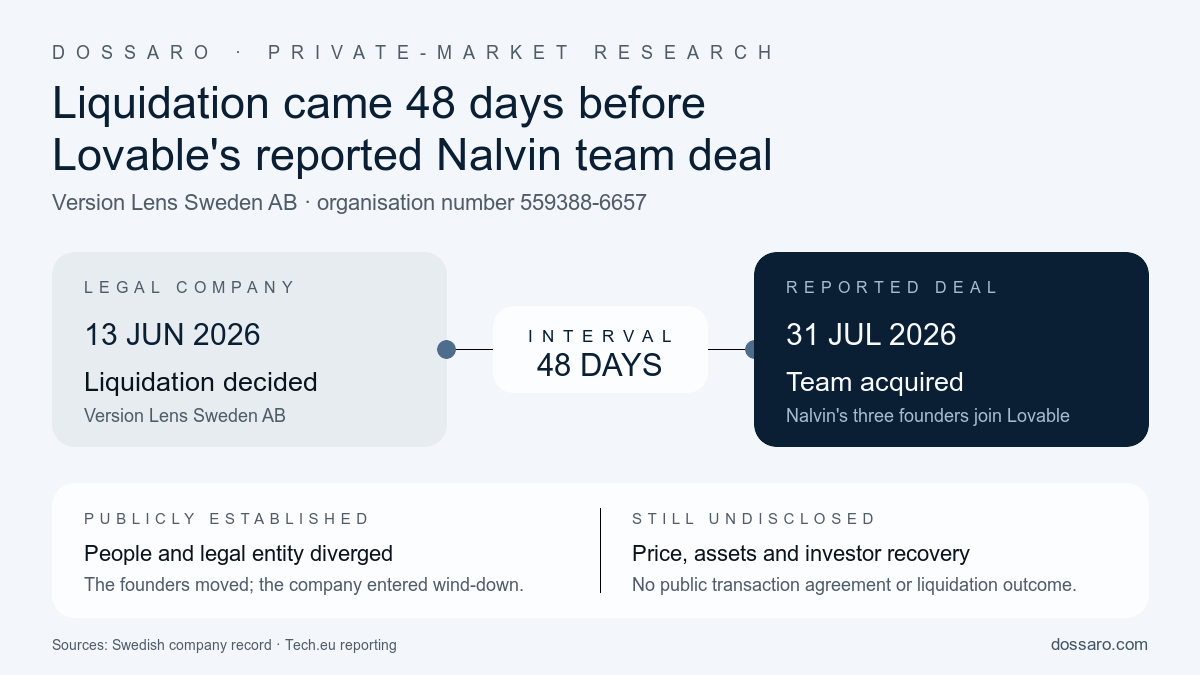
Version Lens Sweden AB, the legal company behind Nalvin, entered liquidation on 13 June 2026. Forty-eight days later, Lovable was reported to have acquired Nalvin's three-person team.
That sequence changes the economics of the announcement. This was not publicly established as a conventional purchase of a healthy operating company. The confirmed event is narrower: founders Pontus Gifvas, Fredrik Stockman and Pascal Chatterjee joined Lovable after their venture-backed company had already entered liquidation.
For private-market readers, the distinction separates two outcomes that acquisition headlines often collapse. The people found a new operating home. The earlier investors' recovery, any assets transferred and any consideration paid remain questions for the liquidation and transaction documents.
| Date | Public event | What it establishes |
|---|---|---|
| 7 July 2022 | Version Lens Sweden AB incorporated | The legal entity later trading as Nalvin was created |
| 2024 financial year | Latest reviewed annual accounts | SEK 129,000 revenue, SEK 6.339m loss and four employees |
| 13 June 2026 | Liquidation decided | The company entered a formal wind-down state |
| 31 July 2026 | Lovable team acquisition reported | The three founders were announced as joining Lovable |
The timing is the central finding. The liquidation decision predates the reported team deal by 48 days, but the available sources do not disclose whether negotiations started earlier or whether the liquidation helped implement an already agreed transaction.
The Timing Changes What The Deal Means
Tech.eu described the transaction as appearing to resemble an acqui-hire because financial details were not disclosed and the announcement centred on the team. Lovable chief executive Anton Osika praised the founders' product instincts, while Nalvin's statement said the team would continue its work inside Lovable.
The Swedish company record adds the missing legal context. Current public profiles for organisation number 559388-6657 show liquidation decided on 13 June 2026. The company is registered at the address of Lönnquist Advokatbyrå, and Anders Lönnquist is listed as liquidator.
This does not prove that Lovable acquired only employment contracts or that no intellectual property, code or other asset moved. It does show that the operating team and the legal entity had become economically separable before the public announcement. A buyer can value the founders' knowledge and working relationship without taking on the full history, liabilities or ownership structure of their former company.
That is similar to the distinction in Dossaro's analysis of Noscendo's selective asset sale to Bruker: the brand-level story can sound like a company acquisition even when the legal and economic perimeter is narrower. Nalvin's public record does not yet reveal that perimeter, so the safe conclusion is about sequence, not asset allocation.
A Venture-Backed Company Had Reached A Formal Wind-Down
Nalvin had previously raised a €1.5 million pre-seed round from People Ventures, Curiosity and Pitchdrive, according to Tech.eu. The capital funded an artificial-intelligence agent product, but the latest reviewed accounts show that Version Lens had not yet built a revenue base close to its cost structure.
The accounts report values in Swedish kronor (SEK):
| 2024 financial snapshot | Reported amount | Decision-relevant reading |
|---|---|---|
| Revenue | SEK 129,000 | Commercial income remained small |
| Annual result | SEK -6.339m | The company was absorbing substantially more capital than it generated |
| Total assets | SEK 10.89m | Assets remained inside the legal entity at the reporting date |
| Equity | SEK 10.235m | The balance sheet still showed positive equity at year-end |
| Employees | 4 | The company was a small, concentrated operating team |
The table does not establish the company's balance sheet on the liquidation date. It establishes the last reviewed historical state: a four-person company with minimal revenue, a large annual loss and assets largely financed by equity. The accounts also do not identify which assets remained valuable, liquid or transferable in June 2026.
Positive 2024 equity is therefore not evidence that investors will recover their original capital. Liquidation costs, later operating losses, creditor claims and the value realised for assets all affect the eventual distribution. None of those later figures is available in the reviewed public material.
The Founders' Outcome And The Company's Outcome Diverged
The reported deal gives the founders continuity. Lovable gains a team that had already worked together on autonomous software agents, while Gifvas, Stockman and Chatterjee move into a new operating environment at Lovable.
Version Lens follows a different path. Once a company is in liquidation, its remaining assets and liabilities sit inside a legal process. The liquidator, rather than the founders acting in the ordinary course, is responsible for the wind-down. Any transaction involving company assets would need to be understood within that process.
That divergence matters for the investors named in the pre-seed round. People Ventures, Curiosity and Pitchdrive backed the company, not an abstract promise that its founders would always remain together. If value moved through an asset sale, licence or other agreement, the terms would determine what entered the liquidation estate. If the public event covered talent only, the company could retain a different set of assets and claims. The current evidence supports neither conclusion.
| Economic question | Publicly established | Still undisclosed |
|---|---|---|
| What happened to the people? | The three founders joined Lovable | Employment terms and incentives |
| What happened to Version Lens? | Liquidation was decided before the announcement | Final assets, claims, costs and distributions |
| What did Lovable acquire? | The announcement described acquisition of the team | Any code, intellectual property, contracts or other assets |
| What did investors receive? | No recovery outcome is public | Purchase proceeds, creditor waterfall and shareholder distribution |
The important takeaway is not that investors received nothing. It is that the team outcome cannot stand in for the investor outcome. A successful landing for founders can coexist with a poor, partial or even positive recovery for the company, depending on documents that have not been published.
An Orderly Transaction Is A Plausible Counter-Reading
The chronology does not prove a distressed last-minute rescue. A liquidation decision can form part of an orderly wind-down after a negotiated talent transaction. Lovable and the Nalvin founders may have reached commercial alignment before the formal status date, with the legal steps following in a sequence chosen by advisers.
That counter-reading fits the evidence just as well as a deal assembled after the company failed. The 48-day interval identifies the state of the legal entity when the acquisition was announced. It does not identify the parties' motives, the start of negotiations or the contractual closing date.
The same caution applies to liabilities. Nothing reviewed establishes that Lovable assumed Version Lens's debts, and nothing establishes that it avoided them. Acqui-hire reporting describes the commercial emphasis of a deal, not its complete legal perimeter.
The Next Documents Will Show Where The Value Went
Three records would materially change the current analysis. An acquisition or asset-transfer agreement would define what Lovable bought and the price. A liquidator's report would show realised assets, claims and costs. Final liquidation accounts would show how the remaining value was distributed.
Those records would answer the financing question that the celebratory announcement leaves open: whether the €1.5 million-backed company produced recoverable value for its investors after the team moved.
Until then, the durable finding is precise. Version Lens Sweden entered liquidation on 13 June 2026, and Lovable's acquisition of the Nalvin team was reported 48 days later. The founders' destination is public; the transaction perimeter and investor recovery are not.
That boundary is also the lesson for acquisition research. A brand, a team and a company are not interchangeable. Dossaro's M&A target-screening workflow starts by resolving the exact legal entity before asking which assets and obligations crossed the transaction boundary. The company insolvency notice workflow then preserves procedural evidence without turning it into an unsupported recovery conclusion.
Continue reading
Related Research
Bruker Bought Noscendo's Software, Not The Venture-Backed Company
After nearly €40m of venture funding, Noscendo entered insolvency. Bruker acquired DISQVER, patents and selected staff while the laboratory closed.
Rail Europe's Parent Had Negative Equity Before Omio Deal
Rail Europe's parent reported negative equity and its operating company lost €6.27m before Omio's proposed acquisition, putting price and debt at the centre.
Wexler's Founders Held 54%, But £4.66m Ranked First
Legora bought a Wexler that was 54% founder-owned on its last visible share count, but £4.66m of seed preference ranked ahead of ordinary shares.
ecoLocked's Lead Investors Doubled Their Stakes Before Insolvency Proceedings
Matterwave and Climentum doubled their ecoLocked share counts in a 2025 issue, concentrating investor exposure before preliminary insolvency proceedings.