
Frank Hummel and Vestas Were SOWITEC's Last Visible Owners
The latest visible SOWITEC owner list showed Frank Hummel at 74.91% and Vestas' vehicle at 25.09% when four core group companies entered insolvency.
On this page
Conduct your own private market research
Add dossaro to Claude or ChatGPT and run source-backed register research from your own workspace.
 Add to Claude
 Add to ChatGPT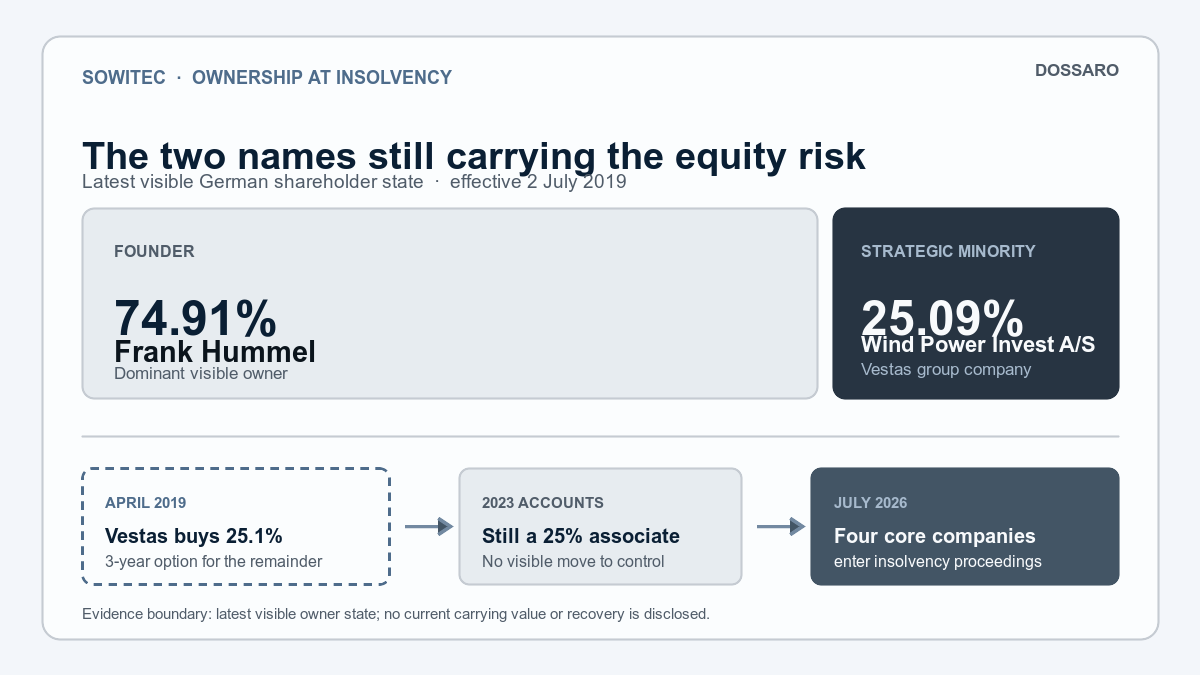
The latest visible SOWITEC shareholder list names founder Frank Hummel with 74.91% and Wind Power Invest A/S, a Vestas group company, with 25.09%. That ownership split was still the last visible register state when SOWITEC group GmbH and three wholly owned subsidiaries entered provisional insolvency administration in July 2026.
Vestas had entered with a more ambitious route. In April 2019, SOWITEC announced that the wind-turbine group would acquire 25.1% and receive an option to buy the remaining shares within three years. The option window passed without Vestas becoming the visible controller. Wind Power Invest's 2023 accounts still listed SOWITEC as a 25% associate.
That chronology changes the commercial reading of the insolvency. The developer was not only founder-owned. A strategic buyer had secured a path to control, did not visibly take it, and remained exposed to the residual equity outcome.
| Named owner in the latest visible list | Visible position | Economic position at that evidence date |
|---|---|---|
| Frank Hummel | 74.91% | Founder and dominant equity holder |
| Wind Power Invest A/S | 25.09% | Strategic minority held inside the Vestas group |
The table is not presented as a confirmed August 2026 cap table. No newer shareholder list was visible. It is the latest public ownership state, reinforced by the Vestas vehicle's later associate disclosure, and it names the two parties whose private equity exposure remained visible before insolvency.
Vestas Bought a Quarter and Negotiated a Route to the Rest
SOWITEC's 2019 transaction announcement says the company and its then sole shareholder, Frank Hummel, agreed that Vestas would take 25.1% of the share capital. Vestas also received an option to purchase the remaining stake within three years from closing.
The strategic logic was explicit. Vestas said the investment gave it access to an independent development company and strengthened its co-development capabilities in Latin America. SOWITEC said Vestas would strengthen its equity and help the developer move further along the value chain.
The German shareholder list filed in July 2019 shows how the agreement landed. Hummel retained the large majority. Wind Power Invest became the named minority holder. The percentages differ by one basis point from the rounded public announcement, but they describe the same two-party structure.
| Date | Public or register event | What it established |
|---|---|---|
| 11 April 2019 | Vestas minority investment announced | 25.1% stake plus a three-year option for the remainder |
| 2 July 2019 | Latest visible shareholder state became effective | Frank Hummel 74.91%; Wind Power Invest A/S 25.09% |
| 2023 reporting year | Wind Power Invest accounts list SOWITEC as a 25% associate | The Vestas vehicle still reported the minority holding after the option window |
| 15 July 2026 | Provisional administration announced for four core companies | The strategic minority met a distressed outcome without visible Vestas control |
The sequence does not show why Vestas declined or failed to use the option. It does show the result: the announced path to a full acquisition did not become a later visible control state.
For private-market readers, that distinction matters. An option gives a strategic buyer a choice, not an obligation. It can preserve access to information, commercial cooperation and future control while limiting the initial capital at risk. If the target performs, the buyer can consider taking the rest. If the target deteriorates, the buyer can remain a minority and cap its direct equity exposure.
The Owner Names Put the Distress in the Right Place
Public insolvency coverage naturally centres on SOWITEC, its founder and its employees. The owner list adds a second exposed capital provider.
Frank Hummel remained the dominant shareholder and therefore carried most of the visible equity risk. He also remained the sole registered managing director when the insolvency restriction was entered. Wind Power Invest held the smaller but still material strategic position. Its link to Vestas is not an inference from branding: the Danish company's accounts identify it as part of the Vestas Wind Systems A/S group.
This makes Vestas more than a supplier watching a customer's distress from outside. Through Wind Power Invest, it had residual equity exposure to SOWITEC. Equity ordinarily sits behind creditors in an insolvency, so any value for either shareholder depends on the proceeds available after secured and other creditor claims. The public evidence does not quantify that residual value.
The situation resembles the concentration visible before ecoLocked's preliminary insolvency, but with a different strategic history. ecoLocked's filings showed investors increasing their exposure shortly before distress. SOWITEC shows a long-standing industrial minority that never became control.
The owner trail also shows the value of tracing German Handelsregister shareholder evidence across time. The list identifies legal holders at a dated state, the deal announcement explains entry, and the later Danish disclosure tests persistence beyond the option period.
Four Core Companies Entered the Proceedings
GÖRG's 15 July announcement says petitions were filed for the holding and three wholly owned operating subsidiaries. The Tübingen Local Court appointed Dr Holger Leichtle as provisional administrator.
| Affected legal entity | Relationship described by GÖRG | Public proceeding state |
|---|---|---|
| SOWITEC group GmbH | Group holding company | Provisional insolvency administration |
| SOWITEC International GmbH | Wholly owned subsidiary | Provisional insolvency administration |
| SOWITEC Operation GmbH | Wholly owned subsidiary | Provisional insolvency administration |
| SOWITEC Projekt GmbH | Wholly owned subsidiary | Provisional insolvency administration |
GÖRG said the subsidiaries handled international and domestic projects and services to project companies, including maintenance and bookkeeping. It also said operations would continue, wages were secured through German insolvency payments, and the administrator would assess restructuring viability and investor interest. The group then employed around 80 people, about 30 of them in Germany.
The insolvency perimeter should not be confused with every wind or solar project SOWITEC ever developed. The group commonly developed project companies for sale to investors and utilities. Whether valuable rights sit inside the four affected companies, in separate project vehicles or under contracts with third parties is a question for the administrator's asset review.
That distinction will decide who can benefit from a sale. A buyer may want selected development rights, permits, service relationships or operating assets without acquiring the holding company. Dossaro's analysis of Noscendo's selective asset sale shows why the sale perimeter can matter more than the buyer headline: valuable assets may move while old equity remains attached to an insolvent shell.
Delayed Payments Explain the Trigger, Not the Full Capital Outcome
Tagesschau and SWR reported that Hummel attributed the crisis partly to delayed payments from Mexico and Colombia in the upper single-digit millions of euros. GÖRG separately said expected South American customer payments had not arrived as scheduled and that attempts to find a stakeholder solution had failed.
Those statements identify the immediate cash-pressure narrative. They do not provide an audited receivables schedule, creditor ranking or proof that the delayed payments were the sole cause. They also do not show whether the receivables remain collectible or who has security over them.
The commercial consequence is therefore broader than the missing amount. A project developer can own valuable work in progress while facing a liquidity failure because permitting, construction and customer payments occur on different timelines. Insolvency administration tests whether that pipeline can be financed, sold or completed quickly enough to preserve value.
For Hummel and Vestas, the outcome depends on that test after creditor claims. For employees and project counterparties, continuity depends on whether buyers or financiers support the viable parts of the business. For an acquirer, distress may create access to selected projects without requiring a purchase of the old shareholder structure.
Management Narrowed Before the Insolvency
The register history shows a contraction in formal management during the 18 months before the filing. Harald Rudolph resigned from the holding and four related companies effective 31 January 2025. Gerd Hummel resigned from the holding, international and operation entities effective 31 May 2025. Frank Hummel was the sole registered managing director when provisional administration was entered.
That sequence is relevant to responsibility and process, but it does not prove causality. The public documents do not connect either resignation to the delayed payments, financing attempts or the later insolvency. They show that formal management concentration increased as the group approached distress.
Wind Power Invest remained a visible shareholder, but no reviewed source establishes that Vestas controlled day-to-day collections, project financing or the decisions before the petitions.
Vestas May Have Limited the Economic Damage
The fairest counter-reading is that the option worked as optionality was designed to work. Vestas gained a strategic foothold and the ability to consider full ownership, but it was not required to take the remaining 74.91%. Staying at 25.09% may have limited its direct equity exposure relative to a complete acquisition.
Accounting may have reduced that exposure further. Wind Power Invest could have impaired, written down, hedged or disposed of part of the economic interest after the 2023 reporting date. The latest available evidence does not answer that question. A visible legal stake is not the same as its current carrying value on Vestas' books.
The finding is therefore not that Vestas lost 25.09% of a known company value. No valuation or recovery can be supported. The finding is that the strategic investor remained the latest visible minority owner after its route to control expired, while the founder remained the dominant owner and four central companies entered distress.
The Administrator's Asset Map Will Decide What the Stakes Are Worth
Three documents can turn that ownership exposure into a measurable result.
| Next document | Decision-relevant answer |
|---|---|
| Wind Power Invest A/S 2024 or 2025 accounts | Whether the SOWITEC associate was impaired, written off or disposed of |
| SOWITEC creditor schedule and latest accounts | Liabilities, receivable quality, security and asset coverage |
| Administrator report or sale notice | Which project rights and operations remain viable, what is sold and whether equity can recover anything |
The old shareholder agreement would add a fourth answer: what rights survived after the acquisition option ended and whether Vestas retained reserved matters or other minority protections.
Until those records appear, the conclusion is narrow. Frank Hummel and Wind Power Invest are the names in SOWITEC's latest visible owner state. Hummel held roughly three quarters; Vestas' vehicle held roughly one quarter after the option period. The insolvency process will decide whether either position has residual value, while later Vestas vehicle accounts should show whether the strategic investor had already recognised the damage.
Continue reading
Related Research
ecoLocked's Lead Investors Doubled Their Stakes Before Insolvency Proceedings
Matterwave and Climentum doubled their ecoLocked share counts in a 2025 issue, concentrating investor exposure before preliminary insolvency proceedings.
Bruker Bought Noscendo's Software, Not The Venture-Backed Company
After nearly €40m of venture funding, Noscendo entered insolvency. Bruker acquired DISQVER, patents and selected staff while the laboratory closed.
VMG Took 50% Of Voodin As Its €48m EU Project Began
German shareholder lists show VMG Green took 50% of Voodin as related VMG companies joined the consortium running a €48.18m EU-backed blade factory.
Salesforce Raised Its SPREAD Stake Through A Founder Secondary
German shareholder lists show Salesforce acquired 612 existing SPREAD shares from two founder vehicles, raising its stake from 5.5% to 6.7% without new capital.