
Deutsche Telekom Agreed to Buy Both Halves of Poland's Fiberhost Split
Deutsche Telekom agreed to buy Fiberhost's open-access network and INEA's retail business, reunited after a 2021 split under one Polish holding chain.
On this page
Conduct your own private market research
Add dossaro to Claude or ChatGPT and run source-backed register research from your own workspace.
 Add to Claude
 Add to ChatGPT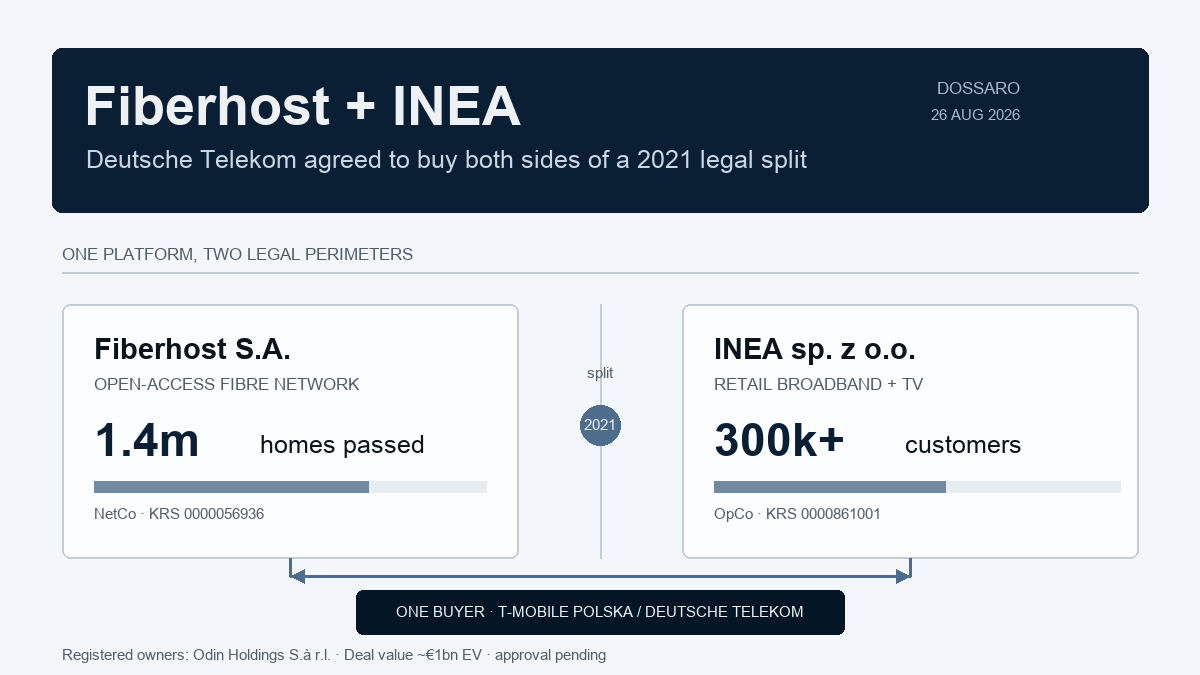
Deutsche Telekom has agreed to buy two Polish businesses that were deliberately separated five years ago: Fiberhost, an open-access fibre network, and INEA, a retail broadband and television provider. The transaction, announced on 17 August 2026, values the pair at about €1 billion and is subject to Polish competition approval.
The legal history changes the way the deal should be read. This is not simply a telecom operator buying one broadband company. In 2021, the former INEA S.A. moved its organised retail operating unit into a separate company, now called INEA sp. z o.o., while the infrastructure company became Fiberhost S.A. Both businesses are now recorded as wholly owned through Odin Holdings S.à r.l. Deutsche Telekom is therefore buying the network and the customer-facing operator together, after the split created a ring-fenced wholesale asset and a separate retail platform.
| Deal element | Public and register evidence | Commercial consequence |
|---|---|---|
| Buyer | Deutsche Telekom, through T-Mobile Polska | A mobile-led group adds both fixed infrastructure and a retail base |
| Network asset | Fiberhost S.A., KRS 0000056936, open-access FTTH network passing more than 1.4 million homes | The buyer controls the wholesale platform on which other operators depend |
| Retail asset | INEA sp. z o.o., KRS 0000861001, with more than 300,000 broadband and TV customers | The buyer also obtains a direct customer relationship |
| Seller chain | Macquarie European Infrastructure Fund 5 and minority shareholders, through the Odin structure | The transaction is a controlled-platform sale, not a newly formed merger |
| Status | Agreement announced; Polish competition approval remains outstanding | Ownership and final remedies are not yet closed |
The €1 billion headline covers two different businesses
Deutsche Telekom's announcement says it has agreed to acquire 100% of Fiberhost and INEA from Macquarie Asset Management, on behalf of Macquarie European Infrastructure Fund 5, and minority shareholders. The group says Fiberhost's network reaches more than 1.4 million homes and INEA serves more than 300,000 customers. The deal is described at an enterprise value of about €1 billion and still requires approval from Poland's competition authority.
Reuters' report carries the same value and customer figures, while noting that Fiberhost will retain non-discriminatory wholesale access after closing. That promise is central to the economics because the network and retail company sit in the same acquisition perimeter. T-Mobile Polska will gain the network's physical reach and a large retail base, while rival service providers continue to rely on the open-access layer under the stated terms.
The announced value is an enterprise-value headline, not a disclosed equity cheque to any single seller. The sources do not publish debt, cash, minority percentages or a proceeds waterfall. No return for Macquarie or any minority holder can be calculated from the €1 billion figure.
A 2021 demerger created the NetCo and OpCo perimeter
The Polish register history is the less visible part of the transaction. A public KRS record for Fiberhost S.A. identifies it as the successor to INEA S.A. and records Odin Holdings S.à r.l. as the 100% shareholder. A separate record for INEA sp. z o.o. describes a 1 July 2021 demerger: an organised part of the former INEA S.A.'s enterprise, explicitly described as the OpCo functional business unit, was transferred into the receiving company.
That sequence matters. The retail operation was not merely renamed after the network was sold. It was moved into a separately registered legal person, while the infrastructure side remained in the company that became Fiberhost. The buyer now reunites the two economic halves under T-Mobile Polska even though their operating, regulatory and customer roles remain distinct.
The latest KRS extracts in the research record show Odin Holdings as sole shareholder of both sides. For Fiberhost, the extract records 8,345 shares held by Odin. For INEA, it records 235,641 shares with an aggregate nominal value of PLN11,782,050, also held by Odin. These share counts describe the registered legal chain; they are not a disclosure of the €1 billion price or the ultimate fund-level allocation.
The structure resembles other transactions where an acquisition vehicle or holding chain carries the legal control while the operating assets remain in separate companies. In sonnen's sale to TIVEN, a new vehicle appeared above the operating company before the public completion statement. Here, the relevant clue is the opposite: the network and retail businesses were separated first and are now being bought together.
Why wholesale access becomes the central condition
Fiberhost is described as an open-access network. That means its commercial role is not limited to selling retail subscriptions; it provides infrastructure that other operators can use. INEA, by contrast, sells broadband and television services to consumers. The legal split made those functions easier to distinguish. The proposed acquisition brings them under one owner again.
Deutsche Telekom says the purchase will help T-Mobile Polska become a converged mobile and fixed-line operator. Cinco Días' independent coverage reports the same strategic rationale and notes the commitment to preserve non-discriminatory wholesale access. The condition protects competitors from an immediate loss of network access, but it does not erase the structural fact that the network owner will also operate a major retail business.
That creates a practical distinction between legal access and economic neutrality. A wholesale-access promise can preserve a route for rival operators, yet the buyer still controls investment priorities, network upgrades, service levels and the commercial relationship with its own retail subsidiary. The available sources do not establish that T-Mobile will favour INEA, breach access rules or obtain a regulatory advantage. They do establish why the access condition is more than standard transaction wording: it addresses the dual role created by buying both sides of the old split.
The DORMA-Glas successor-vehicle case shows a different perimeter lesson. There, an operating business moved into a clean successor company while the insolvent legal entity remained behind. Fiberhost and INEA show the reverse pattern: two solvent, separately registered businesses are being reunited under a buyer that wants both the network and the customer base.
Odin's ownership chain is clear, but the proceeds are not
The KRS records support a narrow ownership conclusion. Odin Holdings is the registered 100% shareholder of Fiberhost and INEA in the current extracts. The public announcement identifies Macquarie European Infrastructure Fund 5 and minority shareholders as the seller side. Together, those facts show a controlled holding chain behind the sale without assigning every share of the fund vehicle to a particular investor.
Macquarie's 2017 acquisition release describes the earlier investment in INEA. An EBRD project record provides additional public context on the fibre platform. Neither source publishes a current debt schedule, minority cap table, distribution notice or the price allocation between Fiberhost and INEA.
The distinction is important for anyone trying to infer a sponsor return. A €1 billion enterprise value can include debt assumed or refinanced and does not tell us how much cash reaches Macquarie, minority shareholders or any financing vehicle. The register's 100% ownership entries show who sits in the legal chain, not how sale consideration is split above it.
The same boundary applies to the network's future investment. Deutsche Telekom says the transaction will support fibre expansion and T-Mobile Polska's fixed-broadband growth. It does not disclose the capital expenditure plan, the purchase-price allocation or the financial targets attached to the deal. The article therefore treats the €1 billion as a reported transaction value and the network/customer figures as operating scale, not as a forecast of revenue or profit.
The next control question is regulatory, not nominal ownership
The strongest current finding is precise: Deutsche Telekom is buying both halves of a 2021 legal split, and both are currently recorded under Odin Holdings. Fiberhost supplies the open-access network; INEA supplies the retail customer base. The combination gives T-Mobile Polska a broader fixed-line position while making wholesale neutrality a material condition of the deal.
That conclusion does not depend on guessing an ultimate beneficial owner or a seller payout. It rests on the public transaction announcement, an independent report, and KRS history that identifies the demerger and common holding chain. The agreement remains subject to Polish competition approval, so the final remedies, closing date and post-close governance are unresolved.
The next documents to watch are the Polish competition decision and any remedy package, the share purchase agreement or closing notice, Odin Holdings' accounts, and the debt and minority schedule for the €1 billion enterprise value. Those documents could show whether wholesale access is backed by measurable service obligations, how much debt sits in each operating company and how the seller-side proceeds are allocated.
Continue reading
Related Research
Sonnen's Sale Put 98.33% Of Its Holding Company Into YUMA
Shell sold sonnen to TIVEN, but filings show a new YUMA vehicle held 98.33% of sonnen Holding weeks before the completion statement went public.
DORMA-Glas's Asset Deal Was Prepared Before The Rescue Headline
DG Glas's €25,000 successor vehicle and shareholder filings predated DORMA-Glas's rescue announcement, separating operating continuity from creditor recovery.
Skye's Redx 'Acquisition' Leaves Legacy Skye Holders With 5.38%
Skye's proposed Redx merger would leave legacy Skye holders with 5.38%, while Redx holders and new financiers control 94.62% and Redx leads the board.
Oceanloop's €38.5m Headline Is Mostly a 2024 EIB Facility
Oceanloop's €38.5m financing headline is 83% debt tied to a 2024 EIB facility, while €6.5m equity enters a 22-position roll-up with dilution unresolved.