
DORMA-Glas's Asset Deal Was Prepared Before The Rescue Headline
DG Glas's €25,000 successor vehicle and shareholder filings predated DORMA-Glas's rescue announcement, separating operating continuity from creditor recovery.
On this page
Conduct your own private market research
Add dossaro to Claude or ChatGPT and run source-backed register research from your own workspace.
 Add to Claude
 Add to ChatGPT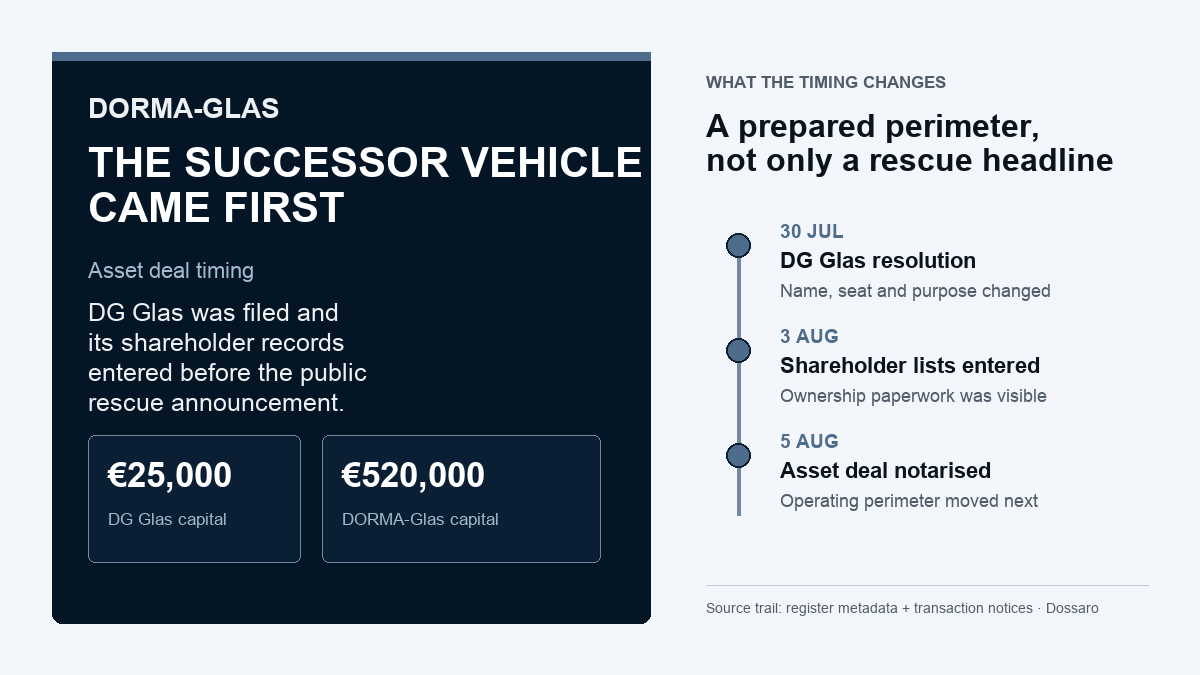
The rescue headline arrived on 7 August. The register sequence started earlier. A €25,000 company called DG Glas had already changed its name, seat and business purpose, filed applications and placed shareholder-list records in the register before the 5 August notarisation described by the transaction adviser.
That chronology turns a simple rescue announcement into a perimeter story. DORMA-Glas was already in self-administration, with a €520,000-capital incumbent later recorded as dissolved. The operating business, plant, inventory, intellectual property and Bad Salzuflen property could continue in a new vehicle, while creditor recovery remained attached to the old estate.
The evidence is strong on timing and legal identity, but not on price, allocation or recovery. The register makes the preparation visible. It does not yet provide a buyer-level ownership map or a payout schedule for the insolvent company.
A new vehicle was ready before the public signing
GÖRG, adviser to the insolvency process, says the asset deal was notarised on 5 August and announced two days later. Its notice names Phillip Schlossstein of Schlossstein Capital AG and James Roberts of Roberts Land Limited as the buyers. The transaction was structured as an asset deal through the newly established DG Glas GmbH, with most of DORMA-Glas's 210 jobs expected to continue.
The legal chronology adds a detail missing from that announcement. DG Glas's register record shows articles dated 30 July, applications filed on 31 July and three shareholder-list records entered on 3 August. A 30 July resolution changed the company's name, moved its registered seat from Frankfurt am Main to Bad Salzuflen and expanded its business purpose to include acquiring and continuing businesses or business units. The company had €25,000 of nominal capital.
| Date | Register or public event | Economic reading |
|---|---|---|
| 30 July 2026 | DG Glas resolution changed name, seat and purpose | Successor perimeter was being shaped before the headline |
| 31 July 2026 | DG Glas applications filed | The vehicle was moving through registration steps |
| 3 August 2026 | Three DG Glas shareholder-list records entered | Ownership paperwork was in the register before notarisation |
| 5 August 2026 | GÖRG says the asset deal was notarised | The public transaction became legally documented |
| 7 August 2026 | GÖRG and HEUKING published notices | The rescue and buyer names reached the market |
Pre-closing filings can be ordinary transaction housekeeping. They are not, by themselves, proof of who funded the buyer or how the purchase price was allocated. They do establish that DG Glas was not simply a name attached after the rescue announcement. The vehicle and its shareholder-list paperwork were already being assembled.
The old company carried the insolvency perimeter
DORMA-Glas GmbH is a separate legal entity in the Lemgo register, HRB 2238. Dossaro's structured extract records €520,000 of capital, a self-administration process opened on 1 May 2026 and a later dissolution entry. GÖRG's notice describes the same process: the Bielefeld court opened formal insolvency proceedings under self-administration on 1 May after provisional proceedings had begun in March.
That distinction matters because an asset deal can preserve operations without transferring the old company's entire balance sheet. GÖRG says the transferred perimeter includes the operating business, intellectual property, plant and equipment, inventory and the Bad Salzuflen real estate, including existing leasehold rights. It also says the new investor solution should keep most jobs and the site in operation.
For employees, customers and suppliers, the successor structure can provide continuity. For creditors, continuity is not the same as recovery. Their outcome depends on what the old estate receives for the assets, which liabilities remain with DORMA-Glas and how the proceeds are distributed under the insolvency process.
The buyer-side notice from HEUKING confirms that Schlossstein Capital and Roberts Land acquired DORMA-Glas from self-administration through a structured M&A process. It supports the identity of the buyer-side parties, but it gives no consideration figure. The local reporting from Neue Westfälische had already described DORMA-Glas's financial distress and the importance of its Bad Salzuflen manufacturing base.
€25,000 is a legal-capital signal, not a price tag
The successor's €25,000 nominal capital is useful because it dates the legal vehicle and shows the scale of the company at incorporation or restructuring. It is not a valuation. The old company's €520,000 capital is not an asset value either. Comparing those figures can show that the successor was a newly capitalised legal shell relative to the incumbent, but it cannot show that 4.8 percent of DORMA-Glas's value moved into DG Glas or that creditors recovered any particular amount.
The same discipline applies to the shareholder-list records. Dossaro fetched the 3 August DG Glas shareholder-list artifact, but the German register parser returned no readable text or tables. The public record therefore supports the existence and timing of the filings, not the names or percentages behind them. Karl-Phillip Schlossstein appears as DG Glas's managing director in the register profile; that role does not, by itself, establish the company's ownership or the allocation between buyer vehicles.
This is the difference between a prepared perimeter and a reconstructed transaction. The first is visible in the dated filings and the adviser notices. The second requires a readable shareholder list, sale documentation or an insolvency report that ties consideration to assets and liabilities.
The announcement answers continuity, not allocation
The adviser notices use the language of a successful rescue because that is the immediate operating outcome. GÖRG says the business was stabilised during the self-administration process and that a structured M&A process attracted several national and international investors before the Roberts Land companies prevailed. The notice names the plant, the intellectual property and the workforce as parts of the continuing business.
HEUKING's buyer-side account is consistent on the transaction route. It describes the acquisition as a structured process out of self-administration and identifies Schlossstein Capital and Roberts Land as the clients it advised. Neither notice sets out a purchase price, a split between the two buyer groups or the liabilities that DG Glas assumed.
That omission is normal for a short transaction announcement, but it defines the next diligence step. A customer can read the notices as evidence that the Bad Salzuflen operation has a successor. A creditor cannot read them as evidence of a recovery rate. The two audiences are looking at different sides of the same asset perimeter.
Continuity for the plant, a new underwriting question for the estate
The transaction changes the commercial question around DORMA-Glas. The immediate question was whether a specialist manufacturer could keep its plant, customer relationships and workforce alive. The new question is how value was divided between the operating successor and the old insolvency estate.
That question is practical for several groups. A supplier deciding whether to extend terms needs to know which company stands behind future orders. A buyer underwriting the successor needs to understand which intellectual property, inventory and real estate rights actually transferred. An insolvency creditor needs the sale consideration and the claims waterfall. Employees need clarity on which entity employs them after closing.
The distinction also appears in Freqcon's asset rescue, where a new vehicle preserved selected operations while the old company's liabilities remained a separate underwriting problem. DORMA-Glas presents the same perimeter question in a fresh German manufacturing case, with the pre-announcement register sequence making the preparation visible.
The public notices answer the first layer: Schlossstein Capital and Roberts Land are the named buyers, DG Glas is the successor vehicle, and most jobs were expected to continue. The register answers the timing layer: DG Glas's legal perimeter was being assembled before the public signing. The documents still leave the economics of the separation open.
The next decisive record is a readable DG Glas shareholder list or closing filing. For the old company, an insolvency report or sale document that discloses consideration, assumed liabilities and creditor distributions would complete the picture. Until then, the strongest supported finding is narrower and more useful than a recovery estimate: DORMA-Glas's viable operating perimeter was prepared for transfer into a clean €25,000 successor while the €520,000-capital incumbent remained in insolvency.
Continue reading
Related Research
Freqcon's €1.7m Rescue Left The PE-Backed Company Behind
Amper paid €1.7m for Freqcon's operating assets, moving jobs into a €25,000 vehicle while the former PE-backed company stayed in insolvency.
Frank Hummel and Vestas Were SOWITEC's Last Visible Owners
The latest visible SOWITEC owner list showed Frank Hummel at 74.91% and Vestas' vehicle at 25.09% when four core group companies entered insolvency.
Cycles Lapierre Had €108m Due Within A Year After Its €60m Rescue
Cycles Lapierre reported €108.2m due within one year and €45.7m of negative equity after a €60m rescue, exposing its dependence on Accell funding.
Harvey Nichols’ Accounts Put Administration Inside The Sale Process
Harvey Nichols was sold from administration after its accounts disclosed administration-contingent bids and a £46.8m swing from net assets to liabilities.