
Freqcon's €1.7m Rescue Left The PE-Backed Company Behind
Amper paid €1.7m for Freqcon's operating assets, moving jobs into a €25,000 vehicle while the former PE-backed company stayed in insolvency.
On this page
Conduct your own private market research
Add dossaro to Claude or ChatGPT and run source-backed register research from your own workspace.
 Add to Claude
 Add to ChatGPT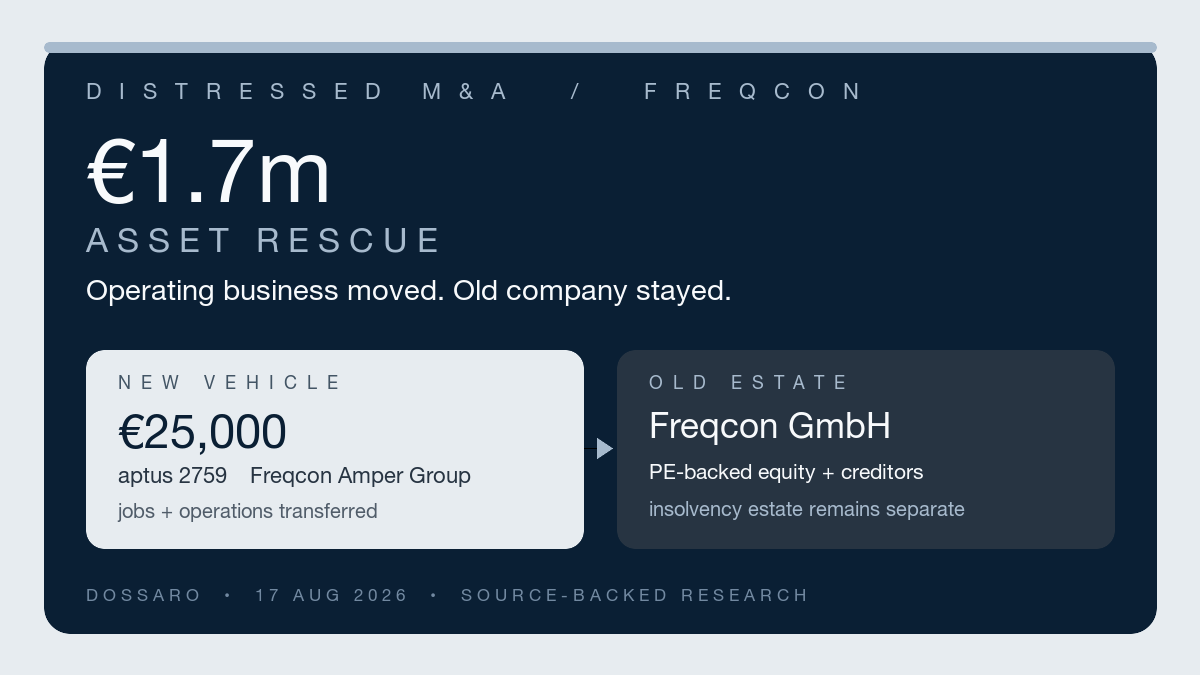
Amper paid €1.7 million for Freqcon's productive business unit, assets and technology in an insolvency process. The operating business and all jobs moved to Freqcon Amper Group GmbH. The old Freqcon GmbH did not move with them: it remained the legal seller and the company carrying the insolvency estate.
That separation is the economic fact hidden by the word “rescue”. The buyer's vehicle was incorporated only days before the transaction as a generic €25,000 shelf company, then renamed Freqcon Amper Group GmbH. Employees and customers gained continuity, but the former private-equity owners and the creditors of Freqcon GmbH remained attached to a different legal shell.
The public record therefore describes a job-preserving asset transfer, not a share acquisition. It does not disclose how much of the price went to particular assets, which liabilities were assumed, or what the old owners and creditors will recover.
The €1.7m Deal Preserved Operations, Not The Old Company
Amper's 30 July announcement says it acquired Freqcon's productive business unit, including assets and technological capabilities, for a total of €1.7 million within insolvency proceedings. Amper described the purchase as a way to add power-conversion, energy-storage and control-system capabilities to its defence, national-security and energy businesses.
Dentons' independent account adds the restructuring sequence. Freqcon filed for insolvency in mid-April 2026. The creditors' committee approved the sale, all jobs were preserved and the business transferred to Freqcon Amper Group GmbH with effect from 1 August. The legal form of the transaction matters: the announcement identifies a productive unit and assets, not the shares of Freqcon GmbH.
The chronology visible in the commercial register makes the separation concrete.
| Date | Legal or public event | Economic reading |
|---|---|---|
| 4 July 2023 | PREMIUM announced its majority acquisition of Freqcon | Sponsor capital and founder succession entered the old company |
| 13 July 2026 | Buyer vehicle incorporated as aptus 2759. GmbH with €25,000 capital | A clean acquisition shell existed before the sale closed |
| 28–29 July 2026 | Shelf company renamed Freqcon Amper Group GmbH | The shell was converted to the operating transaction vehicle |
| 30 July 2026 | Amper announced the €1.7m productive-unit acquisition | Public price attached to assets and capabilities, not old-company shares |
| 1 August 2026 | Dentons says operations transferred to the new vehicle | Jobs and operating continuity moved; the insolvency estate did not |
The €25,000 is registered share capital, not the buyer's total investment. A clean vehicle is normal in distressed M&A because it can take selected assets and contracts without importing every historical claim. It also means that the headline purchase price cannot be read as a payment for the former shareholders' equity.
The Old Ownership Map Was Private Equity Plus Founder Capital
Freqcon was not an ownerless distressed business. The sponsor's 2023 announcement says funds advised by PREMIUM Equity Partners acquired the majority from founder Norbert Hennchen. It says Hennchen stayed involved as a minority shareholder and managing director during a transition period.
The 3 July 2023 shareholder list in the sourcing record makes the split precise: PREMIUM Mittelstand Fund II GmbH & Co. KG held 75.656%, PREMIUM Investment Carry IV GmbH & Co. KG held 4.344% and Hennchen held 20%. The sponsor and carry vehicles therefore controlled 80% of the old company's visible equity before insolvency. That is the ownership map attached to Freqcon GmbH, not to the new acquisition vehicle.
The sponsor's public announcement also says the investment benefited from European Fund for Strategic Investments support. That establishes a link between public-backed capital and the old sponsor fund. It does not give the European Investment Fund a direct claim on Amper's asset-purchase price or establish the fund's eventual recovery.
The distinction is important for anyone reading the transaction as a conventional exit. A share sale would normally transfer the old equity and its governance rights into the buyer's ownership chain. An asset purchase in insolvency instead lets the buyer select the operating perimeter while the old equity remains exposed to the estate's waterfall.
The Fund's Historical Exposure Was Much Larger Than The Price
The public registry-data mirror of PREMIUM Mittelstand Fund II's 2023 accounts reports €13,206,318.56 of Freqcon shares and an €851,111 shareholder loan at 31 December 2023. Together those line items amount to €14,057,429.56 of historical carrying exposure.
Compared with the €1.7 million asset price, the arithmetic difference is €12,357,429.56. That is a useful measure of how far the disclosed purchase price sits below the old fund's reported exposure. It is not a loss calculation. Carrying values can differ from market value, the fund may receive distributions through the insolvency estate and the asset price may exclude assumed liabilities, new working capital or consideration paid elsewhere in the transaction.
The same account shows why the exposure comparison is still decision-relevant. The Freqcon share holding and shareholder loan were recorded inside an investment fund that held other portfolio companies and had its own capital structure. When the operating business moved into Amper's vehicle, the fund's claim did not automatically move with the assets. The economic outcome for the sponsor therefore depends on the insolvency process, not just on the number Amper put in its announcement.
A Rescue Can Be Good For Jobs And Still Bad For Old Equity
Dentons says all jobs were preserved and that the investor solution protected the prospects for the business and employees. That is a meaningful result for a company that manufactures power electronics and energy-storage systems from Rethem. Amper gains a functioning industrial platform and access to German and Central European customers without buying the old company's entire legal history.
The same structure can produce a very different result for stakeholders left behind. Trade creditors, lenders and former shareholders of Freqcon GmbH must look to the insolvency estate and its distribution rules. They cannot assume that the new company's continuing revenue, contracts or technology will replenish the old entity. The €1.7 million may be the headline consideration for the transferred perimeter, but it is not automatically a pool available to every claimant.
This is the same diligence problem visible in Cycles Lapierre's rescue, where operating continuity and a capital structure's accumulated liabilities had to be analysed separately. It also resembles the clean-buyer logic in Harvey Nichols' administration sale: a preserved brand or business does not imply that the old company survived economically intact.
For operators, the new vehicle can be a practical reset. For investors and creditors, it creates a boundary question: which assets, employees, contracts and obligations crossed the line, and which stayed with Freqcon GmbH? The public announcements answer the first part only at a high level.
The Next Documents Decide Who Was Rescued
The decisive missing document is the asset-purchase agreement. It should allocate the €1.7 million across inventory, intellectual property, customer contracts, equipment and assumed obligations. It should also show whether Amper paid cash at closing, assumed liabilities or committed additional working capital after the transfer.
The insolvency administrator's report and any distribution schedule would answer the other side of the transaction. They could show recoveries for lenders and trade creditors, the treatment of the former shareholders' claims and whether the €1.7 million was the estate's only material realisation. Freqcon Amper Group GmbH's executable shareholder list would establish who funded and controls the continuing business.
Until those documents appear, the defensible conclusion is narrow but consequential. Amper bought Freqcon's operating assets for €1.7 million and moved them into a newly renamed €25,000 company, preserving jobs while leaving the former PE-backed company and its insolvency exposure behind. The transaction rescued the business as an operating platform. It did not, on the public evidence, rescue the old equity or settle the creditor waterfall.
Continue reading
Related Research
Cycles Lapierre Had €108m Due Within A Year After Its €60m Rescue
Cycles Lapierre reported €108.2m due within one year and €45.7m of negative equity after a €60m rescue, exposing its dependence on Accell funding.
Harvey Nichols’ Accounts Put Administration Inside The Sale Process
Harvey Nichols was sold from administration after its accounts disclosed administration-contingent bids and a £46.8m swing from net assets to liabilities.
Sudolabs' Buyer Vehicle Took 100% Of The Operating Company
Sudolabs' buyer vehicle took 100% of its Slovak operating company, while its former 35/35/30 parent was renamed and the founders stayed managers.
Certain Energy's £10m Series A Ended Ceres' Registered Control of RFC Power
Certain Energy's £10m Series A reset RFC Power's register: Ceres moved below the PSC threshold as British Business Investments entered the ownership record.