
Harvey Nichols’ Accounts Put Administration Inside The Sale Process
Harvey Nichols was sold from administration after its accounts disclosed administration-contingent bids and a £46.8m swing from net assets to liabilities.
On this page
Conduct your own private market research
Add dossaro to Claude or ChatGPT and run source-backed register research from your own workspace.
 Add to Claude
 Add to ChatGPT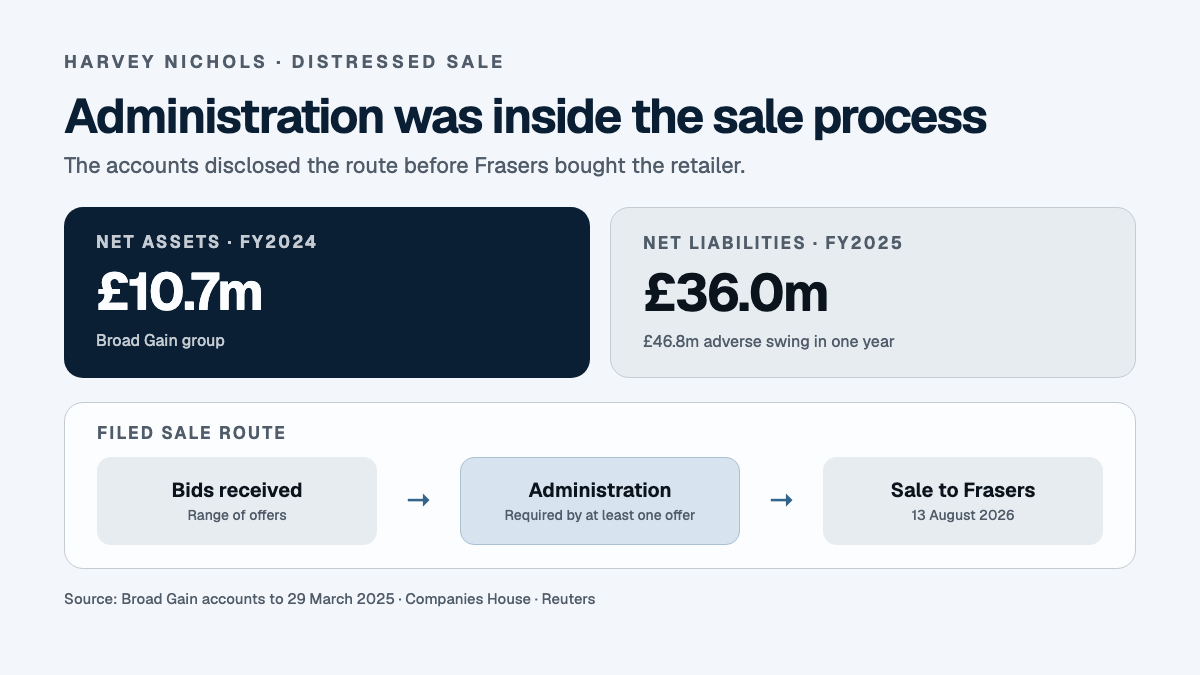
Harvey Nichols was sold to Frasers Group from administration after its own latest accounts had disclosed that at least one bid required formal administration before a sale.
That sequence makes the insolvency process part of the transaction architecture, not merely a collapse that happened before a rescue. Broad Gain (UK) Limited, the retailer’s operating-group parent, said it had received a range of offers and that “one or more” would require administration before sale. The accounts were approved on 30 July 2026. Reuters reported Frasers’ acquisition out of administration on 13 August.
The accounts also show why a solvent sale route had become difficult. Revenue fell 9.8% to £184.752 million in the year to 29 March 2025, the operating loss widened to £38.680 million and the group moved from £10.746 million of net assets to £36.016 million of net liabilities.
This does not establish that Frasers demanded administration or identify which bid carried that condition. It does show that the old owner and directors were evaluating offers against a business whose liability position had deteriorated by £46.762 million in one year.
The Accounts Disclosed An Administration-Contingent Bid
Broad Gain’s 2025 group accounts were prepared on a break-up basis rather than a going-concern basis. The directors said they were considering strategic options, including a sale of part or all of the business, and had received several bids.
Their disclosure then introduced the decisive condition. While a range of offers had been received, at least one required the group to enter formal administration before sale. No offer had been accepted when the accounts were approved.
The same note said Broad Gain would need additional funding if it was not sold. No such funding had been agreed under the base or downside scenarios. Without a sale or new funding, the directors expected the group to cease trading during the assessment period.
This is stronger than a general warning about material uncertainty. The accounts connect three events directly: active bids, an administration condition attached to at least one offer and a funding gap if no sale completed.
The public record stops before identifying the bidder behind that condition. Pre-sale reporting showed Frasers and Next in the process, but it does not connect either bidder to the wording in Broad Gain’s accounts. The eventual Frasers transaction and the earlier administration-contingent offer may be the same route, but the available documents do not prove that.
The Operating Group Swung £46.8m Into Net Liabilities
The sale process ran beside a steep deterioration in Broad Gain’s filed financial position.
| Broad Gain group measure | FY2025 | FY2024 | Change |
|---|---|---|---|
| Revenue | £184.752m | £204.869m | -9.8% |
| Operating loss | £38.680m | £27.446m | Loss widened £11.234m |
| Loss after tax | £48.741m | £34.078m | Loss widened £14.663m |
| Net assets / (liabilities) | (£36.016m) | £10.746m | £46.762m adverse swing |
| Average employees | 1,215 | 1,349 restated | -9.9% |
Revenue fell by £20.117 million. The operating loss grew 40.9%, while total liabilities reached £279.047 million against £243.031 million of assets.
The group’s balance sheet also changed shape. Interest-bearing loans and borrowings of £152.003 million, lease liabilities of £61.089 million, trade and other payables of £50.760 million and employee benefits of £10.817 million were all classified as current liabilities at the 2025 year-end. The comparable 2024 balance sheet had placed much of the debt and lease stack beyond one year.
That reclassification does not by itself identify what a purchaser assumed. It does show the short-term pressure inside the old perimeter when the sale was negotiated.
The Core Retail Perimeter Carried The Deficit
Broad Gain separated the retail business from its stand-alone restaurant operation. The split shows where the negative net position sat.
| FY2025 segment | Revenue | Operating loss | Net assets / (liabilities) |
|---|---|---|---|
| Retail stores, online and head office | £174.269m | (£35.972m) | (£44.071m) |
| Stand-alone restaurants | £10.483m | (2.708m) | £8.055m |
| Group total | £184.752m | (38.680m) | (36.016m) |
The retail, online and head-office segment produced 94.3% of group revenue and almost all of the operating loss. It carried £44.071 million of net liabilities. The restaurant segment was also loss-making at the operating level, but still reported £8.055 million of net assets.
This matters because “Harvey Nichols” can refer to a brand, a store estate, an online operation, restaurant activity, international licences or the legal companies behind them. A purchase out of administration can transfer a selected operating perimeter while claims remain with old entities.
The current public sources do not provide the administrator’s sale schedule. They therefore do not establish which stores, leases, licences, inventory, employee obligations or creditor claims moved to Frasers. That is the same analytical problem visible in Dossaro’s review of Noscendo’s selective asset sale to Bruker: the buyer headline is incomplete until the transferred perimeter is known.
The Holding Company Impairment Removed The Old Cushion
Harvey Nichols Group Limited, an investment-holding company below Broad Gain, recorded a second sharp balance-sheet change.
Its 2025 accounts show a £104.927 million loss after tax, primarily driven by a £105.307 million impairment of intercompany loans. The company moved from £43.408 million of net assets to £61.519 million of net liabilities.
Current creditors rose to £97.527 million. Of that amount, £97.518 million was owed to group undertakings. The composition matters: this is evidence of a collapsing internal funding position, not proof that £97.527 million was owed to outside trade creditors.
The impairment also should not be added mechanically to Broad Gain’s £36.016 million net-liability figure. The two accounts describe entities inside the same wider structure, with intercompany claims between them. Adding the figures would double count parts of the internal exposure.
What the holding-company accounts do establish is that a £99.226 million debtor balance due from group undertakings in 2024 had been reduced to effectively nil after impairment. The asset that had supported the holding company’s positive equity no longer carried its former accounting value.
Administration Can Improve A Distressed Sale’s Executability
There is a legitimate commercial reason for a bidder to prefer an insolvency sale. Administration can give a purchaser a defined process for acquiring selected assets and operations while the administrator manages claims against the old companies. It can also make a transaction executable when the existing group cannot fund continued trading or transfer every liability on acceptable terms.
That is the strongest benign reading of Broad Gain’s disclosure. An administration condition may have reflected the financial state of the seller and the need for a legally workable sale, rather than an attempt by a bidder to force a collapse.
But the route also changes who bears risk. Old-company creditors may depend on sale proceeds and the statutory priority waterfall rather than continued payment by the operating business. Shareholders can lose the residual value of their equity. Employees, landlords, suppliers and concession partners may face different outcomes depending on which contracts transfer.
None of those outcomes can be calculated from the annual accounts or the acquisition announcement. The sale price is undisclosed. So are creditor recoveries, the treatment of secured debt and leases, and the exact liabilities retained by the old perimeter.
The Administrator’s Report Will Show What Frasers Actually Bought
The durable finding is narrower than a verdict on the deal. Harvey Nichols’ own accounts disclosed that at least one offer required formal administration before sale. The eventual acquisition occurred out of administration after the retail group had moved to £36.016 million of net liabilities and its holding company had impaired £105.307 million of intercompany loans.
The next decision-changing document is the administrator’s proposal and statement of affairs. It should identify the appointed companies, creditor classes, estimated recoveries and the basis for choosing the sale. A transaction report or sale agreement could then show the consideration and the assets, contracts and liabilities transferred to Frasers.
Until those documents appear, it would be wrong to say Frasers engineered the administration or acquired the entire old corporate perimeter free of every liability. The evidence supports a more precise conclusion: administration was already inside the bid architecture, and the financial deterioration made that route commercially consequential.
Continue reading
Related Research
Cycles Lapierre Had €108m Due Within A Year After Its €60m Rescue
Cycles Lapierre reported €108.2m due within one year and €45.7m of negative equity after a €60m rescue, exposing its dependence on Accell funding.
Automata France Entered Liquidation With €48.7m Of Customer-Product Liabilities
Automata France entered liquidation after reporting €48.7 million of customer-product liabilities against €13.9 million of cash and crypto in 2024.
Bruker Bought Noscendo's Software, Not The Venture-Backed Company
After nearly €40m of venture funding, Noscendo entered insolvency. Bruker acquired DISQVER, patents and selected staff while the laboratory closed.
Rail Europe's Parent Had Negative Equity Before Omio Deal
Rail Europe's parent reported negative equity and its operating company lost €6.27m before Omio's proposed acquisition, putting price and debt at the centre.