
i23’s £4.9m Seed Arrived After Its Founder Control Record Changed
i23 raised £4.9m for an AI insurance broker after its founder subscribers ceased to be registrable PSCs, leaving the control chain unresolved.
On this page
Conduct your own private market research
Add dossaro to Claude or ChatGPT and run source-backed register research from your own workspace.
 Add to Claude
 Add to ChatGPT
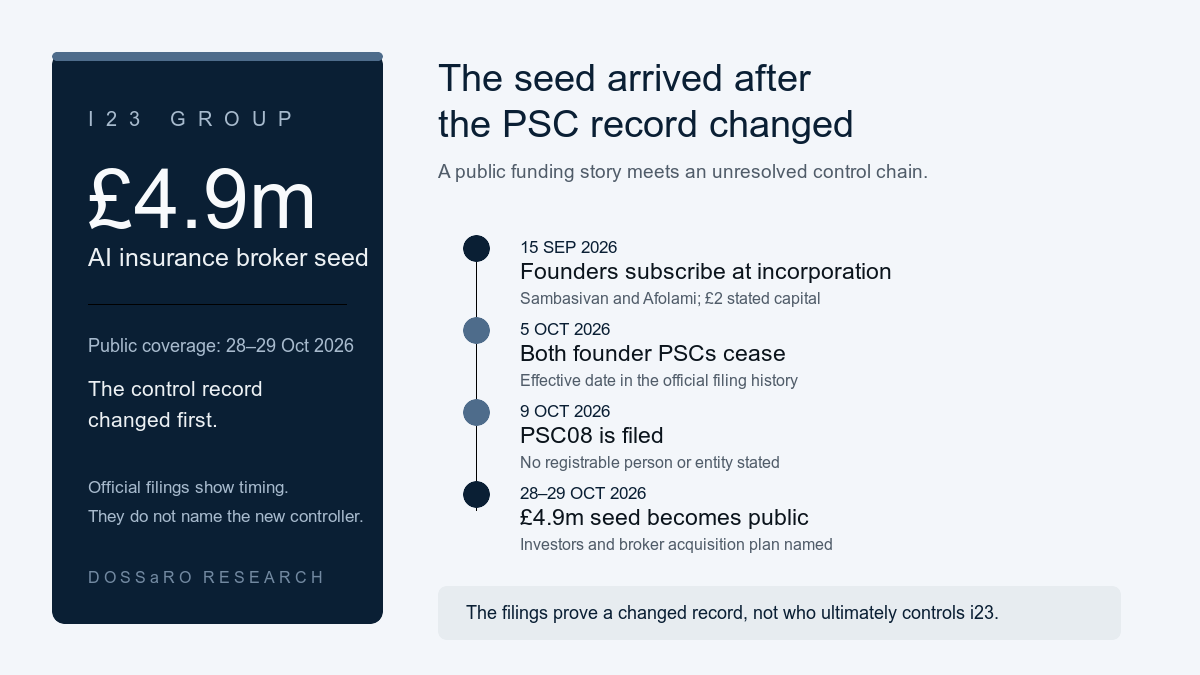
i23’s £4.9m seed was publicised after both founder subscribers had ceased to be registrable people with significant control, and after the company had filed that it knew of no registrable controller. The filing sequence does not prove that the founders lost control or that investors took it. It does establish that the statutory control record changed before the funding story reached the market.
That distinction matters because i23 is not raising money for an ordinary software product. Public coverage describes an AI-native commercial insurance broker that plans to acquire an existing broker, but does not name the target or disclose the acquisition terms. The first diligence question is therefore not only how the agentic operating model will work. It is who controls the legal vehicle that is expected to buy the broker, and whether that vehicle is the same company in which the seed was subscribed.
The seed is an acquisition strategy, not just an AI story
The EUVC report dated 28 October 2026 describes an oversubscribed £4.9m seed for i23. It names Outward VC, Seedcamp, Insiders VC and Four Cities Capital among the investors and says the company is building an AI-native commercial insurance broker. Tech.eu’s report on 29 October gives the same financing figure and identifies Bim Afolami and Anand Sambasivan as founders, with Mike Coombes and Salman Valibeik also on the founding team.
The operating proposition is to use software agents for routine commercial-broking administration while building a regulated insurance business. The more consequential sentence in the coverage is the acquisition plan: i23 intends to buy an existing broker. The target, timing, consideration and financing of that purchase are not public. That leaves the £4.9m headline unable to answer whether the money is primarily working capital, acquisition capital, or a package that will be combined with debt or seller rollover.
The company’s legal identity is also specific. The Companies House record identifies I23 Group Limited, company number 17460902, a UK private company incorporated on 15 September 2026. It started with £2 of stated capital. The incorporation filing lists Anand Sambasivan and Abimbola Afolami as subscribers. This is the starting point for the control record, not the end of it.
The public timeline puts the control change before the announcement
The official filing history shows that both founders later ceased to be recorded as people with significant control. The cessation entries were filed on 9 October and state that the effective date was 5 October 2026. The same filing history records a PSC08 notification on 9 October. The active PSC page says that the company knew, or had reasonable cause to believe, that there was no registrable person or registrable relevant legal entity in relation to it, with the statement notified on 5 October.
The sequence is more useful than any single filing:
| Date | Public record | What it establishes |
|---|---|---|
| 15 September 2026 | I23 Group Limited incorporated with £2 stated capital; Sambasivan and Afolami subscribe | The two founders were the initial subscribers to the new legal vehicle |
| 5 October 2026 | Both founders’ PSC status ceases; PSC08 statement is notified | The company’s registrable control record becomes non-specific on that effective date |
| 9 October 2026 | PSC07 cessations and PSC08 are filed | The control change enters the public filing history |
| 14 October 2026 | Director details and registered office change | The vehicle’s formal administration changes before the seed reports |
| 28 October 2026 | EUVC reports the £4.9m seed | The funding and acquisition strategy become public |
| 29 October 2026 | Tech.eu reports the seed and founding team | Independent coverage repeats the financing narrative |
The 14 October entries are not proof of an ownership transfer. They record changes to director details and a move of the registered office from Wood Street in London to Arquen House in St Albans. Their significance is timing: the company’s formal record was being updated in the same period in which its founder PSC entries had ended and before the funding announcement was published.
What the PSC filing does, and does not, establish
A person with significant control entry is a statutory disclosure, not a complete cap table. A cessation can follow a transfer, a change in the relevant percentage or voting rights, a corporate or trust arrangement, a nominee relationship, or a correction to an earlier filing. A PSC08 statement means the company reported no person or relevant legal entity that met the registrable conditions at that time. It does not mean that the company had no economic owner or that no one could influence decisions.
| Confirmed fact | Commercial reading | Not established by the public record |
|---|---|---|
| Sambasivan and Afolami were subscribers on 15 September | They were the initial founders attached to the incorporation vehicle | Their percentage ownership after incorporation or after the seed |
| Both ceased to be registrable PSCs effective 5 October | The statutory control record changed before the seed coverage | That the founders sold out or lost control |
| PSC08 says no registrable person or entity was known on 5 October | The public register does not identify a controller at that point | The identity of any nominee, trust, parent or other non-registrable holder |
| The seed was reported on 28 and 29 October | Investors funded a business whose legal-control trail was already non-specific | Investor allocations, rights, preferences or board control |
This is why the article should not turn “no registrable controller” into “no controller.” The first is the filing fact. The second would be an unsupported conclusion. The public record supports a control-chain question, not an allegation about hidden ownership.
The distinction is familiar in private-market analysis. Hyperexponential’s Guidewire exit shows why a headline transaction needs to be read through the legal capital structure already in place. Cognitive Credit’s financing similarly separates the amount raised from the priority and control rights that determine who is economically exposed. i23 presents the same problem earlier in the life cycle: the seed amount is known, while the ownership and governance layer around the fundraising vehicle is not.
The acquisition plan makes the unanswered question practical
If i23 were only selling software, the unresolved PSC chain would still matter to investors, but the commercial consequence would be easier to contain. A planned broker acquisition raises the stakes. The buyer will need authority to sign, fund and operate the transaction. It will also inherit or negotiate around a regulated business, customer relationships, employees, insurance distribution permissions and any financing attached to the target.
That makes the legal vehicle’s control and funding path decision-changing. Investors will want to know whether the seed was subscribed into I23 Group Limited, an operating subsidiary, a parent above it, or a vehicle that will sit beside the acquisition entity. They will also need to distinguish board appointment rights from share ownership and identify whether any founder or investor rights sit in a shareholders’ agreement that does not appear in the register.
The public announcement does not answer those questions. It names the investors and describes the operating ambition, but it does not provide a target name, purchase price, debt package, shareholder allocation or governance terms. The gap is therefore not a technical footnote. It is the difference between capital for an early-stage operating company and capital assembled around a corporate acquisition platform.
A routine restructure remains a live explanation
There are benign explanations for the filing sequence. I23 may have inserted a parent company, moved shares into a corporate or trust structure, crossed a reporting threshold, or corrected an initial PSC position as it prepared to raise capital. The director and registered-office updates may be ordinary administration around a new holding company. None of those explanations can be selected from the public pages alone.
The evidence therefore supports a narrow but material conclusion: I23 Group Limited’s statutory control record became non-specific on 5 October, before the £4.9m seed was publicised and before the planned broker acquisition was explained. That is a stronger finding than the generic description of a founder-led AI insurance startup, but it is not evidence that founders were pushed out or that investors acquired control.
The next decision-changing documents are the shareholder agreement, the post-seed cap table, any parent or nominee records, and the acquisition materials for the broker. Those documents would show where the seed was subscribed, which rights were granted, whether a new controller exists outside the PSC threshold, and whether the entity buying the broker is the same vehicle that raised the money.
The £4.9m headline tells investors what capital arrived. The Companies House sequence tells them what still needs to be explained before underwriting the broker acquisition: who controls i23, where the seed was subscribed, and whether the buyer will be the same entity that the public announcement describes.
Sources
Continue reading
Related Research
Guidewire’s $1.7bn Hyperexponential Deal Runs Through an Existing Capital Stack
Guidewire agreed to buy Hyperexponential for $1.7bn plus up to $400m. UK filings show an existing preferred stack, not a new pre-sale financing.
Cognitive Credit’s $40m Growth Investment Sits Beside a New HSBC Security Layer
Cognitive Credit announced a $40m Summit-led investment, while filings show 876 new shares and an outstanding HSBC security over its IP and business.
StrollMe’s €22m Raise Finances a Fleet, Not Just a Valuation
StrollMe raised €22m in equity and debt. Its filings and customer terms put the key question on fleet, receivables and risk allocation, not valuation.
XRlabs Added Seed-2 Preference Rights While Its Founder Kept Statutory Control
XRlabs raised an $8.4m Playground-led seed while filings show 621,130 Seed-2 shares and a founder still above 50% with majority board rights.