
Guidewire’s $1.7bn Hyperexponential Deal Runs Through an Existing Capital Stack
Guidewire agreed to buy Hyperexponential for $1.7bn plus up to $400m. UK filings show an existing preferred stack, not a new pre-sale financing.
On this page
Conduct your own private market research
Add dossaro to Claude or ChatGPT and run source-backed register research from your own workspace.
 Add to Claude
 Add to ChatGPT
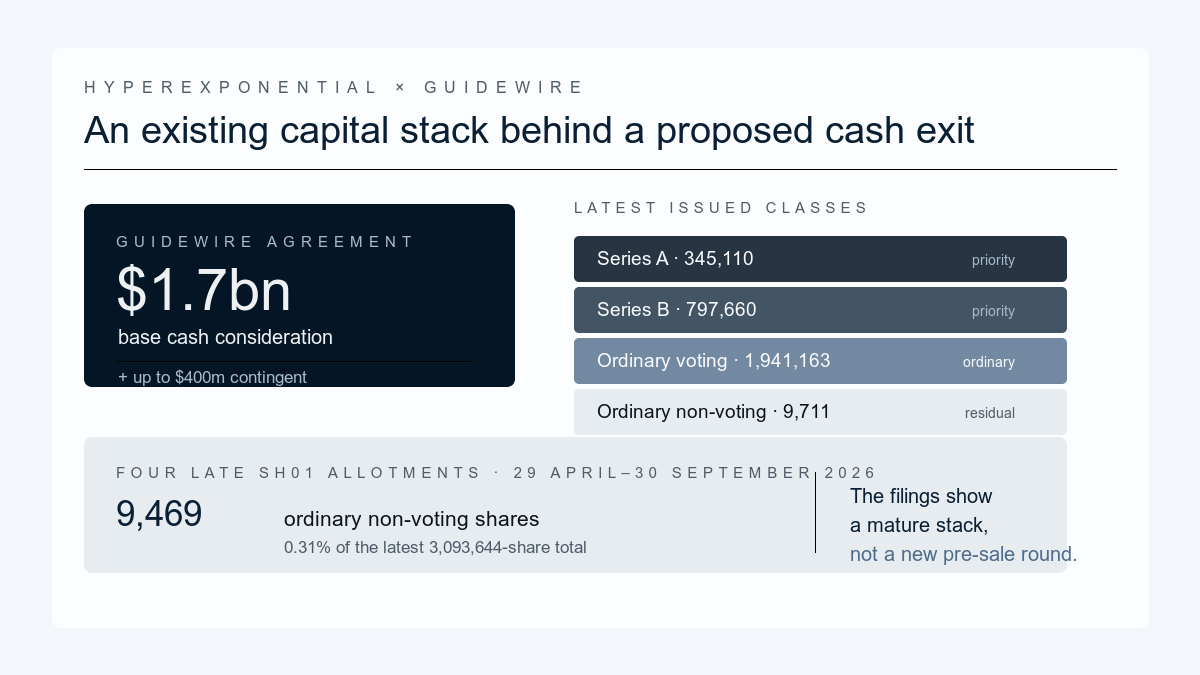
Guidewire is offering $1.7bn in cash for Hyperexponential, but the UK filing trail says the exit is running through a capital stack that was already built. Series A and Series B sit above ordinary voting and residual ordinary non-voting shares, while only 9,469 small non-voting shares were added across four late allotments. The visible filings do not look like a new preferred financing that explains the headline price.
That distinction changes the economic question. The proposed acquisition is not closed, and the public record does not identify individual sellers or allocate proceeds. It does show an existing hierarchy of voting, dividend and liquidation rights through which the cash consideration and a possible earnout would have to move. Guidewire is buying the company with $1bn of term-loan capacity and existing cash, rather than financing Hyperexponential with a new round immediately before the announcement.
A $1.7bn deal with $400m tied to future revenue
Guidewire’s definitive-agreement announcement, published in October 2026, says it will acquire all issued share capital of London-based Hyperexponential for a $1.7bn base cash payment, subject to customary adjustments, plus up to $400m of contingent consideration. The earnout is tied to specified recurring-revenue targets. Guidewire expects the transaction to close in the second quarter of its 2027 fiscal year.
The buyer describes Hyperexponential as an AI-native underwriting and pricing provider used across more than $75bn of annual commercial property-and-casualty premium. TechCrunch’s independent report puts the cash price at $1.7bn and the performance-linked component at up to $400m, and says Hyperexponential had raised nearly $90m according to PitchBook. Insurance Times likewise describes the London insurance platform and the two-part consideration.
Guidewire says it will use a $1bn term loan together with existing cash to fund the purchase. That is buyer-side acquisition financing, not evidence that Hyperexponential issued a fresh preferred class to fund the exit. The distinction matters because a late financing could change who participates in the price. The filing sequence points instead to holders who were already in the company before the agreement.
The latest filings show four layers, not a blank cap table
Hyperexponential Ltd, Companies House number 11044276, was incorporated in November 2017. Its Companies House filing history records the latest statements of capital and the classes in issue. Across those filings, the total reaches 3,093,644 shares:
| Class | Shares in the latest statements | What the filings say |
|---|---|---|
| Series A | 345,110 | Voting, dividend and liquidation-priority terms |
| Series B | 797,660 | Voting, dividend and liquidation-priority terms |
| Ordinary voting | 1,941,163 | Voting ordinary layer below the stated preferred priority |
| Ordinary non-voting | 9,711 | No vote or dividend; residual position behind the preferred classes |
| Total | 3,093,644 | Existing issued share capital before completion |
The important point is not simply that there are four rows. The classes describe different routes to the economic outcome. Series A and Series B are not interchangeable with ordinary shares because their stated rights include priority on dividends and liquidation. The ordinary non-voting class is smaller and sits at the residual end of the structure. A headline purchase price therefore cannot be translated into a per-share amount without the transaction waterfall, the exact adjustment mechanics and any employee arrangements.
The Companies House PSC record lists Michael Richard Johnson as having the right to appoint or remove directors. It lists Amrit Santhirasenan as holding more than 25% but not more than 50% of shares and votes, with the same director-appointment right. Those entries help identify the pre-close governance map, but they do not say who will receive the cash or how the earnout will be divided.
The late allotments are too small to explain the headline
Four 2026 SH01 filings show small cash-paid allotments in the ordinary non-voting class. The filing dates and allotment dates are visible in the official history:
| Filing date | Allotment date | Filing read-through |
|---|---|---|
| 17 June 2026 | 29 April 2026 | Ordinary non-voting allotment at a stated cash price |
| 24 August 2026 | 11 August 2026 | Ordinary non-voting allotment at a stated cash price |
| 28 September 2026 | 26 August 2026 | Ordinary non-voting allotment at a stated cash price |
| 9 October 2026 | 30 September 2026 | Ordinary non-voting allotment at a stated cash price |
| Combined | 29 April to 30 September | 9,469 shares, about 0.31% of the final total |
The stated cash prices are around £14 to £24 per share. Even taking the combined 9,469 shares at face value, they amount to roughly 0.31% of the 3,093,644 shares shown in the latest statements. They are also in the residual non-voting class. That is not a plausible mechanical explanation for a $1.7bn base consideration, and the filings show no visible Guidewire issuance or new preferred class before the proposed acquisition.
The benign reading is that these were routine employee, option or administrative allotments. They may be relevant to the eventual fully diluted count, but the public records do not connect them to a new financing or to a specific sale agreement. Their significance is therefore structural: they slightly enlarge the residual layer without changing the basic preferred-over-ordinary hierarchy.
The waterfall matters more than the headline multiple
For existing Series A and Series B holders, the deal is best understood as a cash and earnout exit through rights that pre-date Guidewire’s announcement. Priority terms may determine how the base payment is distributed before ordinary holders participate. The public announcement separately refers to an employee retention pool, making employees another relevant constituency. Neither the announcement nor the Companies House filings assign a percentage of the purchase price to a named investor, founder or employee.
That boundary is important for founders and employees as well. The PSC record can show registrable control rights, while the capital statements show classes and numbers, but neither record is a transaction waterfall. It would be wrong to turn Amrit Santhirasenan’s PSC band into a personal payout estimate, or to treat the 9,469 residual shares as a proxy for the retention pool. The public evidence supports the existence of different constituencies, not their individual recoveries.
The structure also explains why the buyer’s financing deserves separate treatment. Guidewire has disclosed a $1bn term loan and existing cash for the acquisition. This is a financing decision by the acquirer. It does not show that Hyperexponential needed a bridge round, that its existing investors were diluted before closing, or that a lender now sits in the target’s share register.
What the next record needs to answer
The proposed transaction changes the expected destination of the capital stack, but not what the public filings currently prove. The strongest reading is narrow: Guidewire is buying a company with an established Series A, Series B and ordinary hierarchy, while a tiny late wave of ordinary non-voting allotments leaves the headline economics largely untouched.
The next decision-changing record is the post-close shareholder statement or transaction document that maps the base cash, the contingent consideration and the employee retention pool across those classes. Until that record is available, the defensible conclusion is not that a particular investor or founder will receive a particular amount. It is that the $1.7bn offer runs through an existing capital stack rather than a last-minute financing whose proceeds can be assigned to individual sellers.
That is a materially different story from “Guidewire bought Hyperexponential for up to $2.1bn.” It tells investors where to look next: at the rights and waterfall that convert a corporate acquisition into distributions, not at a small residual-class issuance that cannot carry the price.
Sources
Continue reading
Related Research
GLAS's Oakley Sale Followed a Debt and Preference Reset
GLAS's Oakley sale followed a debt and preference reset before the public change of control, with £90m redeemed and £46.5m paid through two one-share allotments.
Cognitive Credit’s $40m Growth Investment Sits Beside a New HSBC Security Layer
Cognitive Credit announced a $40m Summit-led investment, while filings show 876 new shares and an outstanding HSBC security over its IP and business.
Tendos’ €12m Seed and Insight’s Separate 40% Stake
Tendos announced a €12m Insight-led seed, while German shareholder lists show a separate 8,221-share transfer that lifted Insight to about 40%.
Impress’s €40m EIB Loan Adds a New Layer to Existing Venture Debt
Impress’s €40m EIB loan sits beside outstanding Trinity charges, while older lender security was satisfied in January, making the debt stack visible.