
Cognitive Credit’s $40m Growth Investment Sits Beside a New HSBC Security Layer
Cognitive Credit announced a $40m Summit-led investment, while filings show 876 new shares and an outstanding HSBC security over its IP and business.
On this page
Conduct your own private market research
Add dossaro to Claude or ChatGPT and run source-backed register research from your own workspace.
 Add to Claude
 Add to ChatGPT
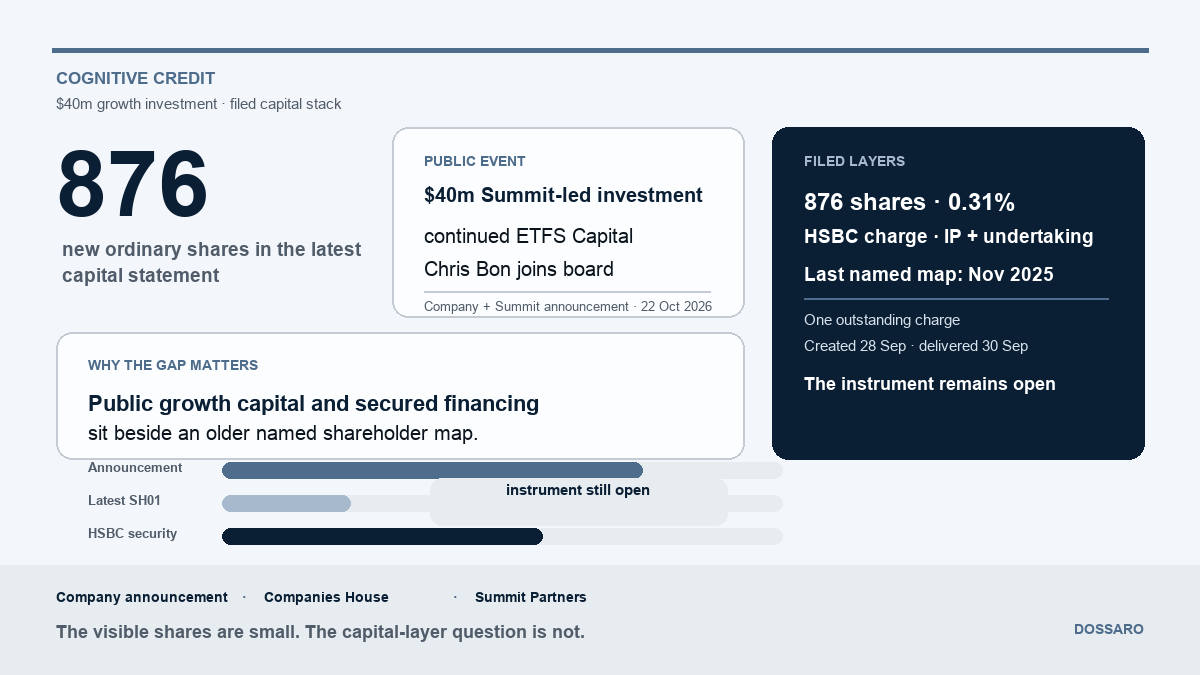
Cognitive Credit announced a $40 million strategic growth investment led by Summit Partners on 22 October. The nearest Companies House capital filing records 876 new ordinary shares, not a named $40 million allotment. A separate filing, delivered two days before the announcement, records an outstanding HSBC Innovation Bank charge over the company’s assets and intellectual property.
That combination does not identify the investment instrument. It does change the diligence question. The public event describes growth capital and a new Summit board relationship. The filings show a small visible equity issuance beside a secured bank layer, while the latest named shareholder map still predates the announcement.
The $40m announcement and the 876-share filing answer different questions
The Cognitive Credit announcement says the investment was completed, led by Summit Partners, and supported by continued participation from ETFS Capital. Summit partner Chris Bon joined the board. The company says it will use the capital to expand in the United States, launch DealConnect for private issuers and develop agentic credit analysis on top of its verified data layer.
Summit’s account describes the same investment as a partnership with a provider of corporate-credit data, analytics and artificial-intelligence workflow tools. Neither announcement publishes a valuation, a subscriber-by-subscriber allocation or a post-investment ownership percentage.
The 13 July 2026 statement of capital at Companies House covers an allotment made on 18 June. It records 742 ordinary shares in one allotment and 134 in another, taking issued capital to 284,347 shares. The 876 new shares equal about 0.31% of the post-allotment total. The filing does not name Summit Partners or ETFS Capital as subscribers.
| Filing state | What Companies House records | Why it matters |
|---|---|---|
| 17 May 2024 SH01 | 53,432 Series B and 21,274 Series A3 shares allotted for cash | The last large visible primary financing step created a multi-class structure |
| 26 November 2025 CS01 | 30 named shareholding lines across ordinary, Series A and Series B classes | The last named ownership map predates Summit’s investment |
| 18 June 2026 SH01 | 742 plus 134 ordinary shares; 284,347 total shares | Only 876 new ordinary shares are visible near the announcement |
| 28 September 2026 MR01 | One outstanding HSBC Innovation Bank charge | The capital stack includes secured financing over company assets and IP |
The direction is the finding: a completed $40 million strategic investment is not mirrored by a comparably large, named primary-share allotment in the latest capital statement. The filings do not prove that Summit received no equity. They show that the legal form of the public transaction is not yet visible in a single new-share event at the operating company.
The last named shareholder map is from before Summit arrived
The 26 November 2025 confirmation statement remains the latest named shareholder snapshot in the filing set. It lists XTX Investments with 72,422 shares across several classes, about 25.55% of the 283,471 shares then outstanding. Robert Slater held 49,673 ordinary shares, about 17.52%. ETFS Capital Holdings 3 held 43,785 Series B and Series A3 shares, about 15.45%. Pentech, Warwick funds, HBM IV, UK FF Nominees and other holders made up the rest of a 30-line register.
That snapshot explains why the new announcement matters to existing holders. A strategic growth investment can change the company's ownership, liquidity and board rights even when a later Companies House filing has not yet named the new investor. The current PSC page records Robert Slater’s cessation on 17 May 2024 and an active statement that the company knows of no registrable person or relevant legal entity. That statement does not identify Summit, ETFS Capital or any post-investment beneficial owner.
The practical question for a growth investor is therefore not simply whether Summit invested. The company and Summit say it did. The question is whether Summit bought existing shares, subscribed at another company layer, received a convertible or preferred instrument, or entered through a transaction whose ownership filing has not yet arrived.
HSBC’s charge puts collateral beside the growth equity
Companies House lists one outstanding charge for Cognitive Credit. HSBC Innovation Bank created it on 28 September 2026 and the company delivered the MR01 on 30 September. The charge page names HSBC as the person entitled and marks the security outstanding.
The filed instrument reaches the company’s property and intellectual property, including Cognitive Credit marks and patent rights, and adds a floating charge over the company’s property or undertaking. It also contains a negative pledge. Those terms put a lender’s priority claim beside the growth-investment story. They do not show a default, a recovery process or lender control.
For a data company, the collateral perimeter is commercially important. The product is built around proprietary datasets, models, software and a reporting library. If those assets are pledged, a future investor or acquirer needs to understand which rights sit ahead of its own claim, whether the charge covers new intellectual property and how any permitted disposal or release works. The public MR01 establishes the existence and broad perimeter of the security; it does not provide the full economic bargain in a short web summary.
This is a different layer from the shareholder register. Spiko’s recent financing analysis separates a parent-level growth round from capital held by a regulated operating company. Sprints’ Fund V analysis likewise distinguishes a fund headline from a manager’s statutory accounts. Cognitive Credit’s filings add a third box: growth equity is announced while bank security sits over the operating company’s assets.
The accounts show a funded but still loss-making platform
The accounts for the year ended 31 December 2025, filed on 28 September 2026, add operating context without resolving the transaction. Cognitive Credit reported £2.624 million of cash, £762,071 of net assets and £18.944 million of share premium. Accumulated losses were £18.185 million, and average headcount was 38. The prior year showed net assets of £3.964 million and 43 employees.
Those numbers are not a verdict on the company. They show why growth capital and bank financing can coexist: a software business may raise equity for product and market expansion while using a secured facility for working capital or a defined operating need. They also show why the legal instrument matters. A $40 million announcement can describe a large strategic step without telling an investor how much new cash reached the company, how much changed hands between existing holders or which claims rank first if the plan takes longer than expected.
The accounts also make the headline harder to translate into a simple ownership percentage. Share premium is already material, preferred classes existed before the Summit announcement and the latest visible allotment is small. The amount of capital, the price paid for it and the rights attached to it are separate questions.
What the public round could still mean
There are several ordinary commercial explanations. Summit may have bought shares from existing holders, invested through a convertible or preferred instrument, subscribed at a parent or affiliate, or closed a transaction whose post-closing statement had not yet been filed. ETFS Capital’s continued participation could describe a new subscription, a rollover or a broader financing package. The current filings do not choose among those forms.
That uncertainty should not be filled with the most dramatic reading. The HSBC security is compatible with ordinary venture debt. The absence of Summit from the June SH01 is compatible with a secondary or deferred filing. The 2025 losses are compatible with a scaling software company investing ahead of revenue. Each explanation still leaves a concrete question about price, priority and control.
The company’s stated expansion plan makes the answer commercially relevant. DealConnect is intended to give investors access to credit models for private issuers in secure data rooms, while the company plans to extend its AI tools across more markets. Those products increase the value of verified data, but they also increase the importance of ownership over the data, software and intellectual property that the HSBC charge covers.
The next post-investment confirmation statement or allotment filing should show whether Summit or an associated vehicle entered the legal shareholder map. The charge instrument and the next accounts should show how the bank security interacts with new intellectual property, disposals and any future acquisition. Until then, Cognitive Credit’s $40 million is a completed public event with an unresolved capital layer: the visible shares are small, the named ownership map is old, and the lender’s collateral is current.
For investors, the underwriting question is precise. Which instrument connects Summit’s $40 million to Cognitive Credit’s legal capital, and what rights sit ahead of that investment over the company’s data, software and intellectual property?
Continue reading
Related Research
Sprints’ €725m Fund V Sits Above a £654,887 Manager Balance Sheet
Sprints says Fund V closed at a €725m hard cap, while UK filings show £2.07m cash, £654,887 net assets and two new HSBC security filings remain outstanding.
Spiko's $90m Series B Has Two Capital Layers Investors Need to Separate
Spiko says NEA led a $90m Series B. French filings show a €5m parent subscription into the regulated company and a separate ratchet-linked financing stack above it.
Qureight's $20m Round Sat Above Preferred Equity and HSBC Security
Qureight's $20m Series B followed a £2m senior C1 issue and four HSBC security filings, placing lenders and preferred capital ahead of older equity.
Noah’s $16m Extension Leaves the UK Capital Stack Nearly Unchanged
Noah’s $16m seed extension added only 3,150 visible UK shares, while two corporate ordinary blocks still anchor its UK capital stack and control records.