
Noah’s $16m Extension Leaves the UK Capital Stack Nearly Unchanged
Noah’s $16m seed extension added only 3,150 visible UK shares, while two corporate ordinary blocks still anchor its UK capital stack and control records.
On this page
Conduct your own private market research
Add dossaro to Claude or ChatGPT and run source-backed register research from your own workspace.
 Add to Claude
 Add to ChatGPT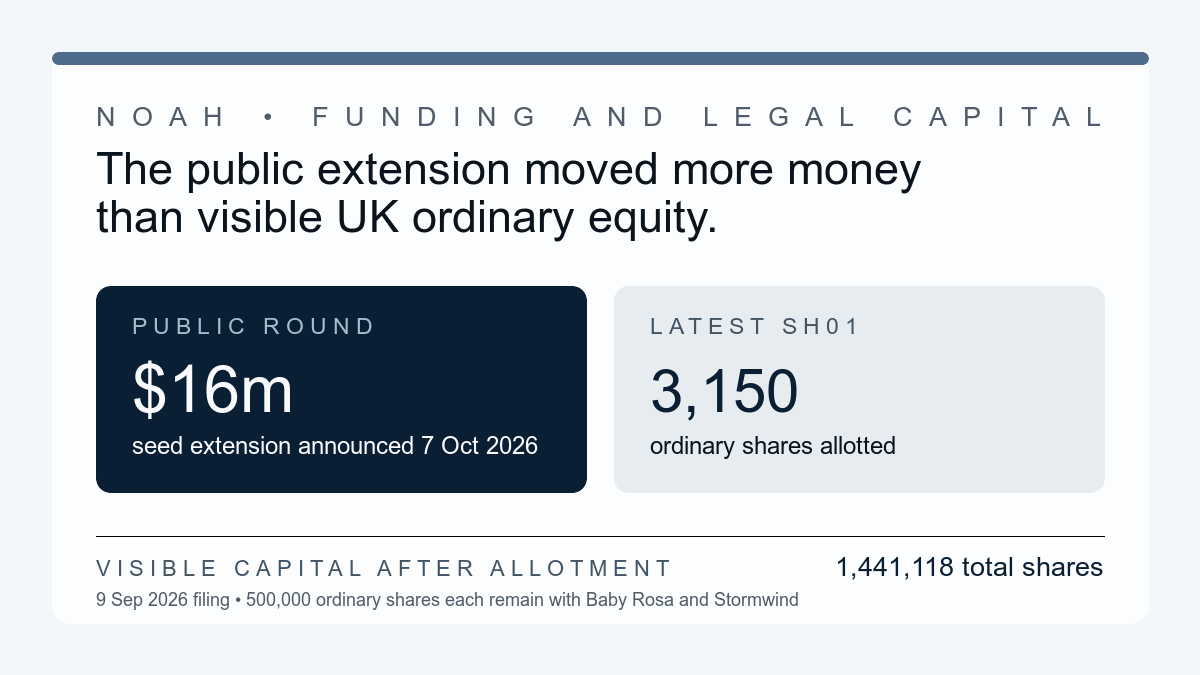
Noah’s latest funding headline is much larger than the ordinary-share movement visible in its UK company record. The stablecoin-payments company said on 7 October that a further $16 million had taken its seed financing to $38 million. The latest filed statement of capital, received on 9 September, records 3,150 new ordinary shares and total issued capital of 1,441,118 shares.
That is not proof that the financing was absent, mislabelled or economically irrelevant. It is a useful distinction between a public funding announcement and the legal capital that has been filed for Noah HQ Ltd. The visible UK stack still has two 500,000-share ordinary blocks, held by Baby Rosa Holdings (UK) Ltd and Stormwind Ltd, alongside a dispersed preferred class. For investors, lenders and potential counterparties, the extension should therefore be read as a financing event whose instrument, issuing entity and dilution mechanics remain to be established, rather than as a straightforward reset of Noah’s UK ordinary equity.
The public extension arrived after a tiny legal allotment
Noah’s 7 October announcement says the company raised an additional $16 million from Endeit, FJ Labs, LocalGlobe and Felix Capital, taking total seed funding to $38 million. It describes more than 150 customers, operations across more than 150 markets and 538% year-to-date revenue growth in 2026. The release names Shah Ramezani as chief executive and frames the money as support for product, licensing, hiring and market expansion.
The UK filing closest to that announcement tells a narrower legal story. The SH01 received on 9 September records two allotments made between 18 August and 4 September 2026: 2,070 ordinary shares and 1,080 ordinary shares. Each has a £0.01 nominal value and £0.97 paid. Together they add 3,150 ordinary shares.
Against a reconciled pre-allotment base of 1,437,968 shares, that is an increase of about 0.22%. The post-allotment statement lists 1,003,150 ordinary shares, 187,968 Series Seed 2 Preferred shares and 250,000 Series Seed Preferred shares, for 1,441,118 shares in total. The filing does not identify the investors named in the funding release, attach a price for a $16 million round or describe the new ordinary allotment as the extension.
The difference is the story. A funding announcement measures money Noah says it has secured. An SH01 records a particular legal issuance into a particular UK company. Treating the second as a complete translation of the first would turn a useful filing fact into an unsupported financing conclusion.
This financing-versus-capital distinction also appears in Fundcraft’s €12 million growth financing and separate French capital conversion, where group-level money and a subsidiary’s balance-sheet entry described different layers of the same business.
The earlier record shows two ordinary blocks and a crowded preference class
The older filings make the ordinary-share position unusually legible. Two Companies House correction filings received on 29 January 2025 restate the capital associated with the 2023 and 2024 confirmation statements as 1,000,000 ordinary shares, 154,791 Series Seed 2 Preferred shares and 250,000 Series Seed Preferred shares, or 1,404,791 shares. Both show 500,000 ordinary shares held by Baby Rosa Holdings (UK) Ltd and 500,000 held by Stormwind Ltd. Baby Rosa also appears with 187,500 Series Seed Preferred shares.
The 28 December 2024 confirmation statement, filed on 3 February 2025, adds an important complication. Its shareholder list includes a 33,177 Series Seed 2 holding for Theodorus Lamus, even though the statement-of-capital section still reports 154,791 Series Seed 2 shares and 1,404,791 total shares. Adding that listed holding to the capital-class figure produces 187,968 Series Seed 2 shares and a reconciled 1,437,968-share base. The filing itself therefore contains a timing or presentation mismatch, rather than a single clean number that can be lifted without context.
| Register snapshot | Ordinary shares | Series Seed 2 | Series Seed | Total shares | What it establishes |
|---|---|---|---|---|---|
| Corrected 2023 and 2024 capital statements | 1,000,000 | 154,791 | 250,000 | 1,404,791 | Two 500,000 ordinary blocks; capital-class total excludes the later-listed 33,177 holding |
| 28 Dec 2024 shareholder list, reconciled | 1,000,000 | 187,968 | 250,000 | 1,437,968 | The list includes the 33,177 Series Seed 2 holding, producing the comparison base used here |
| 9 Sep 2026 SH01 | 1,003,150 | 187,968 | 250,000 | 1,441,118 | 3,150 new ordinary shares are the visible latest allotment |
The 2025 confirmation statement was filed without a capital update. The next concrete movement in the accessible record is the September 2026 SH01. That chronology matters because the funding announcement is new, while the visible share issuance is small and predates it by roughly one month.
The ordinary blocks still anchor the visible governance perimeter
The two corporate ordinary blocks remain the clearest structural fact in the register. Baby Rosa and Stormwind each hold 500,000 ordinary shares in the corrected 2023 and 2024 records. After the September allotment, those blocks together still account for 1,000,000 of 1,441,118 issued shares, or about 69.4% by share count. That percentage is not a voting calculation because the preferred classes rank pari passu except where the articles provide otherwise, but it shows how little the 3,150-share allotment changes the visible ownership architecture.
The Companies House persons-with-significant-control record lists Baby Rosa Holdings (UK) Ltd and Stormwind Ltd as active corporate PSCs. Each is recorded in the more-than-25%-and-up-to-50% bands for shares and voting rights and with rights to appoint or remove directors. Those are legal control disclosures for Noah HQ Ltd. They are not, by themselves, proof of beneficial ownership or of how the new financing economics are allocated.
The two vehicles also make the public founder shorthand more complicated. The register uses legal names and corporate PSC records, while Noah’s funding release uses the public name Shah Ramezani. Neither naming convention is a complete personal ownership statement, so the corporate rights and the public biography should be kept as separate evidence tracks.
The preferred side is more dispersed. The 2024 shareholder list names funds, companies and individuals across the Series Seed and Series Seed 2 classes. The latest SH01 keeps those class totals at 187,968 and 250,000. The visible record therefore shows a financing stack with a concentrated ordinary base and a broad preferred layer, not a clean before-and-after priced round.
The financing can be real without appearing as ordinary equity
There are several commercially ordinary explanations for the gap between the $16 million announcement and the 3,150 ordinary shares. The extension could use a convertible instrument, sit in a parent or another group vehicle, be reflected in a later allotment or simply not be represented by the filing selected here. The public announcement does not state which explanation applies, and the Companies House record does not decide it.
That boundary should change how the round is used in diligence. A reader can state firmly that Noah announced $38 million of seed financing in total, that the latest public release attributes the additional $16 million to four named investors and that the latest SH01 adds 3,150 ordinary shares. A reader cannot safely model the SH01 as the priced equity purchase for those investors, derive a post-money valuation from it or assume that the new cash went directly into Noah HQ Ltd’s ordinary class.
The next useful evidence would be the subscription or instrument terms, the identity of the issuing entity, any conversion mechanics and a later cap-table or confirmation statement that records the economic effect. If the money was raised at group level, counterparties also need to know which entity received it and which entity bears the obligations attached to it.
The same discipline is visible in Inforcer’s Series C filing, where new money, redesignated old shares and implied value had to be separated before the round could be described accurately. Noah’s record is less complete, but the question is similar: which legal line carries the commercial event?
A small issuance still changes the questions investors ask
It would be easy to dismiss 3,150 shares as administrative noise. That would also be a mistake. The allotment takes ordinary shares above one million and leaves the two 500,000 blocks nearly equal, while the total share count rises only 0.22% on the reconciled base. It is a hard, dated legal fact that narrows what the latest public announcement can mean for the UK company.
The commercial consequence is not that Noah’s funding headline is false. It is that funding scale, dilution and governance sit on different evidentiary tracks. A venture investor evaluating the extension, a lender looking for the entity with cash, or a buyer assessing future conversion risk should not substitute the $38 million headline for the still-unanswered questions about instrument, recipient, issue price, preferred rights and eventual dilution.
Noah has put a larger financing number into the market. Its latest UK capital filing has moved by 3,150 ordinary shares, while Baby Rosa and Stormwind remain the two 500,000-share corporate anchors and the preferred class remains dispersed. The next filing or financing document will show whether those are simply two views of one extension or evidence of money moving through a wider group structure.
Sources: Noah’s 7 October funding announcement, Noah’s 2025 $22 million seed announcement, Companies House company profile, and Axios Pro Rata’s independent report.
Continue reading
Related Research
Fundcraft's €12m Growth Financing Sat Beside a €1.24m Internal Capital Conversion
Fundcraft announced €12m of group growth financing while its French AIFM converted €1.24m of shareholder debt into capital without a cash remittance.
Inforcer Doubled Its Implied Valuation As Old Shares Entered Series C
Inforcer's filed Series C nearly doubled its implied value in nine months, while one-third of the preferred class came from existing ordinary shares.
Allogenetics’ €3.8m Round Sits Beside NBank’s 5.78% to 17.32% Shift
Allogenetics’ €3.8m Pre-Series A coincided with NBank Capital rising from 5.78% to 17.32% and the founder falling to 23.05%. The register shows dilution, not price.
Spiko's $90m Series B Has Two Capital Layers Investors Need to Separate
Spiko says NEA led a $90m Series B. French filings show a €5m parent subscription into the regulated company and a separate ratchet-linked financing stack above it.