
Spiko's $90m Series B Has Two Capital Layers Investors Need to Separate
Spiko says NEA led a $90m Series B. French filings show a €5m parent subscription into the regulated company and a separate ratchet-linked financing stack above it.
On this page
Conduct your own private market research
Add dossaro to Claude or ChatGPT and run source-backed register research from your own workspace.
 Add to Claude
 Add to ChatGPT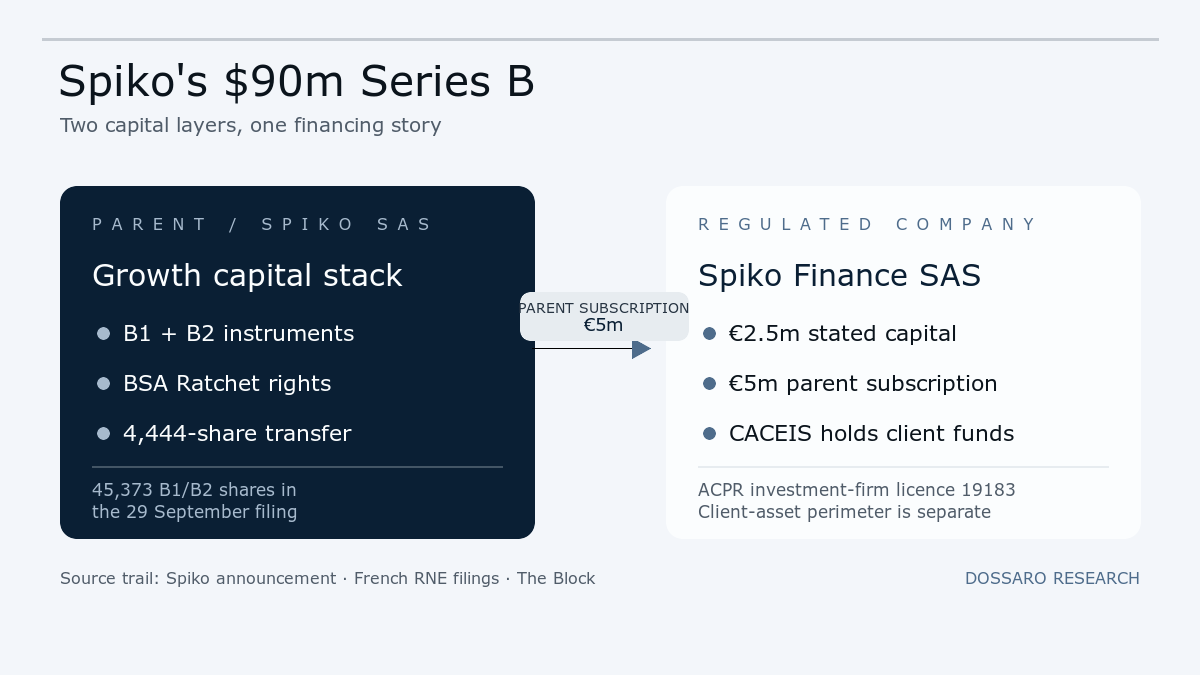
Spiko says New Enterprise Associates led a $90 million Series B to expand its tokenized cash-fund business. French corporate filings show why that headline should not be read as a single balance-sheet event: Spiko's parent and its regulated operating company sit in different capital layers.
The public announcement describes a fast-growing platform, with more than 10,000 businesses and individuals in more than 25 jurisdictions. Spiko's French announcement reports €2.4 billion in assets under management, while The Block's independent account uses a $2.7 billion figure. Both accounts identify NEA as the Series B lead and describe plans for new products, markets and hires.
The register evidence answers a narrower but more consequential question: which entity carries the regulated capital and how was it funded? A depositary certificate says Spiko Finance was increased from €500,000 to €2.5 million through a €5 million subscription by its parent, SPIKO SAS. Separate parent filings show B1 and B2 instruments, ratchet-linked rights and a secondary share transfer. They do not prove that the October Series B subscription was made directly into Spiko Finance or identify the allocation among named investors.
That distinction is the story. The financing headline describes growth capital at group level. The filings show a separately capitalised regulated company and an investor-rights stack above it.
The round sits above the regulated company
Spiko's own announcement dated 6 October 2026 says the company raised $90 million in Series B funding led by NEA, taking total funding to $120 million. It lists Index, Bpifrance, Speedinvest, Flourish, Shapers, White Star, Blockwall, Frst, EQNX, Mirana and Wintermute among the wider investor group.
Those are company-level financing claims. They do not identify the legal subscriber for each class of shares issued by SPIKO SAS, nor do they say that the $90 million was paid into Spiko Finance SAS. That is not an accusation or a sign of an unusual structure. Licensed financial businesses commonly separate a regulated subsidiary from a parent that raises capital, hires staff and owns group technology.
Spiko's legal and company information makes the perimeter explicit. Spiko Finance SAS has €2.5 million of stated capital and an ACPR investment-firm licence, number 19183. The page says client funds are held by CACEIS Bank and are never held by Spiko. The regulated company's legal capital is therefore not a proxy for the $90 million round, and the platform's assets under management are not corporate cash.
| Public financing frame | Filed legal layer | What can be concluded |
|---|---|---|
| $90m Series B led by NEA; $120m total funding | SPIKO SAS parent has staged B1 and B2 issues and a separate transfer record | The announcement supports a group-level financing event, not an entity-specific subscription allocation |
| €2.4bn AUM in Spiko's French announcement and more than 10,000 clients | Spiko Finance SAS has €2.5m stated capital | AUM and legal capital measure different things and should not be combined |
| New products, markets and hires | Client funds held by CACEIS Bank, according to Spiko | Growth spending and client-asset custody sit on different evidentiary tracks |
A €5m parent subscription funded Spiko Finance
The most concrete bridge between the two layers is a French RNE depositary certificate for Spiko Finance. The certificate records a proposed increase from €500,000 to €2.5 million. It describes 200 million new ordinary shares at €0.01 each, plus a €3 million issue premium, for a total subscription of €5 million.
The sole legal-person subscriber named in that certificate is SPIKO SAS, SIREN 953 542 958. The certificate says the funds were deposited and the document was issued for the capital increase. This is direct evidence of a parent-to-subsidiary capitalisation. It is not direct evidence of who subscribed for the October Series B, because the certificate concerns Spiko Finance and the public Series B announcement does not publish a subscription agreement or an investor-by-investor allocation.
The legal capital endpoint matters. Spiko Finance's €2.5 million is the regulated company's stated capital after the proposed increase, not the value of the group. A parent can use a larger financing round for technology, distribution and acquisitions while capitalising the regulated entity on a different timetable. The filings give investors a reason to model those cash flows separately.
This is the same diligence problem that appears in Restate's parent and operating-company cap table: a financing headline can span entities with different obligations. Osavul's Luxembourg holdco structure shows the related risk of treating a holding company as if it were the operating or regulated business. Those comparisons do not establish Spiko's investor allocation. They show why the legal entity is the first question.
The parent built a staged B1 and B2 stack
The parent filings show that SPIKO SAS had already been using targeted instruments before the Series B announcement. A 23 July 2026 presidential decision records a first 33,761-share B1 issue and a further 3,768 B1 issue. It also records 2,909 B2 shares. Each ABSA combined an ordinary share with a BSA Ratchet instrument, while the issue prices and beneficiary lists were redacted in the public extract.
The 31 July decision says the B1 and B2 tranches were fully subscribed and paid. It also states that 1,637 B1 and 9,444 B2 shares remained available under the delegations. Those residual limits are not the same thing as issued shares, but they show that the parent had created room for additional targeted financing.
By the 29 September filing, the parent statutes showed 224,211 ordinary shares. The class breakdown included 38,020 B1 and 7,353 B2 shares, or 45,373 B1 and B2 shares combined. That is about 20.24% of the issued-share count. The ratio is a capital-structure observation, not a claim about economic ownership or voting control. The filing's heading and body also differ on the number of BSPCE exercises, so that disputed count is not used here.
The attached ratchet instruments are the important commercial detail. Their triggers, exercise prices and holders are not disclosed in the extracts. A share count therefore understates the negotiated position: the B1 and B2 labels identify classes, while the ratchets may alter future dilution or protection depending on terms that remain private.
A 4,444-share transfer was not new money
A separate 3 August 2026 parent decision labels 4,444 existing ordinary shares as B2 shares for identification. The document calls them “Actions Cédées” and says they were transferred by certain associates. It does not disclose the buyers, sellers or price.
That language matters because the transfer is not a capital increase. It changes the label and ownership trail of existing shares, while the B1 and B2 issues described in the July decisions are new capital. A financing analysis that adds every B-labelled share to the round proceeds would mix primary issuance with a secondary transaction.
The distinction also limits what can be said about named investors. Spiko's announcement names NEA and other funds at group level, but the public RNE extracts do not map those names to B1, B2 or the 4,444 transferred shares. The safest reading is that the parent had a staged instrument and transfer architecture whose investor-level allocation still requires another document.
What the two layers mean for an investor
For a venture investor, lender or acquisition buyer, the immediate implication is an entity-by-entity diligence model. The parent may hold the Series B proceeds, group intellectual property, employment costs and investor rights. Spiko Finance may carry the licence, regulatory capital and the relationship with the custodian. Those positions can create different cash-flow, insolvency and consent questions.
For a counterparty, the distinction is equally practical. A contract with Spiko Finance is not automatically a claim on parent-level financing proceeds. A parent-level investor right is not automatically a right over client assets held at CACEIS. The public record supports those boundaries, but it does not reveal the intercompany agreements or the Series B subscription terms.
The two capital layers also change how the headline should be compared with the balance sheet. The $90 million announcement is a financing amount. The €5 million parent subscription is a specific capitalisation event. The €2.5 million Spiko Finance capital is a legal-company figure. None of the three is a substitute for a current shareholder register, a group cash-flow statement or a regulatory capital return.
The next decision-changing document is the October Series B subscription agreement, share issue decision or updated parent register. It should identify the subscribing legal entities, the issue class, the price and any ratchet or preference rights. Until that arrives, the strongest defensible conclusion is narrow: Spiko announced a large group-level financing, while French filings show a parent that separately capitalised its regulated subsidiary and built a staged B1/B2 instrument stack above it.
Continue reading
Related Research
Restate’s $20m Series A Meets a 79.552% Delaware Parent Stake
Restate's $20m Series A follows a German register snapshot where Delaware parent Restate Software held 79.552%, leaving the round's operating-company cap table unproven.
Osavul's €8.5m Series A Put a Luxembourg Parent Above Its Ukrainian Operating Company
Osavul's €8.5m Series A followed a Luxembourg holdco formation, a 100% Ukrainian operating-company contribution and pre-written investor protections.
Joe AI's €2m Round Added a Protected 31,008-Share Block
Joe AI's €2m round reserved 31,008 ABSA shares and matching ratchet warrants for one unnamed subscriber, while Épopée gained a strategic seat in governance.
NEURA's Bosch Shuttle Deal Lands on a Newly Syndicated Capital Base
NEURA's Bosch Shuttle deal adds a proven logistics platform to a company whose 2026 register widened around five new vehicles while Bosch held 0.11% nominal equity.