
Restate’s $20m Series A Meets a 79.552% Delaware Parent Stake
Restate's $20m Series A follows a German register snapshot where Delaware parent Restate Software held 79.552%, leaving the round's operating-company cap table unproven.
On this page
Conduct your own private market research
Add dossaro to Claude or ChatGPT and run source-backed register research from your own workspace.
 Add to Claude
 Add to ChatGPT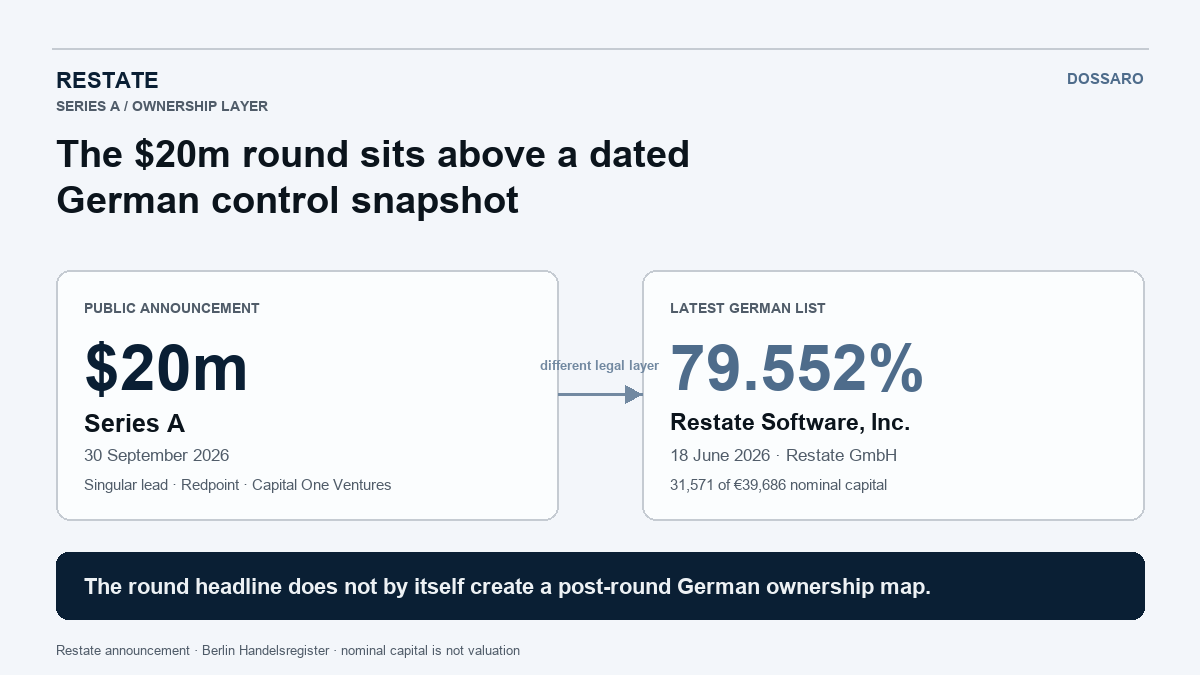
Restate announced a $20 million Series A on 30 September, led by Singular with Redpoint Ventures and Capital One Ventures participating. The latest German shareholder list reviewed for this article tells a different kind of story about the financing: before the round was announced, Restate Software, Inc., a Delaware parent, held 79.552% of the Berlin operating company’s nominal capital.
That distinction is the finding. The public financing announcement describes capital for a durable-execution business aimed at AI agents and backend infrastructure. The German register shows the legal control path of Restate GmbH, but its latest list is dated 18 June 2026, before the Series A announcement. It therefore does not evidence new Series A investors entering the German company, or show where the round’s new economic exposure was issued.
The Series A and the register answer different questions
Restate’s announcement says the company raised $20 million to make durable execution a broader building block for backends. Restate describes a runtime that records progress, recovers from failures and supports long-running processes, including AI-agent loops. The company says Replit moved execution of its Replit Agent onto Restate and that a Fortune 500 bank uses it for financial workflows with multi-region consistency requirements.
Independent TechCrunch coverage reports the same $20 million Series A, led by Singular with Redpoint and Capital One Ventures, and says Restate plans to hire go-to-market staff, add engineers and expand its San Francisco Bay Area presence. It also places the company in competition with Temporal, which TechCrunch says raised a $550 million Series E at a $12.55 billion valuation.
Those sources establish the commercial event and the stated use of capital. The German Handelsregister portal answers another question: who held the shares of Restate GmbH at the latest visible date, and how did that legal position change over time? The two layers should not be collapsed into one cap table.
A Delaware parent consolidated control before the round
The register sequence records a clear control path for the German company.
| Register state | Restate Software, Inc. | Igal Shilman | Total nominal capital | What changed |
|---|---|---|---|---|
| 2 March 2023 | €16,668, or 66.6667% | €8,334, or 33.3333% | €25,002 | Share transfers dated 16 February 2023 |
| 13 June 2023 | €31,352, or 79.0002% | €8,334, or 20.9998% | €39,686 | Capital increase dated 17 May 2023 |
| 18 June 2026 | €31,571, or 79.552% | €8,115, or 20.448% | €39,686 | 219 shares transferred from Shilman to the parent on 2 April 2026 |
The March 2023 shareholder list records Restate Software, Inc. with 16,668 one-euro shares and co-founder Igal Shilman with 8,334. The June 2023 list follows a capital increase that created 14,684 new one-euro shares for the Delaware parent, taking its nominal position to 79.0002% while Shilman’s holding stayed at 8,334 shares.
The June 2026 list records the next visible step. It says the entries changed after share transfers dated 2 April 2026. Restate Software, Inc. held 31,571 shares and Shilman held 8,115. The 219-share movement lifted the parent’s nominal percentage to 79.552% and reduced Shilman’s to 20.448%.
The percentages are calculated from nominal share amounts and are rounded as shown in the filings. They are not a valuation, a fully diluted ownership schedule or a substitute for any preferred rights, voting agreement or other instrument that is not present in these lists.
The operating company was already parent-controlled
The timing matters. Restate’s public Series A announcement came on 30 September. The latest German list in the evidence set was entered in June and describes a 2 April transfer. It is a pre-round snapshot of the German GmbH, not a post-round investor list.
That makes the parent-versus-operating-company split commercially important. If the Series A was subscribed at Restate Software, Inc. or another financing vehicle, its investors may have gained exposure to the group without appearing in the German shareholder list. If the round was partly or wholly issued by Restate GmbH, a later German filing would be needed to show that change. The current register evidence does not choose between those structures.
This is not an unusual arrangement for a software company expanding across jurisdictions. A parent can raise venture capital, own the operating subsidiary and fund the business through contributions, intercompany arrangements or other documented transfers. But the distinction changes where an investor, employee or counterparty should look for the rights attached to the round.
The latest German list therefore supports a narrow, affirmative conclusion: the company receiving the German operating activity was already controlled by a Delaware parent before Restate announced its Series A. It does not support the stronger claim that Singular, Redpoint or Capital One Ventures own a specific percentage of Restate GmbH, or that they entered the German cap table at all.
The founder’s visible stake moved before the financing headline
The 2 April transfer is also a separate economic event from the Series A. Shilman’s nominal holding fell by 219 one-euro shares, from 8,334 to 8,115, while the parent’s holding rose by the same amount. The register does not state a price, motive or broader settlement around that transfer.
The movement is small relative to the company’s €39,686 nominal capital, but it is visible in the legal ownership path. It puts the Delaware parent at 79.552% immediately before the public financing announcement and leaves Shilman at 20.448%. The record does not establish whether the transfer changed voting arrangements beyond the shares themselves, or whether any economic rights sat outside the nominal list.
That chronology matters for diligence. A reader who starts with the Series A headline might assume the financing is the next major cap-table event. The German register shows that a parent-level control structure and a founder-to-parent transfer were already in place. The round may have changed the group’s investor economics without changing this German share register, but that remains a question for the parent’s financing documents or a later German filing.
Our analysis of Wordsmith’s Delaware-parent structure shows the same diligence problem from a different angle: a public financing can sit above the operating company where employees, customer contracts and local liabilities are recorded. Restate’s latest German list provides the legal control snapshot, while the Series A announcement provides the financing and growth plan.
Durable execution is the commercial bet behind the capital
Restate says its runtime is designed to make durability cheap and fast enough to sit inside an agent loop rather than only around a large workflow. Its announcement says managed durable execution can cost tens of dollars per million durable actions, compared with roughly one dollar for a million database writes or events, and argues that lower latency and operating complexity are needed for broader adoption.
That product thesis explains why the financing story is not just a jurisdictional filing exercise. Restate is selling infrastructure whose value depends on being embedded in customers’ applications. The company says Replit uses more than ten times as many durable actions in its newer agent architecture and that DOSS runs high-volume enterprise workflows on Restate. TechCrunch reports multiple six- and seven-figure customer contracts in recent months.
Those are company and interview claims, not evidence of investor allocations. They do show the commercial reason the parent-level financing question matters. A Series A used to hire a go-to-market team and expand toward US customers can increase the operating company’s needs for staff, contracts and infrastructure while the legal equity remains above it.
The next document that would change the reading
The current record supports three hard findings. Restate announced a $20 million Series A led by Singular, with Redpoint Ventures and Capital One Ventures participating. Restate Software, Inc. held 79.552% of Restate GmbH’s nominal capital in the latest German list, after a 219-share transfer from Shilman on 2 April 2026. The list predates the round announcement.
The next decision-changing evidence is a parent-level cap table, a financing agreement or a later German shareholder list that identifies where the Series A was issued and which rights came with it. That document would connect the headline amount to the legal entity bearing the operating risk. Until then, the precise reading is that Restate raised $20 million for its durable-execution expansion on top of an operating company already controlled by a Delaware parent, not that the public round itself proves a new German ownership map.
Continue reading
Related Research
Wordsmith's $114m Funding Sits Above A £1 UK Subsidiary
Wordsmith AI has announced $114 million of funding above a one-share UK subsidiary, while Ross McNairn's latest register state preserves founder control rights.
CloudNC’s $20m announcement sits beside a voting preferred-share filing
CloudNC announced $20m, while its latest SH01 records 44.9m voting Series B shares with priority economics, no named allottees and no direct currency match.
Inforcer Doubled Its Implied Valuation As Old Shares Entered Series C
Inforcer's filed Series C nearly doubled its implied value in nine months, while one-third of the preferred class came from existing ordinary shares.
Syte’s €9m Series A Gave amberra and NRW.BANK Equal 7.02% Blocks
syte’s €9m Series A gave amberra and NRW.BANK equal 7.02% nominal blocks, while founder vehicles still held 30.8% in the latest filed ownership list.