
Osavul's €8.5m Series A Put a Luxembourg Parent Above Its Ukrainian Operating Company
Osavul's €8.5m Series A followed a Luxembourg holdco formation, a 100% Ukrainian operating-company contribution and pre-written investor protections.
On this page
Conduct your own private market research
Add dossaro to Claude or ChatGPT and run source-backed register research from your own workspace.
 Add to Claude
 Add to ChatGPT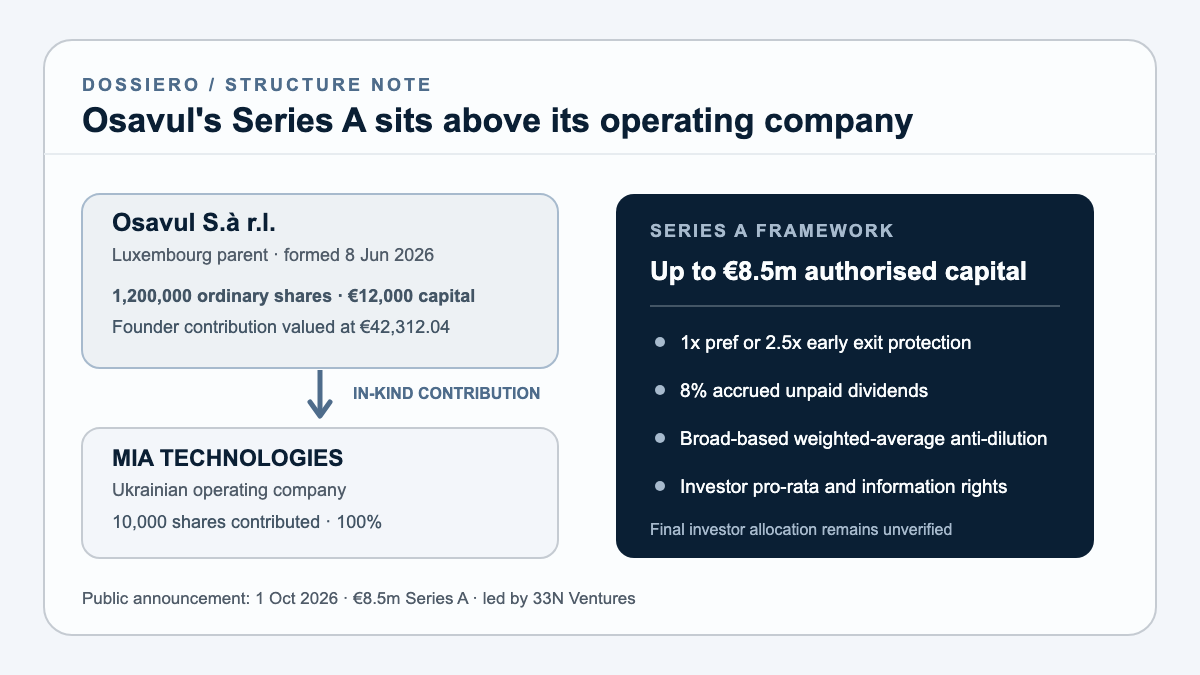
Osavul's public €8.5 million Series A was announced on 1 October, but the financing sits on a legal structure created months earlier. On 8 June 2026, founder Dmytro Bilash incorporated Osavul S.à r.l. in Luxembourg and contributed 100% of the Ukrainian operating company, MIA TECHNOLOGIES, into the new parent. The Luxembourg registration deed also set out a Series A framework with senior exit economics, accrued dividends and anti-dilution protection.
That sequence changes what the headline means. The company announcement and Balnord's investor note describe a round led by 33N Ventures with Balnord, G+D Ventures and existing investor 42CAP, taking total funding to about €12 million. SecurityWeek's independent report adds context on the company's hybrid cyber and physical threat-intelligence product. The filed deed answers a different question: what sits above the operating business, and which downside and conversion rights were designed before the investor-by-investor allocation became public?
The €8.5m headline sits above a new parent
Osavul presents the round as a move from government and defence customers into enterprise and critical-infrastructure markets. That commercial expansion is real in the public announcement. The legal record shows that the financing was not framed only as a new issue inside the existing Ukrainian company.
The official Luxembourg Business Registers publication records a new Luxembourg société à responsabilité limitée with a purpose that includes holding, managing and controlling foreign participations and raising debt. The deed was signed on 8 June, four months before the Series A announcement. Its initial state can be summarised as follows:
| Layer | Source-backed fact | Why it matters |
|---|---|---|
| Luxembourg parent | Osavul S.à r.l. was formed on 8 June 2026 with 1,200,000 ordinary shares at €0.01 each and €12,000 of initial capital | New financing and governance rights can sit at the parent rather than directly in the Ukrainian operating company |
| Founder contribution | Dmytro Bilash contributed 10,000 shares representing 100% of Ukrainian LLC MIA TECHNOLOGIES, registration 41371100 | The parent began with the operating company as an in-kind contribution, not an empty shell waiting for a later cash subscription |
| Contribution value | The deed values the contribution at €42,312.04, comprising €12,000 capital and €30,312.04 premium | The registered value is an opening balance-sheet figure, not a valuation of the later Series A |
| Authorised capital | The deed allows up to €8.5m of additional capital for five years and permits new classes and terms | The legal capacity matches the size of the announced round without proving that every authorised euro was issued |
The distinction between authorised capital and issued capital is central. The deed makes room for an €8.5 million financing and describes the securities that can be created. It does not, by itself, publish the final number of shares subscribed by 33N, Balnord, G+D Ventures or 42CAP. The later registration publications were listed in the sourcing run, but their payloads were not parseable, so the current record cannot allocate the round.
The founder moved the operating asset first
The most consequential filed fact is the in-kind contribution. Bilash subscribed the 1.2 million ordinary shares in the Luxembourg parent and paid for them by transferring 10,000 shares of MIA TECHNOLOGIES. The deed says those shares represented the entire Ukrainian company. It records €12,000 as capital and €30,312.04 as share premium, for a total contribution value of €42,312.04.
That is a structural change, not a statement about where Osavul's staff, customers or intellectual property physically sit. The public record supports a Luxembourg company owning the Ukrainian operating entity. It does not establish that the operating team moved, that contracts were novated, or that the founder retained a particular percentage after the Series A.
The sequence matters for diligence because the investor relationship now has two legal layers. A customer or lender assessing the Ukrainian business may need to understand its upstream ownership and any obligations to the Luxembourg parent. An investor subscribing at the parent level would receive rights against the parent and its share classes, while the value underneath depends on the operating company and its own contracts. The Osavul contact page still lists a Luxembourg registered address alongside the company's public operating story; that public presentation is consistent with a cross-border structure but does not replace the filed ownership evidence.
Series A protections were written into the charter
The deed establishes Pre-Seed, Seed and Series A classes. It describes Series A as senior and gives it a package of rights that can change the return order in a sale, early exit or down round. The rights are architectural evidence. They are not proof that every named investor received the same instrument.
| Series A term in the deed | Economic reading |
|---|---|
| 1x non-participating liquidation preference | A Series A holder can take its preference before ordinary holders, then choose the applicable conversion outcome rather than participate twice under a standard non-participating structure |
| 2.5x Early Exit Protection | A defined early-exit scenario can provide a larger protected return than the ordinary 1x preference, subject to the deed's conditions |
| 8% accrued unpaid dividends | Unpaid preferred dividends add a return claim over time before the remaining value is divided |
| Broad-based weighted-average anti-dilution | A later down round can adjust the conversion economics without the full ratchet effect of a one-for-one price reset |
| Pro-rata and information rights for major investors | Qualifying investors can seek continued participation and reporting, subject to the deed's thresholds |
| Special conversion condition involving 33N Ventures | One named lead has a deed-specific conversion condition, but the public record does not disclose its exercised outcome |
This is why the financing should not be reduced to the number in the press release. In a strong sale, ordinary holders may still receive value after the preference is satisfied. In a weak sale or an early exit, the 2.5x protection and accrued dividends can absorb more of the proceeds before ordinary shares participate. In a down round, the weighted-average adjustment can preserve more of a preferred holder's conversion position than a new common-equity holder would have.
None of those outcomes is a forecast. The deed shows the rights that can shape them. The missing variable is the issued share count and the allocation among investors. Without that state, no public source can responsibly say whether Bilash, Plieshakov, 33N or any other holder controls a majority, or what percentage of the parent each investor owns.
Why the holding-company wrapper changes the financing question
The benign reading is straightforward: a Luxembourg parent can be a standard institutional-financing and governance wrapper for a company with Ukrainian operations and international customers. It can give investors a familiar European top-company, centralise the share classes and provide a stable place for future capital raises. The deed contains no evidence of distress, misconduct or a hidden transfer of control.
That benign reading does not make the structure economically neutral. The parent is where the new money and preference rights are designed to sit. The operating company is the asset contributed into that parent. This separates the place where revenue and customer obligations arise from the place where investor exit economics and future capital decisions are recorded.
For counterparties, the diligence checklist therefore expands:
- Identify whether a contract, licence or security is held by MIA TECHNOLOGIES or Osavul S.à r.l.
- Read the parent-level share classes and any later issuance deed before treating the €8.5 million as ordinary equity.
- Test whether the Series A preference, accrued dividend and anti-dilution terms rank ahead of the ordinary shares that represent the founder's contribution.
- Separate the public list of investors from the legally documented subscription and voting position.
Other structures on Dossaro show why that separation matters. Headline's EU VIII records distinguish a Luxembourg fund from the entities associated with its manager, while Restate's Series A parent and operating-company record shows how a headline financing can sit across more than one legal layer. Those articles do not prove Osavul's investor allocation. They provide a useful comparison for reading a parent-level financing without collapsing every entity into one balance sheet.
What the public record still cannot answer
The current evidence proves the legal architecture and the rights framework. It does not prove the final cap table after the October round. The later Luxembourg publications would be decision-changing if their payloads disclosed the Series A issue, subscriber identities, share counts, voting rights or any change to the managers. They were not available in parseable form in this sourcing run.
The next document watchpoint is therefore a later share-issue deed, updated articles, share register, prospectus or investor filing. It should show how much of the authorised €8.5 million was issued, whether the named investors subscribed directly or through vehicles, and how the 33N conversion condition operates in practice. Until that record appears, the strongest defensible conclusion is narrow but material: Osavul's €8.5 million Series A was built on a Luxembourg parent that already held the founder's entire Ukrainian operating company, with senior preference and dilution protections written into the parent-level financing framework.
Continue reading
Related Research
Headline's $400m Fund Is Real. Its Manager Map Is Not Yet Singular
Headline's $400m EU VIII is an active Luxembourg AIF, but CSSF and CNMV records map it to two AIFM relationships while LP economics remain undisclosed.
NEURA's Bosch Shuttle Deal Lands on a Newly Syndicated Capital Base
NEURA's Bosch Shuttle deal adds a proven logistics platform to a company whose 2026 register widened around five new vehicles while Bosch held 0.11% nominal equity.
Restate’s $20m Series A Meets a 79.552% Delaware Parent Stake
Restate's $20m Series A follows a German register snapshot where Delaware parent Restate Software held 79.552%, leaving the round's operating-company cap table unproven.
Syte’s €9m Series A Gave amberra and NRW.BANK Equal 7.02% Blocks
syte’s €9m Series A gave amberra and NRW.BANK equal 7.02% nominal blocks, while founder vehicles still held 30.8% in the latest filed ownership list.