
Headline's $400m Fund Is Real. Its Manager Map Is Not Yet Singular
Headline's $400m EU VIII is an active Luxembourg AIF, but CSSF and CNMV records map it to two AIFM relationships while LP economics remain undisclosed.
On this page
Conduct your own private market research
Add dossaro to Claude or ChatGPT and run source-backed register research from your own workspace.
 Add to Claude
 Add to ChatGPT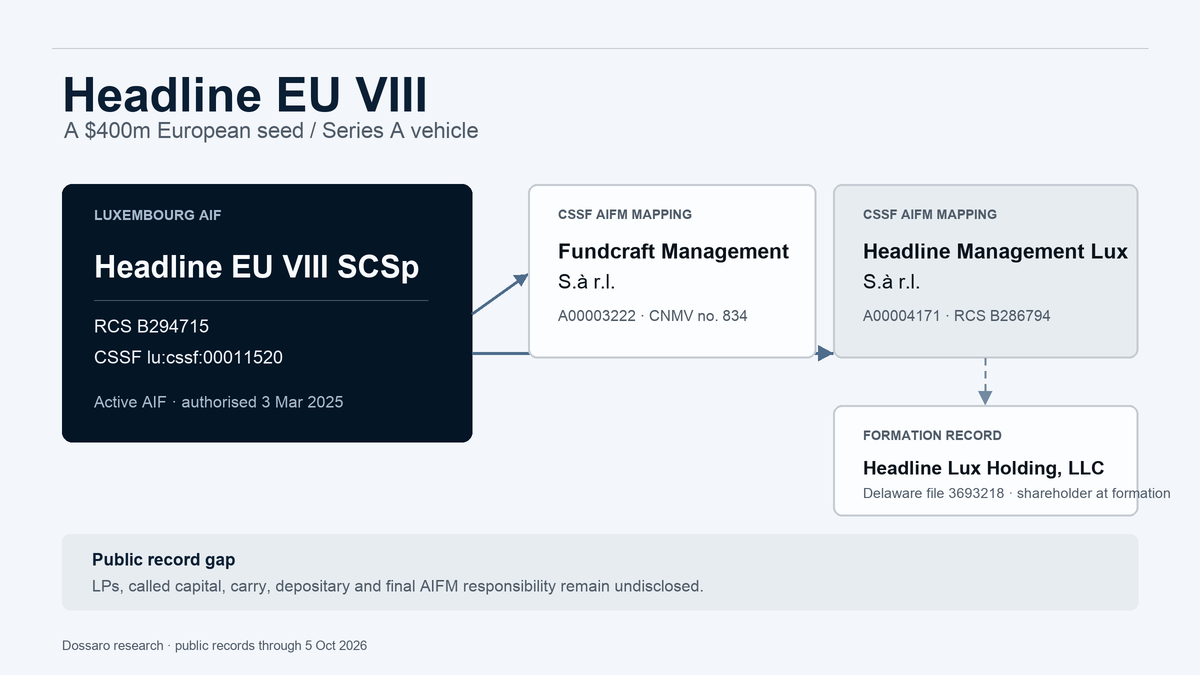
Headline’s $400 million European fund is not just a launch announcement. Public records place the vehicle in a real, active Luxembourg alternative investment fund structure, but they do not give the market one clean answer to the question “who manages it?” The CSSF relationship feed maps Headline EU VIII SCSp to two AIFM relationships, while Spain’s CNMV register identifies Fundcraft Management S.à r.l. as the management company for the fund’s professional-client offering.
That split is the research finding. It does not prove a dispute, a change of control or a hidden owner. It shows that the Headline brand, the Luxembourg fund entity, a Delaware-linked Headline manager and a regulated service provider occupy different layers of the public record. The missing layer is the one investors and competitors usually want most: the final operating allocation of responsibility, the LP commitments, the carried-interest economics and the fund’s portfolio capacity.
The $400m announcement describes investment capacity, not governance
Headline’s public profile describes a multi-region early-stage platform investing from seed through Series A, with separate later-stage growth capacity. Tech.eu’s account of the close reports that Headline EU VIII closed at $400 million and will back European seed and Series A companies, with a strong artificial-intelligence focus. The same article places Headline’s overall assets under management above $5 billion.
Those facts establish the commercial scale of the announcement. They do not establish who committed capital, how much has been called, what portion is reserved for follow-on rounds or whether the headline amount is already investable by every regional team. A fund close is an investment-capacity statement. The legal and regulatory records have to answer the operating questions separately.
The exact fund is Headline EU VIII SCSp, Luxembourg RCS B294715. A public Luxembourg profile identifies it as an active société en commandite spéciale at 19 Rue Aldringen, L-1118 Luxembourg, with a registration publication dated 24 March 2025. The CSSF supervised-entities register identifies the same vehicle as an active alternative investment fund, with authorisation dated 3 March 2025 and identifier lu:cssf:00011520.
The Spanish regulator provides an independent check. The CNMV register lists Headline EU VIII SCSP as foreign alternative investment fund no. 6367, registered in Luxembourg on 11 July 2025 and offered exclusively to professional clients. It names Fundcraft Management S.à r.l. as the management company, with official register no. 834 and a registered office in Bertrange.
One fund, two AIFM relationships
The current CSSF relationship search is more complicated than the CNMV presentation. It returns two source-backed fund-to-AIFM mappings for lu:cssf:00011520:
| Public record layer | Entity | Identifier | What the record supports |
|---|---|---|---|
| Fund register | Headline EU VIII SCSP | RCS B294715; CSSF lu:cssf:00011520 | Active Luxembourg AIF, authorised 3 March 2025 |
| CSSF AIFM mapping | Fundcraft Management S.à r.l. | Relationship A00003222 | Regulatory service-provider relationship; authorised 22 March 2022 |
| CSSF AIFM mapping | Headline Management Lux S.à r.l. | Relationship A00004171 | Regulatory service-provider relationship; authorised 7 June 2024 |
| CNMV foreign-fund record | Fundcraft Management S.à r.l. | CNMV register 834 | Management company named for the professional-client offering |
The two CSSF rows are not proof that both entities share ownership of the fund or that both have identical responsibilities. The source describes them as AIFM relationships, but the public feed does not expose a final delegation schedule, depositary appointment or operating split. It is therefore safer to describe the result as a split manager map than to choose one row and treat the other as noise.
The counter-reading matters. Identifier feeds can preserve a former relationship, a delegated arrangement or a transition between service providers. The existence of two rows may reflect regulatory history rather than simultaneous day-to-day management. The public evidence supports the presence of both mappings. It does not resolve their effective dates, priority or scope.
Headline’s Luxembourg company adds a second layer
The second CSSF-linked entity is not the fund itself. Headline Management Lux S.à r.l., Luxembourg RCS B286794, was constituted on 3 June 2024 with EUR 12,000 of capital divided into 12,000 fully paid shares. Its formation record identifies Headline Lux Holding, LLC, a Delaware company with file no. 3693218, as the sole shareholder at formation.
The corporate purpose is broad. It covers holding, acquiring and managing participations, investing in companies and providing portfolio-management or control-related services. That language is consistent with a management or holding platform, but it is not a beneficial-ownership statement about Headline EU VIII. It does not disclose the fund’s limited partners, the general partner’s carry, a shareholder agreement or the economic terms under which Headline Management Lux may act for the vehicle.
This distinction is easy to lose because the same Headline name appears in the fund brand, the Luxembourg company and the Delaware holding chain. The records establish an entity relationship and a regulatory mapping. They do not turn the brand into a complete cap table.
Why the missing LP economics matter
The headline close changes the competitive context for European seed investors. A $400 million vehicle can support larger initial cheques, longer reserves and a credible signal to founders building in artificial intelligence. But the public record still cannot answer four commercially important questions:
- Who supplied the capital? No public source reviewed here names the LPs or their commitment amounts.
- What is the called capital? The announcement gives a close size, not the amount already drawn for investments.
- Who carries final responsibility? The CSSF feed shows two AIFM relationships, while the CNMV record presents Fundcraft as the management company. The final operating allocation is not public.
- What is the investment shape? The public sources describe seed and Series A focus, but not regional allocations, reserve ratios, ownership targets or portfolio concentration.
That information gap is economically meaningful. A fund can be large on paper and still have a different deployment pace, reserve policy or governance model from the one inferred by a founder reading the announcement. The gap also matters to competing managers assessing Headline’s hiring, cheque-size and follow-on capacity.
Other public fund records show why the legal wrapper deserves separate attention. Runway Venture Capital’s Fund II structure distinguishes the UK manager from the AIF vehicle, while E2D’s €500 million fund shows how a Luxembourg structure can expose an AIFM without exposing LP economics. Claret Fund IV demonstrates the same boundary from the manager-economics side: a public fund announcement can describe strategy and scale while leaving carry, commitments and control terms private.
The safe conclusion is narrower than the headline
Headline EU VIII is a real, active and regulated Luxembourg AIF associated with a $400 million European early-stage close. The public records also show a Headline-linked Luxembourg manager company and a separate Fundcraft management-company record. Taken together, they make the vehicle more legible, not fully transparent.
The strongest defensible conclusion is therefore not “Headline has two managers” and not “the fund’s ownership is hidden.” It is this: the public manager map is not singular, and the records do not yet show which entity carries final operating responsibility or who supplied the capital. That is enough to change how the fund should be read by founders, rival managers and researchers, without claiming facts the records do not contain.
The next document that would change the story is a current Luxembourg fund publication or regulatory filing that states the effective AIFM appointment, delegation terms or depositary. A partnership agreement, offering memorandum or verified LP disclosure would then move the analysis from regulatory architecture to fund economics. Until such a document becomes public, the $400 million figure should be treated as verified investment capacity with unresolved governance and ownership detail.
Continue reading
Related Research
RunwayVC's €40m Fund II Sits Behind A NOK30,000 Fund Vehicle
RunwayVC's €40m Fund II is registered as a NOK30,000 alternative-investment vehicle, while a separate five-person manager carries the governance layer.
E2D's €500m Defence-Fund Target Has a Luxembourg Vehicle, Not a Public LP Ledger
E2D’s €500m defence-fund target now has a Luxembourg vehicle, an IQ EQ AIFM and a July first close, but LP commitments and allocation control remain undisclosed.
Claret's €575m Fund IV Close Sits Beside a £4.46m Profit Jump
Claret's €575m close expanded lending capacity, while UK filings show £4.46m manager profit, £1.31m ordinary dividends and a €6.7m commitment.
DIG's $120m Fund III Was Built Beside a New UK Investment Vehicle
DIG's $120m Fund III launched beside a new UK company whose sole shareholder is the Guernsey fund LP, while its older adviser reported £988,744 due after one year.