
Claret's €575m Fund IV Close Sits Beside a £4.46m Profit Jump
Claret's €575m close expanded lending capacity, while UK filings show £4.46m manager profit, £1.31m ordinary dividends and a €6.7m commitment.
On this page
Conduct your own private market research
Add dossaro to Claude or ChatGPT and run source-backed register research from your own workspace.
 Add to Claude
 Add to ChatGPT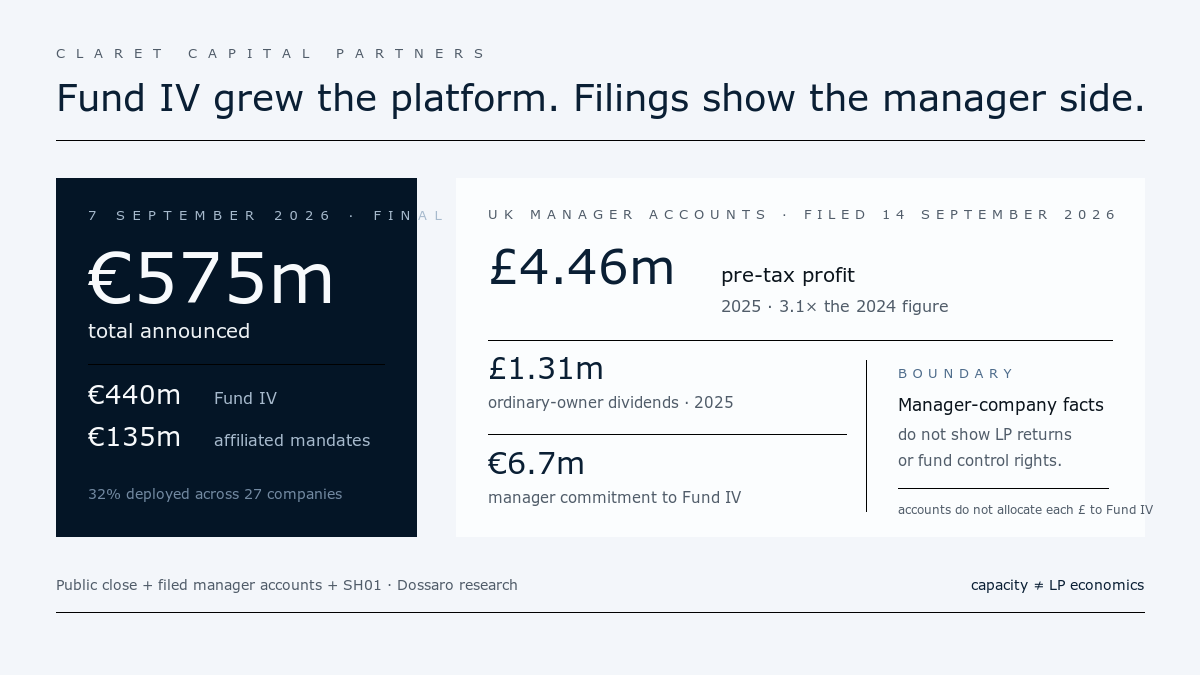
Claret Capital Partners' €575 million final close enlarged its growth-debt platform, but the UK manager's latest accounts show a second economic layer. The 2025 filing reports £4.46 million of pre-tax profit, up from £1.46 million in 2024, £1.31 million of ordinary-shareholder dividends, and a further €200,000 commitment to Fund IV that took the company's commitment to €6.7 million.
Those figures do not prove that Fund IV alone caused the profit increase, that the dividend was paid from the close, or that limited partners earned a particular return. They do show why the headline should be split between the capacity raised for borrowers and the economics visible at the manager company. Claret's announcement describes €440 million of Fund IV commitments plus €135 million of affiliated discretionary mandates. The accounts then show how fee timing, distributions and manager balance-sheet exposure sit alongside that capital.
The €575m headline contains two different pools
Claret announced the final close on 7 September 2026. Its statement says Fund IV accounts for €440 million and affiliated discretionary mandates for €135 million, with 32% of Fund IV capital deployed across 27 companies. It also says the group has raised more than €1.3 billion since inception. The second-close announcement had described Fund IV as above €350 million and more than €115 million of discretionary co-investment partnerships, before the final close separated the two components at €440 million and €135 million.
The distinction matters for anyone reading the total as a single fund. A mandate can give Claret capital to deploy without carrying the same vehicle, fee, governance or reporting terms as Fund IV. The public announcements do not set out the mandate agreements, so this article does not treat the €575 million as a single LP pool or use it to infer a precise investor allocation.
The Next Web independently confirms the €440 million and €135 million split, the 32% deployment figure and the private-wealth and ELTIF context. Alternative Credit Investor likewise reports the final close and the growth-debt strategy. Those sources corroborate the public event. They do not disclose a fund-level waterfall or the manager's fee share.
Filed accounts expose the manager-side change
The Companies House accounts for the year ended 31 December 2025 were filed on 14 September 2026. They report a pre-tax profit of £4,456,918, compared with £1,460,853 in 2024. Profit after tax rose to £3,081,524 from £942,581, and net assets to £7,665,697 from £1,814,448. Average employees increased from 23 to 29.
| Manager-company measure | 2025 filed figure | 2024 comparator | What the record supports |
|---|---|---|---|
| Pre-tax profit | £4,456,918 | £1,460,853 | A £2,996,065 increase, or 3.05x the prior year |
| Profit after tax | £3,081,524 | £942,581 | A £2,138,943 increase |
| Net assets | £7,665,697 | £1,814,448 | A £5,851,249 increase |
| Average employees | 29 | 23 | Six more average employees |
| Ordinary-owner dividends | £1,307,770 | Not stated in this comparison | A distribution recorded in the 2025 accounts |
The accounts attribute the higher result to the full-year management-fee impact of a growth-capital fund launched in 2024 and to catch-up management fees after the successful second close. That is unusually useful context for a fund-close story: the manager itself says fee timing and the maturation of the platform were part of the result. It is still not a line-by-line attribution to Fund IV. Other funds, mandates and group activities can sit inside the reported period.
The arithmetic makes the scale visible without turning correlation into causation. Pre-tax profit was about 3.1 times the 2024 figure. That movement coincided with the fundraising sequence, but the accounts do not say that the final close generated a particular amount of profit, nor do they provide an LP return measure.
Dividends and commitment are separate from LP economics
The same accounts record £1,307,770 of dividends to ordinary shareholders in 2025. They also record £86,776 of preference dividends treated as debt and disclose a further £1 million dividend declared after year-end on 6 February 2026. The 2025 ordinary distribution equals about 42.4% of reported profit after tax, a simple comparison rather than evidence of a standing payout policy.
The filing also says the manager committed a further €200,000 to Fund IV on 26 February 2026, taking the company commitment to €6.7 million. It lists a £2,848,583 Fund III commitment, a £1,207,729 Annex Fund commitment and a £5,668,044 Fund IV commitment at first close before the later increase. Because the historical figures are in pounds and the public fund headline is in euros, no precise commitment percentage should be calculated from them.
These are three different cash paths:
- Management fees and catch-up fees are revenue at the manager company.
- Dividends transfer value from the manager company to its ordinary owners, subject to the rights and accounting treatment recorded in the filing.
- A Fund IV commitment sends manager capital into the fund and exposes the company to that investment's outcome.
One path cannot stand in for another. Ordinary-owner dividends are not proof of LP distributions. The €6.7 million commitment is not proof that Claret or any individual shareholder controls Fund IV. And the reported fee increase is not a valuation of the management company.
The capital note shows why “owner” is not one economic position
The statement of capital filed as an SH01 on 2 January 2026 records an allotment beginning 15 December 2025. It shows 1,170 Ordinary A shares allotted with £0 paid and £80.84 unpaid, and 1,170 Ordinary D shares with £24.26 paid. The resulting statement of capital lists 100,000 Ordinary A, 11,110 Ordinary B and 1,170 Ordinary D shares.
The classes do not carry identical rights. Ordinary A and B participate in hurdle and pro-rata economics. Ordinary B and D carry no votes, while D carries no dividend income and participates only above the hurdle. That structure is a reminder that a reported ordinary dividend does not reveal the full owner-by-owner waterfall, and a share count does not establish control without the articles and shareholder register.
This is the same reason a financing headline should be read through its rights. In Foundever's lender-equity recapitalization, lenders receiving 40% of equity changed who bore future risk without proving day-to-day control. Claret's manager filing presents the mirror question: value can move through fees, dividends and commitments while legal ownership and fund-level rights remain separate.
Fund IV remains legally distinct from the manager
Public Luxembourg and Spanish records identify Claret European Growth Capital Fund IV as a separate vehicle. The Luxembourg RCS reference is B282781, its LEI record identifies the fund, and the CNMV lists it as foreign AIF no. 5472 for professional clients with IQ EQ as manager/AIFM. Those records support the legal separation between the fund and Claret Capital Partners Limited.
They do not reveal the LP-by-LP commitment schedule, the partnership agreement, GP reserved matters, carried-interest terms or the allocation of the €135 million mandates. The public ELTIF reference adds product context, but it does not turn a manager commitment into a sponsor stake. E2D's fund/AIFM separation shows why vehicle identity and control rights should be tracked independently from the size of a fund announcement.
The commercial consequence is practical. Borrowers can read the close as more available growth-debt capacity, and the 32% deployment figure indicates that capital is already being put to work. A manager-company reader should also recognise the fee and distribution engine that grows around that capacity. An LP, by contrast, still needs the vehicle documents to understand fees, priority, carried interest and governance.
What the public record still cannot answer
The evidence supports a strong but bounded conclusion: Claret's close enlarged a lending platform whose manager reported materially higher profit, ordinary-owner distributions and a larger Fund IV commitment. It does not support a claim about LP performance, a personal shareholder's return, or a control shift at the fund.
The next decision-changing documents would be the Fund IV partnership agreement, a Luxembourg filing with LP or GP rights, or a UK accounts note that allocates fees and commitments by vehicle. A later confirmation statement could clarify how the A, B and D rights are held, but it would still not replace the fund agreement. Another press release repeating €575 million would add freshness, not the missing economics.
Until those documents appear, the cleanest reading is two-track. Fund IV and the affiliated mandates describe capital that Claret can deploy. The UK accounts describe what the platform did for the manager company and its owners. The close made both visible at once, but they remain different claims with different evidence thresholds.
Sources
- Claret final-close announcement reports the €575 million total, €440 million Fund IV, €135 million mandates and 32% deployment.
- Claret second-close announcement provides the earlier Fund IV and co-investment context.
- The Next Web independently confirms the close split and deployment context.
- Alternative Credit Investor reports the growth-debt strategy and final-close context.
- Companies House profile and filing history identify the manager; the 2025 accounts and SH01 supply the filed figures and capital rights.
- Luxembourg RCS search, LEI record and CNMV Fund IV record provide vehicle and AIFM context.
Continue reading
Related Research
Foundever's Debt Rescue Gave Participating Lenders 40% of Equity
Foundever cut nearly $900m of debt, while S&P says participating lenders received 40% of equity and existing owners invested $225m as maturities moved to 2030 and 2031.
CloudNC’s $20m announcement sits beside a voting preferred-share filing
CloudNC announced $20m, while its latest SH01 records 44.9m voting Series B shares with priority economics, no named allottees and no direct currency match.
E2D's €500m Defence-Fund Target Has a Luxembourg Vehicle, Not a Public LP Ledger
E2D’s €500m defence-fund target now has a Luxembourg vehicle, an IQ EQ AIFM and a July first close, but LP commitments and allocation control remain undisclosed.
PaperShell's €40m EU Grant Leaves A €43m Financing Test
PaperShell's signed 2025 annual report links an €83m factory and €40m EU grant to a planned IPO, while private capital must still fund roughly half.