
E2D's €500m Defence-Fund Target Has a Luxembourg Vehicle, Not a Public LP Ledger
E2D’s €500m defence-fund target now has a Luxembourg vehicle, an IQ EQ AIFM and a July first close, but LP commitments and allocation control remain undisclosed.
On this page
Conduct your own private market research
Add dossaro to Claude or ChatGPT and run source-backed register research from your own workspace.
 Add to Claude
 Add to ChatGPT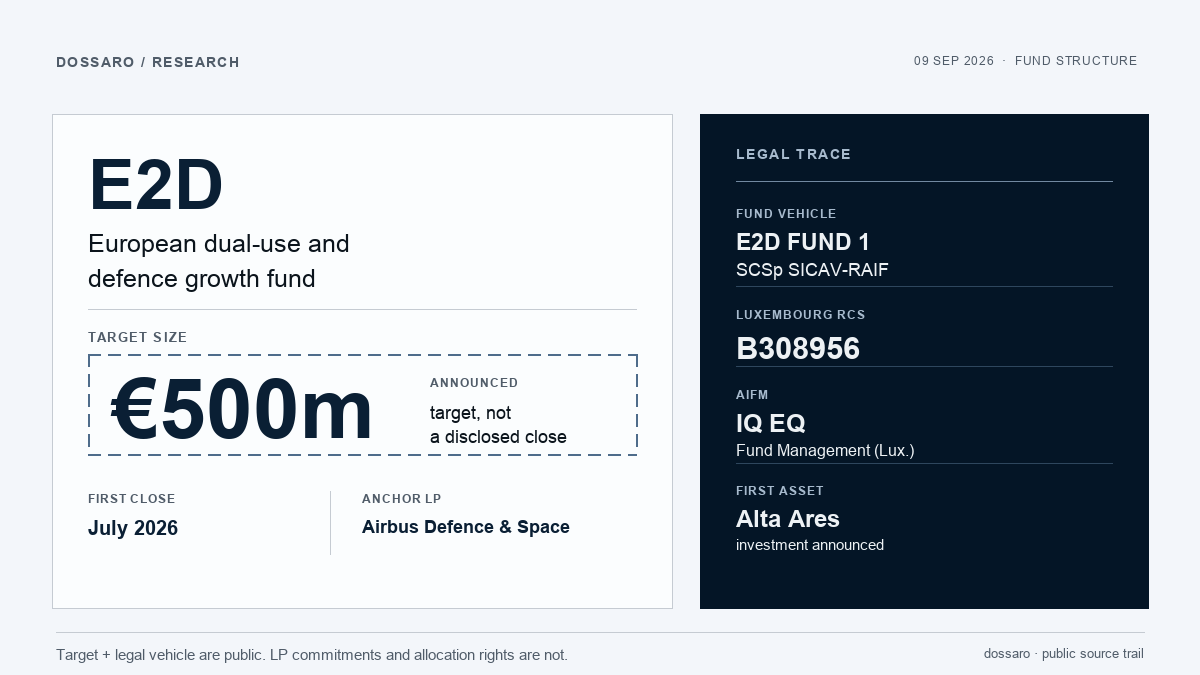
E2D is now more than a defence-fund launch headline. The public record describes a €500 million target, a July 2026 first close, Airbus Defence and Space as an anchor investor and a first investment in French counter-drone company Alta Ares. Luxembourg and CSSF records also identify the fund vehicle and its alternative investment fund manager. What they do not show is the amount closed, the limited-partner commitment ledger or the allocation rights behind the fund.
That distinction changes the useful question for founders, LPs and defence suppliers. E2D is a traceable investment vehicle with capital already moving into a portfolio company, but the €500 million remains a target size rather than a disclosed pool of paid-in or callable capital. The structure tells us where deployment is organised. It does not yet tell us who can direct the next euro.
A target fund became a live deployment vehicle
AVP and Earlybird announced E2D on 18 June 2026 as a European dual-use and defence technology growth fund with a target size of €500 million. Their launch release says the fund intends to back about 20 companies with average investments of approximately €25 million across space, air, land, maritime and subsurface technologies. Twenty investments at €25 million is consistent with the stated target, but neither figure is a commitment amount.
The same release said a first close would take place on 30 June. The later Airbus announcement on 21 July confirmed that Airbus Defence and Space had signed an agreement to become the anchor investor. It also named Alta Ares as E2D’s first investment. A 4 September account from DLA Piper says the Luxembourg-domiciled fund completed its first closing in July.
The chronology supports a narrow but important conclusion: the fund moved from launch to first close and then to a disclosed first asset during the summer. It does not establish how much of the target was closed in July. Airbus has not disclosed the size of its commitment, and the manager has not published an LP-by-LP total.
The legal vehicle answers “which fund?”
Production Dossaro research resolved the legal wrapper as E2D FUND 1 SCSp SICAV-RAIF, Luxembourg RCS B308956, a société en commandite spéciale at 412F Route d’Esch, L-1471 Luxembourg. The Luxembourg Business Registers is the official register portal for the RCS identity. The CSSF research path resolved the vehicle as active alternative investment fund 00013419 and mapped it to IQ EQ Fund Management (Luxembourg) S.A. as AIFM; the regulator’s supervised-entities directory is the relevant public register context.
Those facts are more useful than a brand-only search. The fund is not just an E2D label attached to the AVP and Earlybird websites. It is a Luxembourg partnership and regulated-fund structure with a named manager. The AIFM relationship also separates the vehicle that holds the investment programme from the advisers and sponsors that communicate the strategy.
The legal trace has a hard limit. Profile enrichment and historical-document retrieval were not available in the Dossaro run, so the public record does not expose a complete LP list, beneficial-owner schedule, depositary terms, capital-account split or investor consent matrix. An identifiable vehicle is not the same thing as an identifiable control map.
That distinction also appears in RunwayVC Fund II’s AIF structure, where the registered fund company and its separate manager explain the legal architecture without revealing every LP right. The structure is evidence about where decisions are made, not proof of who owns a particular percentage.
Airbus is an anchor, not a disclosed cheque
The July milestone gives E2D a strategic investor with an obvious industrial reason to participate. Airbus Defence and Space said the investment complements its own direct mergers-and-acquisitions work and is intended to keep European capital, talent and intellectual property on the continent. AVP’s milestone release uses the same anchor-LP description and links the fund to the European sovereignty argument.
Neither release states the amount Airbus committed. That missing number matters because “anchor” describes position and signalling, not necessarily a majority of commitments, a veto right or a particular share class. The announcement also does not say whether Airbus receives preferential access to pipeline companies, information rights, a strategic committee seat or a right to approve investments.
The independent Avitrader report confirms the target, the anchor role and the approximately €25 million average investment language. It likewise does not disclose the cheque size. The source trail therefore supports Airbus’s strategic role while preserving the economic boundary around its commitment.
Alta Ares proves deployment, not fund control
E2D’s first disclosed asset is Alta Ares, a French company developing AI-enabled hardware and software for intelligence, surveillance and reconnaissance missions and counter-uncrewed-aircraft systems. Airbus says the investment follows a memorandum of understanding with Alta Ares to develop and integrate European counter-drone solutions into Airbus’s battle-management suite.
That relationship explains why a strategic anchor and a first portfolio company appear in the same announcement. It does not tell us the investment size, the percentage held by E2D, whether Airbus invested separately in Alta Ares or which governance rights attach to the fund’s position. The AVP and Earlybird launch account says the fund will target growth-stage companies, but it does not turn the first investment into a disclosed control transaction.
The difference between deployment and control is important for a defence supplier considering E2D as a financing source. A first investment shows that the vehicle can execute and that at least one company fits its mandate. It does not show how much dry powder remains, how follow-on reserves are allocated or whether the fund will lead future rounds.
What the public record establishes
| Evidence point | Publicly supported position | What remains unproven |
|---|---|---|
| Fund target | €500m target announced by AVP and Earlybird | Amount actually closed or callable |
| Portfolio design | About 20 companies at roughly €25m average tickets | Ticket size or ownership in any asset |
| First close | Completed in July 2026, according to DLA Piper | First-close amount and LP split |
| Strategic investor | Airbus Defence and Space is described as anchor LP | Commitment amount, rights or vetoes |
| First asset | Alta Ares is E2D’s first announced investment | Price, stake and governance terms |
| Legal architecture | Luxembourg E2D Fund 1, RCS B308956; CSSF 00013419; IQ EQ AIFM | LP ledger, depositary, beneficial owners and allocation controls |
The table is a practical diligence boundary. It keeps “target”, “first close” and “first investment” as three different states instead of treating them as one €500 million cash event. It also separates the legal manager from the investors whose commitments remain private.
Why the split matters for European defence capital
E2D’s stated mandate is growth capital for companies that need to cross from technical proof to procurement scale. That is a different risk profile from an early-stage seed fund. An average ticket of €25 million can support manufacturing, certification, export preparation and the long sales cycles of defence customers. Airbus’s industrial participation can add a route to technical validation or prime relationships, even if the public documents do not promise those benefits to every portfolio company.
For a founder, the relevant diligence question is now structural: is E2D underwriting a round, reserving follow-on capital or coordinating a broader syndicate? For an LP, the question is how the AIFM, the advisers and the strategic committee divide investment authority. For a defence prime, the question is whether the fund’s capital can be paired with integration or procurement access without creating a conflict in the investment process.
The comparison with Mustard Seed + Partners Fund I is instructive. Mustard Seed’s public record also identifies a Luxembourg vehicle and a manager while leaving LP-by-LP rights private. In both cases, the legal wrapper makes the fund searchable; it does not make the capital account public. Auxxo’s Fund II structure shows the same underwriting discipline from another angle: a reported close is not automatically a transparent list of commitments.
The missing commitment ledger is the real story
E2D has crossed three meaningful milestones: a stated €500 million target, a July first close and a first investment in Alta Ares. The Luxembourg RCS and CSSF relationship add a fourth fact that press coverage alone would miss: the fund has a precise vehicle and a named AIFM. That is enough to make the fund legally traceable and operationally credible.
It is not enough to calculate who controls the fund or how much capital remains. The public sources do not disclose the first-close amount, Airbus’s cheque, the LP commitment schedule, management-fee or carry arrangements, portfolio stakes, or investor-consent rights. Nor do they establish that the full €500 million is raised, paid in or available for new deals.
The next decision-changing evidence is concrete: a fund prospectus or partnership agreement, audited or regulatory accounts, a CSSF filing that exposes the capital structure, and a portfolio announcement with consideration or ownership terms. Until those documents appear, the defensible reading is simple. E2D is a real Luxembourg fund that has begun deploying capital into European defence technology, while the economic power behind that deployment remains private.
Continue reading
Related Research
Mustard Seed's €150m First Close Is Already a Deployment Vehicle
Mustard Seed + Partners says nearly €150m is closed and €55m is deployed, but public records still leave LP commitments and fund control unallocated.
RunwayVC's €40m Fund II Sits Behind A NOK30,000 Fund Vehicle
RunwayVC's €40m Fund II is registered as a NOK30,000 alternative-investment vehicle, while a separate five-person manager carries the governance layer.
Auxxo's €33.3m Fund Close Shows Why LP Count Is Not Capital Control
Auxxo's €33.3m Female Catalyst Fund II closed after staged LP entries, but Berlin filings show nominal Haftsumme is not a map of capital or control.
Claret's €575m Fund IV Close Sits Beside a £4.46m Profit Jump
Claret's €575m close expanded lending capacity, while UK filings show £4.46m manager profit, £1.31m ordinary dividends and a €6.7m commitment.