
Allogenetics’ €3.8m Round Sits Beside NBank’s 5.78% to 17.32% Shift
Allogenetics’ €3.8m Pre-Series A coincided with NBank Capital rising from 5.78% to 17.32% and the founder falling to 23.05%. The register shows dilution, not price.
On this page
Conduct your own private market research
Add dossaro to Claude or ChatGPT and run source-backed register research from your own workspace.
 Add to Claude
 Add to ChatGPT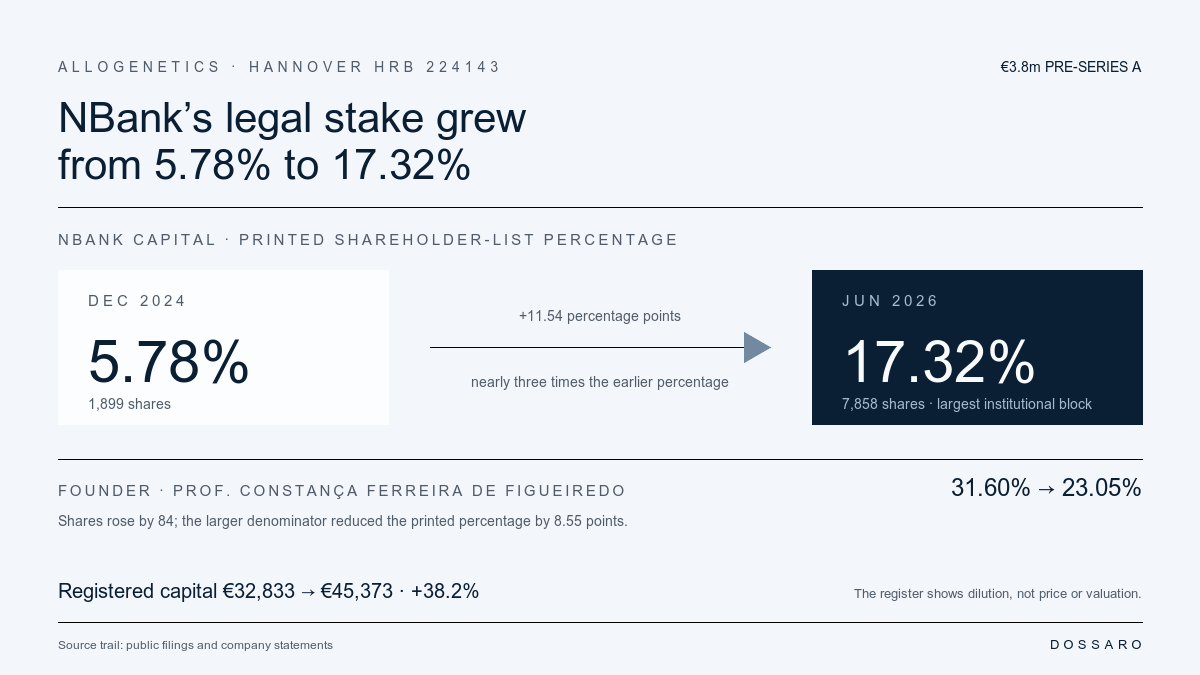
Allogenetics’ €3.8 million Pre-Series A is publicly framed as a step toward clinical development. The company announced the round on 9 September 2026, naming NBank Capital as lead and CARMA FUND and Life Science Valley Wachstumsfonds as participants. The latest accessible shareholder list, filed several months earlier, shows why the financing matters beyond its headline: NBank’s legal stake rose from 5.78% in December 2024 to 17.32% in June 2026, while founder Prof. Constança Ferreira de Figueiredo’s percentage fell from 31.60% to 23.05%.
The register does not disclose the price paid, valuation or investor rights. It does show a 38.2% expansion in registered capital, from €32,833 to €45,373, and identifies a much larger NBank block. The strongest defensible reading is therefore a capital and ownership shift that is consistent with the new financing, not a claim that the April issuance equals the entire €3.8 million round.
The financing headline arrived after a measurable legal change
In its 9 September announcement, Allogenetics said the Pre-Series A will move lead programme ALG-115 through IND-enabling studies toward first-in-human lung-transplant trials planned for the end of 2027 or early 2028. NBank Capital led the round, with CARMA FUND, Life Science Valley Wachstumsfonds and additional corporate and private investors participating. The company describes ALG-115 as a one-time ex vivo gene-therapy approach intended to reduce or eliminate lifelong immunosuppression.
An independent transkript report confirms the €3.8 million amount, NBank’s lead role, the named funds and the intended clinical path. The commercial announcement is current. The legal record sits earlier in the timeline: a shareholder list taken into the Hannover register folder on 4 June 2026 records a 14 April notarial deed and total capital of €45,373.
That sequence is useful but not conclusive. A shareholder list can capture only one capital action within a financing process. It may also reflect a subscription, conversion or other issuance whose commercial terms are not printed in the list. The dates support a connection by chronology; they do not prove that each share in the June list was bought with proceeds from the September-announced round.
NBank’s position nearly tripled in the latest list
The December 2024 list records NBank Capital with 1,899 shares, printed at 5.78% of the company. The June 2026 list records 7,858 shares and 17.32%. That is an increase of 5,959 shares and 11.54 percentage points. The percentage is almost three times the earlier position: 17.32 divided by 5.78 is about 3.00.
CARMA Fund I, which was already alongside NBank in the 2024 financing, also expanded. Its line grew from 1,899 shares, or 5.78%, to 3,306 shares, or 7.29%, an increase of 1,407 shares and 1.51 percentage points. Together, the two public round leaders moved from a combined 11.56% to 24.61% in the two lists.
| Holder or denominator | December 2024 list | June 2026 list | Change | What the register supports |
|---|---|---|---|---|
| Registered capital | €32,833 | €45,373 | +€12,540, or +38.2% | A larger nominal-share denominator |
| NBank Capital | 1,899 shares / 5.78% | 7,858 / 17.32% | +5,959 shares; +11.54 pp | A materially larger legal block |
| CARMA Fund I | 1,899 shares / 5.78% | 3,306 / 7.29% | +1,407 shares; +1.51 pp | A larger co-investor position |
| Constança F. de Figueiredo | 31.60% | 23.05% | −8.55 pp | Percentage dilution; shares rose by 84 |
| Technovera | 33.91% | 27.64% | −6.27 pp | Percentage dilution in a large existing block |
| Ascension | 8.91% | 6.45% | −2.46 pp | Percentage dilution; shares unchanged |
The table compares the printed percentages and share counts in the two Dossaro-sourced lists. Percentage-point changes are arithmetic on those rounded values. They are not returns, valuations or voting-control measurements.
The founder kept shares but lost relative weight
The founder line shows the practical consequence. Figueiredo’s percentage moved from 31.60% to 23.05%, a fall of 8.55 percentage points. The underlying number of shares rose by 84, so the list does not show a founder sale. The change is dilution in the narrow register sense: the total denominator grew faster than the founder’s holding.
Technovera, at 33.91% in the December list, remained a major holder but printed at 27.64% in June. Ascension fell from 8.91% to 6.45% while its share count was unchanged. These movements make the new NBank block more legible. The issue did not merely add a small investor line; it enlarged the company around a new institutional position while reducing the relative weight of earlier holders.
The conclusion still has to stop at the legal holder level. The register names the shareholding vehicles. It does not establish who ultimately controls each vehicle, how votes are coordinated or whether any shareholder agreement gives a holder rights beyond the printed percentage. A larger stake can improve influence, but the documents available here do not establish board appointment rights, reserved matters or unilateral control.
Registered capital is not the €3.8m cheque
The €12,540 increase in nominal capital and the €3.8 million financing headline answer different questions. German GmbH shares can be issued at a premium, so a €1 nominal share need not represent €1 of cash paid. A capital increase can also accompany a conversion or another instrument. Neither the June list nor the public announcement supplies an issue price, a valuation, a preference schedule or a full subscription allocation.
That distinction matters for the apparent scale of the NBank move. The list makes the new block measurable as a share count and percentage. It does not let a reader calculate NBank’s cash investment. Nor can the 38.2% expansion in registered capital be called a 38.2% valuation increase. It is a change in the legal denominator.
The company’s 2024 NBank announcement provides the earlier financing context. NBank Capital and CARMA Fund were described as joint leads in a €3.4 million first round, with business angels participating. That public statement explains why both vehicles already appear in the December list. It does not explain the price or terms of the 2026 issue.
The legal sequence is therefore more informative than a simple repeat of the funding release. It identifies a before-and-after ownership path for the lead and co-lead, and it shows that founder and earlier-holder percentages moved down. The economic bridge from those percentages to the announced capital still requires a subscription or allocation document.
Why the shift matters for a clinical-stage company
Allogenetics is moving from preclinical work toward regulatory and clinical milestones. The company says ALG-115 is intended to modify a donor organ ex vivo by calibrating MHC class I and II antigen presentation, with the goal of reducing graft rejection and lifelong immunosuppression. That programme requires financing across expensive, uncertain steps: IND-enabling studies, manufacturing work, regulatory interaction and a first-in-human trial.
For an investor, the register’s signal is about who is positioned to fund that sequence. NBank Capital is no longer a small 5.78% line. At 17.32%, it is the largest institutional holder in the latest list and a more visible financial stakeholder as the company approaches clinical execution. CARMA’s increase to 7.29% points in the same direction, while the founder and existing holders retain substantial positions with lower relative weight.
This does not establish that NBank controls Allogenetics or that the new round was priced in a particular way. It does show a financing structure in which public and specialist life-science investors increased their legal exposure while the founder remained invested. In private-company diligence, that is a more useful finding than treating the headline amount as a complete ownership map.
The pattern also differs from the timing gap in The Exploration Company’s Series C, where a large financing announcement was not yet visible in the latest parent-company shareholder list. Allogenetics presents the opposite problem: the legal capital and holder changes are visible before the public financing announcement, but the filing does not disclose the commercial terms. Ground A’s pre-seed shows the same reason to separate a new-share block from price and control rights.
What the documents prove, and what remains open
Three points are solid. First, Allogenetics announced a €3.8 million Pre-Series A on 9 September 2026, led by NBank Capital, and independent coverage reports the same amount and clinical objective. Second, the Hannover shareholder-list sequence records capital rising from €32,833 in December 2024 to €45,373 in June 2026. Third, NBank’s printed share position rose from 5.78% to 17.32%, while Figueiredo’s percentage fell from 31.60% to 23.05% despite an 84-share increase.
The unresolved questions are equally material. What issue price and instrument terms sit behind the April deed? Did the June list capture the full Pre-Series A, a tranche or a related capital measure? How were the new shares allocated among NBank, CARMA, Life Science Valley and other investors? Do a shareholder agreement or the articles grant board, veto or preference rights? The current public sources answer none of those questions.
The next document to watch is a later shareholder list or a filing that connects the April deed to the September financing, followed by the subscription or shareholder agreement if it becomes public. Until then, the defensible conclusion is precise: Allogenetics’ latest capital structure shows institutional escalation and founder dilution alongside the new round, but it does not disclose the price or the control economics behind that shift.
For a register-first ownership workflow, Dossaro’s private-company ownership research guide explains how to keep legal percentages, public financing claims and unresolved rights separate. That discipline is what turns a funding headline into a usable transaction map.
Continue reading
Related Research
The Exploration Company’s $450m Series C Is Not Yet Visible in Its German Parent Register
The Exploration Company announced a $450m Series C, but its latest German parent shareholder list still shows €194,197 of capital and no new round entry.
Ground A's €9.1m pre-seed leaves each founder at 22.75%
Ground A's €9.1m pre-seed created 31.75% of new shares, leaving each founder vehicle at 22.75% and Vsquared Ventures III at 14.17% in the latest register.
INLEAP’s €20m Funding Headline Was Cumulative; Founders Held 80% in the 2025 List
INLEAP says it has raised about €20m since founding, while its latest filed shareholder list shows founder holding companies with 80% and outside holders with 20%.
BIOWEG's €30m Series A Mixes Rabo Equity With a €10.3m Grant
BIOWEG’s €30m Series A combines Rabo equity with €10.3m of NRW-linked grant funding, while its register shows Rabo Ventures B.V. at 5.16% in new shares.