
GLAS's Oakley Sale Followed a Debt and Preference Reset
GLAS's Oakley sale followed a debt and preference reset before the public change of control, with £90m redeemed and £46.5m paid through two one-share allotments.
On this page
Conduct your own private market research
Add dossaro to Claude or ChatGPT and run source-backed register research from your own workspace.
 Add to Claude
 Add to ChatGPT
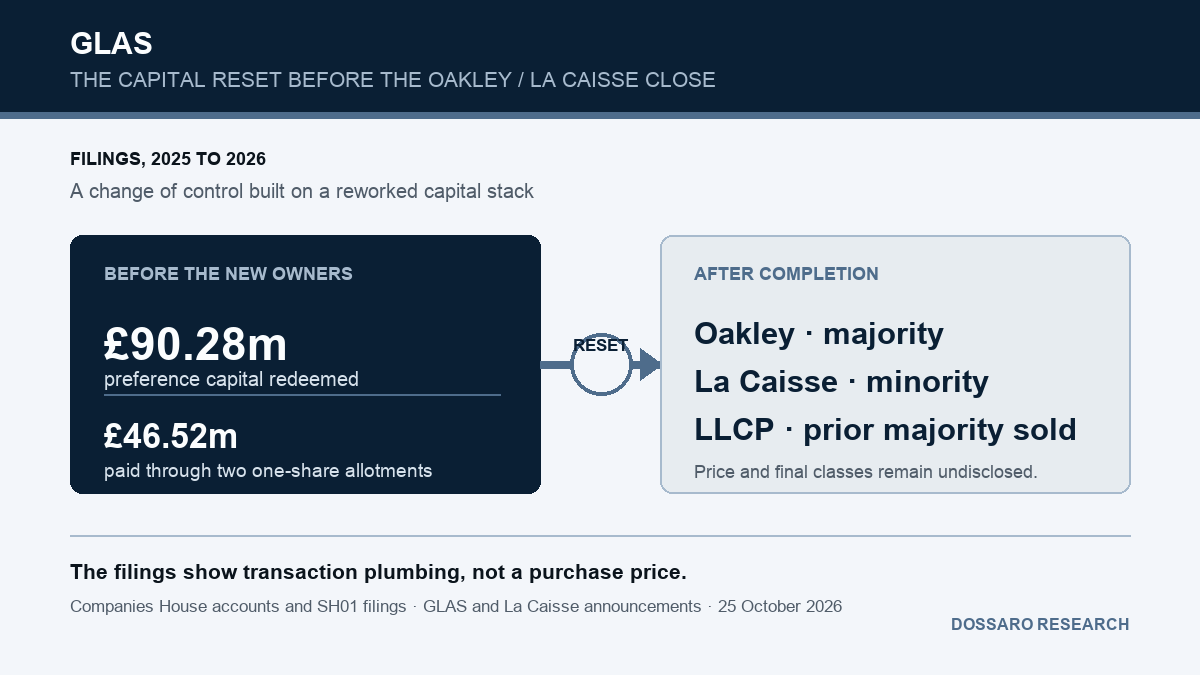
GLAS completed its Oakley Capital and La Caisse transaction in October, but the legal records show that the change of control arrived after a capital reset. The company’s 2025 accounts describe senior-debt refinancings and the redemption of £90.279 million of preference shares. Two Companies House filings then show £46.523 million paid for two nominal ordinary shares. Those amounts reveal the structure’s plumbing without revealing the purchase price or the final owners.
The public announcements describe a clear buyer and seller story. In January, Oakley and La Caisse said that Oakley would acquire a majority position in GLAS, La Caisse would invest as a minority partner and Levine Leichtman Capital Partners would retain a small stake. After regulatory approval, GLAS said on 23 October that Oakley was the majority investor, La Caisse held a minority position and LLCP had sold its prior majority stake.
The filings add a different layer. They do not identify the subscribers to the two expensive one-share allotments, and they do not say that the payments were consideration for the sale. They do show that GLAS entered the announced close with debt terms amended, preference capital removed and substantial cash paid into the share structure. That is a recapitalisation story as much as it is a change-of-owner story.
The public deal was a majority and minority investment, not a price disclosure
GLAS provides agency, trustee, escrow and administration services across institutional debt markets. The company’s completion notice says its assets under administration have grown to more than $940 billion and describes the Oakley and La Caisse investment as support for further expansion. La Caisse’s January announcement put the business at more than 450 employees across 16 offices and said it had delivered 40% organic revenue growth.
Those statements establish the commercial rationale and the ownership direction. They do not establish valuation, consideration, rollover or the class rights attached to the new investors. The latest pre-completion Topco statement in the reviewed record, dated 16 September 2026 and filed on 14 October, still showed A, B, C and D classes, a large preference class, legacy LLCP and Co-Invest A holders, and management, employee and carry holders. Oakley and La Caisse were not yet listed because the statement predates the October completion.
This distinction matters in private-equity research. A majority investment can be a primary subscription, a secondary purchase, or a combination of the two. A minority co-investment can carry board or consent rights that are not visible in a headline. The announcements establish the buyer-side labels, but the legal and economic mechanics sit in the filings around the operating company and its holding chain.
Two one-share allotments carried £46.5 million of paid-in cash
The most unusual signal is the nominal size of the two shares. The SH01 filed for the 31 December 2025 allotment records one ordinary share with a nominal value of £0.004 and an amount paid of £25,094,849.87. The SH01 for the 8 January 2026 allotment records another £0.004 ordinary share and £21,428,038.22 paid. Neither filing shows an unpaid amount.
| Filing event | Nominal shares | Amount paid | What the filing establishes | What it does not establish |
|---|---|---|---|---|
| 31 Dec 2025 allotment, filed 20 Jan 2026 | 1 ordinary share at £0.004 | £25,094,849.87 | Cash was paid into the operating company for the allotment | Subscriber identity, valuation, purchase price or seller proceeds |
| 8 Jan 2026 allotment, filed 20 Jan 2026 | 1 ordinary share at £0.004 | £21,428,038.22 | A second cash allotment followed within days | Whether Oakley, La Caisse or another holder funded it |
| Combined paid-in amount | 2 nominal shares | £46,522,888.09 | Two legally recorded cash movements immediately before the announced transaction | A final cap table or transaction consideration |
The arithmetic is simple: £25,094,849.87 plus £21,428,038.22 equals £46,522,888.09. The interpretation is not. The filings do not name the subscribers, and the cash could represent sponsor financing, an internal reorganisation, acquisition funding or another step in the holding-chain design. It is therefore supportable to call the amount paid-in capital, but not to call it the purchase price.
The two allotments also sit in a broader legal structure. The operating company’s 2025 accounts describe it as an indirect wholly owned subsidiary of Unicorn Topco. The sourcing brief identified corresponding one-share allotments in GLAS Holdings, but this article’s materialised candidate manifest is limited to the three exact operating-company documents used for the public claims above. That keeps the evidence handoff deterministic and avoids treating an unparsed holding-company record as proof of who supplied the cash.
The accounts show a debt and preference reset before the close
The 2025 annual accounts provide the bridge between the allotments and the transaction timetable. The Strategic Report says GLAS refinanced its senior-debt facilities with primary lenders on 25 March 2025 and again on 10 December 2025. The March refinancing introduced new term-loan and revolving-credit facilities and used the proceeds to repay existing senior debt and redeem £90,279,414 of preference shares.
The same passage identifies £4,726,851 of accrued dividends inside that redemption amount. In December, the company entered a further amendment and restatement deed, added a lender and changed leverage-covenant measures and available commitments. The accounts describe the result as a broader recapitalisation that included full redemption of the remaining preference shares and dividend payments to shareholders. They say the transactions reduced the company’s cost of capital and increased financial flexibility.
That is a material change in the distributional order of the business. Preference capital can sit ahead of ordinary equity in a sale or refinancing. Redeeming it before a new sponsor enters can simplify the waterfall, remove accrued claims and make the post-close structure easier to underwrite. It does not tell us who received the money or whether any particular investor was bought out. It does tell us that the business was not handed over with the same preference overhang described in its earlier capital stack.
The accounts also say an SPA for new Oakley investment and an ownership change was entered into at the start of 2026, subject to change-of-control approvals. That chronology supports the phrase “pre-close recapitalisation.” It does not prove that every pound in the preference redemption or the two allotments funded the acquisition. The safest reading is that the recapitalisation and the new investment were connected pieces of transaction preparation, while the exact allocation remains private.
What the reset means for the new owners and old holders
For Oakley and La Caisse, the reset changes the starting point for ownership. The new majority and minority investors are entering a structure in which senior debt has been amended and the large preference balance has been redeemed. The resulting equity may be easier to value because the most visible preference claim has been paid out, but the surviving A, B, C and D classes, management holdings and carry vehicles still matter. A majority label does not replace the need to read the rights attached to each class.
For LLCP and the earlier capital providers, the public record confirms direction but not proceeds. GLAS says LLCP sold its prior majority stake, and the January announcement said it would retain a small stake. Neither source states how the preference redemption, dividends and new allotments affected LLCP’s ultimate payout. The accounts’ redemption language should not be turned into a claim that £90.279 million was paid to LLCP or any other named seller.
For lenders, the sequence shows a business that actively reworked its capital structure while expanding. The accounts report senior facilities, leverage-covenant amendments and an additional lender. That is not a distress finding. It is evidence that financing terms were part of the transaction architecture, and that debt capacity and equity priority were managed together.
The contrast with DORMA-Glas’s prepared successor vehicle is useful. That article traced how a new legal perimeter was assembled before an insolvency asset deal. GLAS presents the opposite commercial setting: a profitable, expanding platform whose operating and holding chain was recapitalised before a sponsor change. In both cases, the public headline becomes more precise when the legal sequence is separated from the business narrative.
The next filing should show who entered the reset structure
The first post-completion Topco confirmation statement, shareholder list or capital statement should identify the legal holders behind Oakley and La Caisse, show the final A/B/C/D and preference balances, and reveal whether management or employees rolled equity. A later set of accounts or transaction document could also connect the £46.523 million allotments to the acquisition agreement, identify the subscribers and show whether any preference or dividend claims survived.
Until those records appear, the strongest supported conclusion is narrow but economically meaningful. GLAS did not move from LLCP to Oakley in a single visible secondary transfer. Before the October close, senior debt was refinanced, £90.279 million of preference capital was redeemed and £46.523 million was paid through two one-share allotments. The filings do not disclose the purchase price or final cap table, but they show that the new owners entered a recapitalised structure whose priorities had already been reset.
Sources: GLAS completion announcement, La Caisse and Oakley announcement, and Companies House filing history.
Continue reading
Related Research
DORMA-Glas's Asset Deal Was Prepared Before The Rescue Headline
DG Glas's €25,000 successor vehicle and shareholder filings predated DORMA-Glas's rescue announcement, separating operating continuity from creditor recovery.
Cognitive Credit’s $40m Growth Investment Sits Beside a New HSBC Security Layer
Cognitive Credit announced a $40m Summit-led investment, while filings show 876 new shares and an outstanding HSBC security over its IP and business.
Sprints’ €725m Fund V Sits Above a £654,887 Manager Balance Sheet
Sprints says Fund V closed at a €725m hard cap, while UK filings show £2.07m cash, £654,887 net assets and two new HSBC security filings remain outstanding.
StrollMe’s €22m Raise Finances a Fleet, Not Just a Valuation
StrollMe raised €22m in equity and debt. Its filings and customer terms put the key question on fleet, receivables and risk allocation, not valuation.