
StrollMe’s €22m Raise Finances a Fleet, Not Just a Valuation
StrollMe raised €22m in equity and debt. Its filings and customer terms put the key question on fleet, receivables and risk allocation, not valuation.
On this page
Conduct your own private market research
Add dossaro to Claude or ChatGPT and run source-backed register research from your own workspace.
 Add to Claude
 Add to ChatGPT
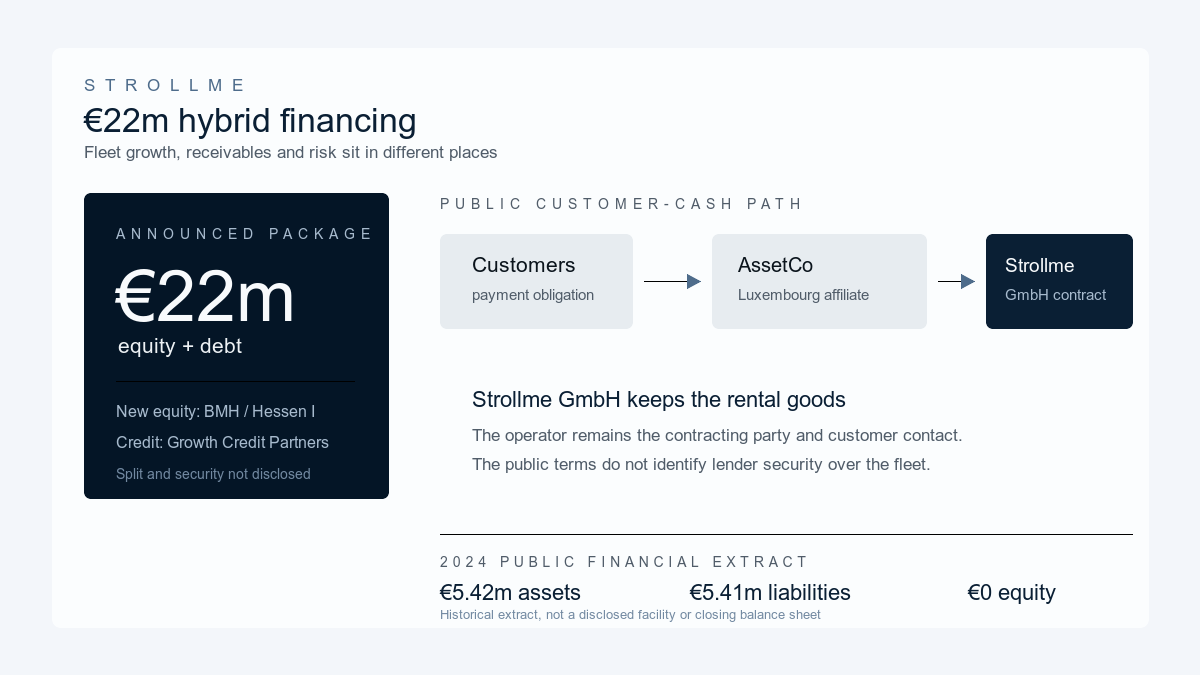
StrollMe’s €22m financing is buying more rental inventory, but its public legal and financial record makes the deal about risk allocation as much as growth. Strollme GmbH remains the contracting party and owner of the rented goods, while customer-payment claims are assigned to affiliated Luxembourg company StrollMe AssetCo S.à r.l. The public announcement names equity and debt, but not the split, security package or lender priority.
That distinction changes what the headline can support. This is not a clean public-money signal from which to infer a post-money valuation. It is a hybrid financing around an operating company whose public financial extract reported €5.42m of assets against €5.41m of liabilities in 2024, with zero equity and a €419.7k non-covered deficit. The most useful question is therefore where cash, receivables, fleet ownership and downside risk sit across the structure.
The €22m is a mixed capital package
The Dealroom financing note and independent coverage by EU-Startups describe a €22m combination of equity and debt. Existing backers Hanse Ventures, HGDF, JOSS and angel investor Kristina Schreiner returned. BMH, through Hessen Kapital I, joined as a new equity investor, while Growth Credit Partners supplied a credit facility.
The announced use is expansion: more strollers, bicycles and car seats available for rental across Europe. The coverage says StrollMe generated 70% revenue growth in 2025 and passed 100,000 rentals, while still turning customers away because inventory was limited. The commercial logic is straightforward. A rental platform needs cash to acquire and maintain goods before customer payments arrive, and the same goods can support recurring revenue over several rental cycles.
The financing sources do not disclose how much of the €22m is equity, how much is drawn debt, whether the facility is committed or term-based, or what collateral and covenants apply. Those omissions matter because the economic exposure is different for a new shareholder and a credit provider. Equity absorbs operating volatility after creditors, while debt depends on a defined repayment source and any available security. The public record identifies the parties, not their priority.
The operating balance sheet changes the reading
The public financial extract for Strollme GmbH reports a sharp change between 2023 and 2024. It is a public extract rather than the facility agreement or a current management balance sheet, so it should be read as a historical position, not a closing statement for the €22m financing.
| Reported position | 2023 | 2024 |
|---|---|---|
| Total assets | Not stated in the cited brief | €5.42m |
| Total liabilities | €1.94m | €5.41m |
| Equity | €787k | €0 |
| Non-covered deficit | Not stated in the cited brief | €419.7k |
The 2024 figures leave only about €10,000 between reported assets and liabilities before considering the deficit presentation. That is not evidence that the company was unable to raise capital, and it does not show the post-financing position. It does show why the €22m should not be presented as a simple equity repricing of Strollme GmbH. New money may be funding fleet growth, refinancing, working capital or a combination of all three.
The same extract reports capital of €42,642 by 2026. Statutory capital is not the same as enterprise value or total equity, but the number reinforces the need to separate legal capital from the announced financing amount. A headline round number cannot establish how much value was created for existing shareholders, how much cash is available for inventory, or whether debt replaces an older liability.
This is the same discipline used when reading any private-company capital stack. Cognitive Credit’s capital structure shows why an amount raised is not enough to identify priority, while GLAS’s recapitalisation before a sale illustrates how balance-sheet changes can alter the reading of a later transaction. StrollMe’s public record is less complete, but the economic question is similarly structural.
Customers pay Luxembourg, but StrollMe keeps the contract
StrollMe’s customer terms add a second layer. The terms state that Strollme GmbH remains the sole contracting party, while all present and future claims to customer payments are assigned to affiliated StrollMe AssetCo S.à r.l. in Luxembourg. Payment to AssetCo discharges the customer. The assignment does not change who the customer contacts: Strollme GmbH remains the sole customer-facing party.
| Part of the arrangement | Publicly stated role | What the source does not show |
|---|---|---|
| Strollme GmbH | Contracting party, operator and customer contact | Its intercompany price for assigned claims |
| StrollMe AssetCo S.à r.l. | Receives assigned present and future customer-payment claims | Whether claims are pledged to a lender or sold at a discount |
| Customer | Payment to AssetCo discharges the payment obligation | Any lender consent or collection waterfall |
| Growth Credit Partners | Named credit-facility provider in financing coverage | Facility size, maturity, security and covenants |
An affiliated receivables recipient can be ordinary treasury administration. It can also make cash collection easier to finance. The terms alone cannot distinguish those readings. What they do establish is that the cash path is not identical to the customer relationship. A customer pays AssetCo, but Strollme GmbH remains responsible for the commercial contract, service and customer contact.
That split matters for a rental business because the operator has to keep buying and maintaining goods while receivables move through a separate legal entity. The assignment may improve cash visibility or allow a lender to monitor collections. It may instead be a group-level settlement arrangement with no external security. Without the facility and intercompany documents, either stronger conclusion would be speculation.
The fleet is still StrollMe’s operating asset
The same terms state that Strollme GmbH remains the owner of the rental goods. Customers may not pledge or otherwise dispose of them. That is a meaningful boundary: the public terms do not say that the Luxembourg affiliate owns the strollers, bicycles or car seats, and they do not identify a lender’s title or charge over the fleet.
The distinction separates three questions that are often collapsed into one funding headline:
- Who owns the goods used to generate rental revenue?
- Who receives customer payments after the assignment?
- Who has repayment priority if the operating company’s cash flow weakens?
The public sources answer the first two at the operating and customer-contract level. They do not answer the third. An investor, lender or analyst should not turn the ownership clause into a claim that the fleet is unencumbered, or turn the payment assignment into a claim that the debt is secured on receivables. Those are document-level questions.
The structure still has a clear commercial consequence. StrollMe is financing a system of physical goods, recurring customer claims and an operator that remains visible to customers. The €22m may increase inventory and availability, but the downside travels through several entities. A weak rental cohort can reduce collections at AssetCo while the operating company still carries maintenance, warranty and customer-service obligations. Conversely, strong utilization can make the receivables stream a useful funding source without changing fleet ownership.
What the structure means for investors and lenders
For equity investors, the attractive feature is operating leverage: more inventory can support more rentals and potentially spread fixed costs across a larger base. The risk is that a capital-intensive fleet consumes cash before utilization reaches the level implied by the growth story. The 2024 extract makes that timing risk visible, even though it does not describe the new financing’s closing balance sheet.
For Growth Credit Partners, the important evidence is not the €22m headline alone. It is the facility’s repayment source, the treatment of assigned customer claims and any restrictions on the operator’s fleet. If receivables are part of the credit package, the assignment may be operationally central. If they are not, the Luxembourg entity may simply centralize group cash. The public sources do not permit a choice between those readings.
For Strollme GmbH, retaining ownership and the customer contract keeps control of the service proposition in the operating company. It also keeps the operating obligations there. That is why the company’s balance sheet and the AssetCo payment path should be read together, rather than treating the Luxembourg clause as a standalone ownership change.
The benign reading is that the 2024 financial extract predates a recapitalisation and that the AssetCo assignment is routine group administration. That is plausible. The stronger claim that the debt is fleet-backed, that receivables have been sold to a lender, or that the €22m created a particular post-money valuation is not supported by the public record.
The next document is the facility and intercompany package
StrollMe’s €22m financing is best read as hybrid capital around an inventory-led rental system, not as a clean valuation mark. Public coverage identifies the equity backer and credit provider. The financial extract shows why the operating balance sheet matters. The customer terms show that payment claims move to a Luxembourg affiliate while Strollme GmbH retains the goods, contract and customer-facing role.
The next decision-changing record is the facility and intercompany package: which entity borrows, what receivables are pledged, whether the fleet is encumbered, and how cash moves between Strollme GmbH and AssetCo. Until those documents are available, the defensible conclusion is narrow. The €22m is financing a rental system with a stretched operating history and a separated receivables path, so the headline is about where risk sits as much as about growth.
Sources
Continue reading
Related Research
Cognitive Credit’s $40m Growth Investment Sits Beside a New HSBC Security Layer
Cognitive Credit announced a $40m Summit-led investment, while filings show 876 new shares and an outstanding HSBC security over its IP and business.
GLAS's Oakley Sale Followed a Debt and Preference Reset
GLAS's Oakley sale followed a debt and preference reset before the public change of control, with £90m redeemed and £46.5m paid through two one-share allotments.
Guidewire’s $1.7bn Hyperexponential Deal Runs Through an Existing Capital Stack
Guidewire agreed to buy Hyperexponential for $1.7bn plus up to $400m. UK filings show an existing preferred stack, not a new pre-sale financing.
Roadsurfer's Kennedy Lewis Majority Follows a Nearly €500m Fleet-Debt Build-Out
Roadsurfer's Kennedy Lewis majority follows nearly €500m of fleet debt, founder rollover and a 2027 profitability target, public sources report.