
Roadsurfer's Kennedy Lewis Majority Follows a Nearly €500m Fleet-Debt Build-Out
Roadsurfer's Kennedy Lewis majority follows nearly €500m of fleet debt, founder rollover and a 2027 profitability target, public sources report.
On this page
Conduct your own private market research
Add dossaro to Claude or ChatGPT and run source-backed register research from your own workspace.
 Add to Claude
 Add to ChatGPT
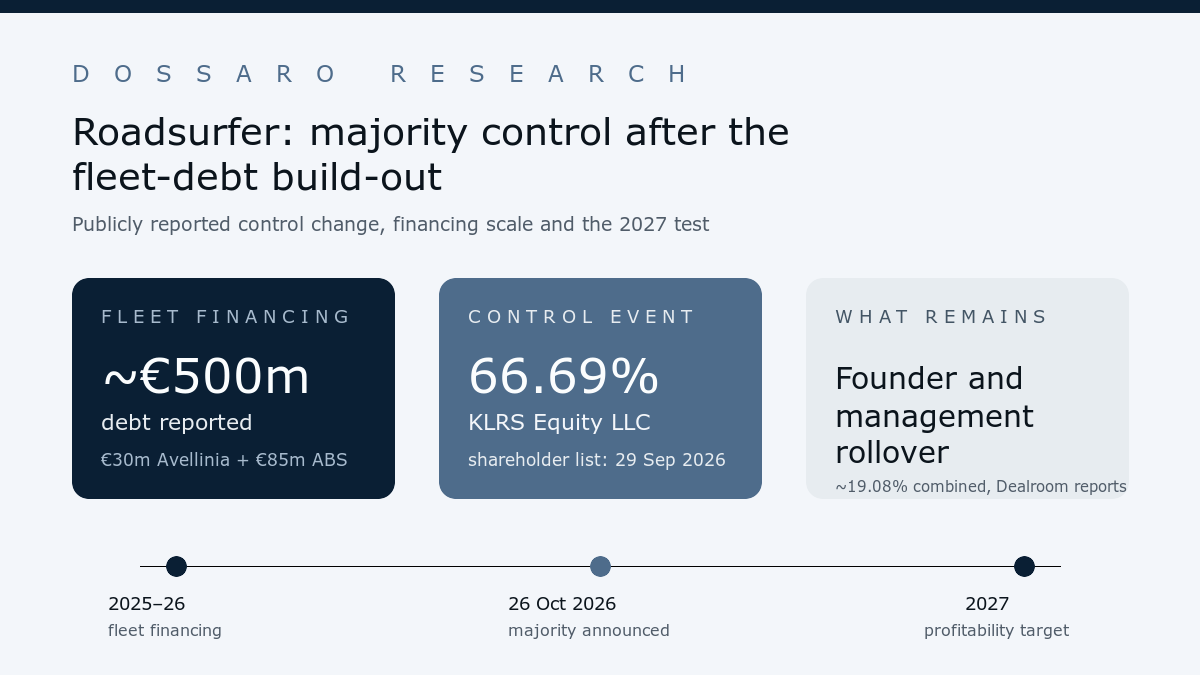
Roadsurfer's reported Kennedy Lewis majority is a control event layered onto an asset-heavy financing program. The latest shareholder list fetched from Germany's commercial register records KLRS Equity LLC with 28,821 of 43,217 shares, or 66.69%. Dealroom reports that founders and management retain a minority while earlier backers including Heartcore were bought out. The same report puts Roadsurfer's debt at nearly €500 million and says profitability is targeted for 2027.
The public evidence therefore supports a more useful reading than a simple growth announcement. Kennedy Lewis is taking the majority position after Roadsurfer financed a roughly 10,000-vehicle platform through multiple debt facilities. The new owner inherits the upside of scale and the execution burden of fleet utilisation, refinancing and profitability. The sources do not disclose the price or establish a distressed sale.
The majority is public, while the register supplies the percentage
Roadsurfer's official 26 October press release says Kennedy Lewis Investment Management invested in the Munich camper provider and became its majority shareholder. It describes the investor as experienced in flexible capital solutions for asset-intensive businesses and says Roadsurfer will continue to focus on operational efficiency, product quality and profitability.
The company says it operates around 10,000 vehicles at roughly 100 rental locations across 16 countries in Europe, the United States and Canada. Those figures explain why a financial investor would care about the fleet as an operating system rather than only a brand. They also show why the capital structure matters: vehicles are both the product customers rent and the asset base that must be financed, deployed and eventually replaced.
Dealroom's independent report adds the ownership detail. It says German commercial-register documents show Kennedy Lewis at 66.69%, with founders Markus and Susanne Dickhardt, co-founders and two managers retaining roughly 19.08% combined. It also says earlier backers including Heartcore were bought out. The report does not disclose a deal value.
The Dossaro-fetched list dated 29 September 2026 makes the percentage auditable. It records KLRS Equity LLC, based in Delaware, with share numbers 1 through 28,821 and 66.69% of the total capital. The list also records Heartcore Capital Fund IV K/S at 6.9%, IAG Invest AG & Co. KG in two blocks totalling 9.71%, Raiffeisen OÖ Invest GmbH & Co OG in two blocks totalling 2.26% and Dicki GmbH in a 4.94% block plus later entries marked “s.o.” The document is a register snapshot. It does not disclose the commercial price, contractual consent rights or every indirect economic interest.
| Recorded fact | Source-supported reading | Boundary |
|---|---|---|
| KLRS Equity LLC holds 28,821 of 43,217 shares | 66.69% majority in the latest fetched shareholder list | It is not a valuation or ultimate-beneficial-ownership conclusion |
| Kennedy Lewis became majority shareholder on 26 October | Official Roadsurfer announcement and Business Wire release confirm the event | The price and primary-versus-secondary split are undisclosed |
| Founders and management retain about 19.08% combined | Dealroom's attributed reading of the register chronology | The register does not label the commercial role of every holder |
The control change follows a large fleet-debt stack
The financing chronology is what makes the majority economically significant. Dealroom says Roadsurfer has taken on nearly €500 million in debt to finance its fleet. It identifies €30 million raised from Avellinia Capital in 2025, an €85 million asset-backed securities structure with Macquarie and venture debt from BBVA. Roadsurfer's press index lists the Avellinia announcement from February 2025 and the €85 million fleet-expansion announcement from July 2025.
Those figures should not be added mechanically. The Dealroom total has a broader scope than the two individually disclosed facilities, and the BBVA amount is not stated in the reviewed sources. The defensible claim is that Roadsurfer operates with a material, multi-instrument fleet-financing stack, not that the company borrowed exactly the sum of the named facilities.
That distinction changes the commercial consequence of the majority sale. The new controlling investor is not simply funding a software business with light fixed assets. It is stepping into a platform where utilisation, residual values, insurance, maintenance and refinancing all feed into returns. A fleet can support growth when vehicles are productive and financed at the right tenor. It can also magnify pressure when vehicles sit idle or debt service outruns operating cash flow.
Roadsurfer's official announcement frames the investment as long-term support for growth and says the business will strengthen operations. Dealroom reports that North America remains a key growth market, Europe has reached a healthy size and the company does not expect to be profitable in 2026. The report says 2027 is intended to mark the shift toward profitability. That target is important because it gives the majority transaction a measurable operating test. The question is not only whether the fleet can expand, but whether the capital structure can carry it to sustainable earnings.
Founder rollover keeps the outcome exposed to execution
The reported founder and management rollover is economically different from full exit. Dealroom's roughly 19.08% combined figure means the operating team remains exposed to the value created or destroyed after the change in control. That can align incentives, but it does not tell us how governance works. The register lists legal holders and percentages; it does not publish reserved matters, board rights, liquidation preferences or the terms under which the retained stake can be sold.
Nor does the rollover prove that the transaction was friendly in every respect. The reviewed sources do not identify a seller, a price, a return hurdle or a distressed process. The safe interpretation is narrower: a financial investor has taken the majority position, founders and management have retained a minority according to independent coverage, and Roadsurfer is still pursuing an operating milestone after a debt-funded fleet expansion.
The structure also explains why the earlier backers' exit matters. Heartcore's reported buyout removes one set of venture investors from the public ownership snapshot while the new majority holder arrives with experience in credit and asset-intensive businesses. That is a change in capital-provider type as well as ownership percentage. The strategic question is whether Kennedy Lewis uses its control to accelerate expansion, prioritise deleveraging, or balance the two while the fleet matures.
The next record should clarify the transfer mechanics
The 29 September shareholder list is the strongest legal ownership evidence reviewed here, but it is still a dated snapshot. A successor list or filing that records the transfer mechanics could show whether KLRS Equity LLC's position changed after the 26 October announcement, whether a new vehicle entered the chain and how the retained holdings were allocated. A public financing update could also explain how the existing Avellinia, Macquarie and BBVA facilities sit alongside the new majority ownership.
Until those records appear, it would be overreach to convert 66.69% into a purchase price, call the transaction a distressed sale or infer ultimate beneficial ownership from the register alone. The commercial finding is already clear: Roadsurfer has moved from a venture-backed growth narrative toward majority ownership by a financial investor after building a nearly €500 million fleet-debt stack, while founders and management remain invested and profitability is still a 2027 target.
That combination makes the deal worth watching. Strollme's hybrid fleet financing shows how vehicle-backed expansion can mix equity and debt. Smile2Impress's EIB debt stack provides a contrast on how a lender package can shape the operating perimeter. Qwello's growth-equity debt roll-up shows why a financing headline can hide several different layers of capital. Roadsurfer adds the control question: who owns the fleet platform when the debt-funded growth phase has to become profitable?
Sources
Continue reading
Related Research
StrollMe’s €22m Raise Finances a Fleet, Not Just a Valuation
StrollMe raised €22m in equity and debt. Its filings and customer terms put the key question on fleet, receivables and risk allocation, not valuation.
Impress’s €40m EIB Loan Adds a New Layer to Existing Venture Debt
Impress’s €40m EIB loan sits beside outstanding Trinity charges, while older lender security was satisfied in January, making the debt stack visible.
Qwello’s Up to €55m Equity Follows Up to €65m Debt
Qwello’s up to €55m equity follows up to €65m of debt as its latest public accounts show a €4.44m loss, framing a capital-intensive roll-up.
GLAS's Oakley Sale Followed a Debt and Preference Reset
GLAS's Oakley sale followed a debt and preference reset before the public change of control, with £90m redeemed and £46.5m paid through two one-share allotments.